Beltrán Ana R, Carraro-Lacroix Luciene R, Bezerra Camila N A, Cornejo Marcelo, Norambuena Katrina, Toledo Fernando, Araos Joaquín, Pardo Fabián, Leiva Andrea, Sanhueza Carlos, Malnic Gerhard, Sobrevia Luis, Ramírez Marco A
Cellular Physiology Laboratory, Biomedical Department, Faculty of Health Sciences, Universidad de Antofagasta, Antofagasta 1270300, Chile.
Department of Education, Faculty of Education, Universidad de Antofagasta, Antofagasta 1270300, Chile.
PLoS One. 2015 Dec 29;10(12):e0146042. doi: 10.1371/journal.pone.0146042. eCollection 2015.
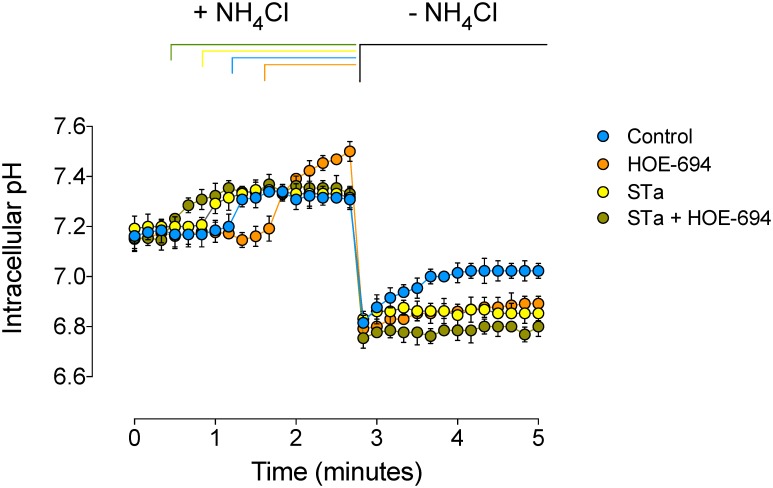
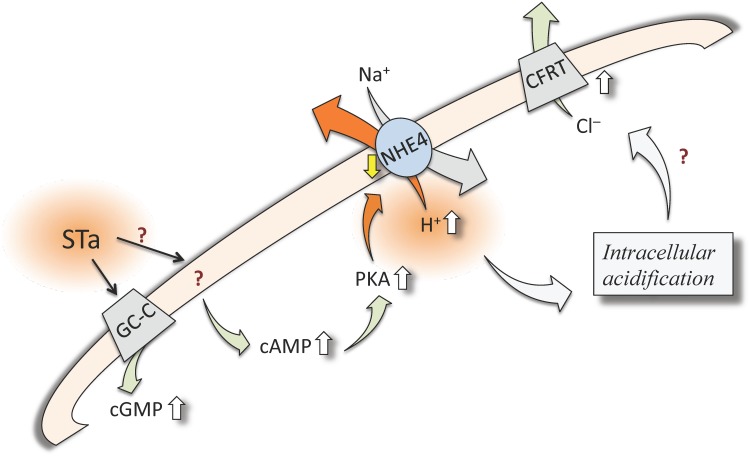
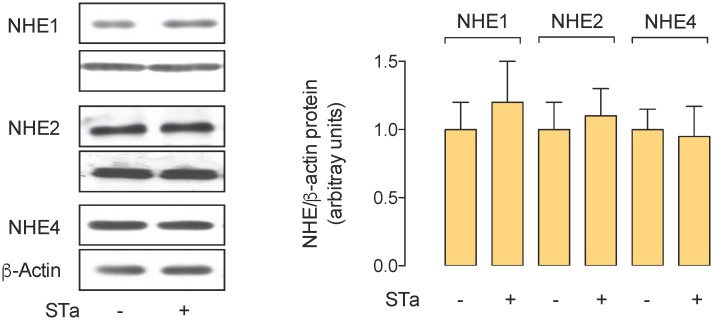
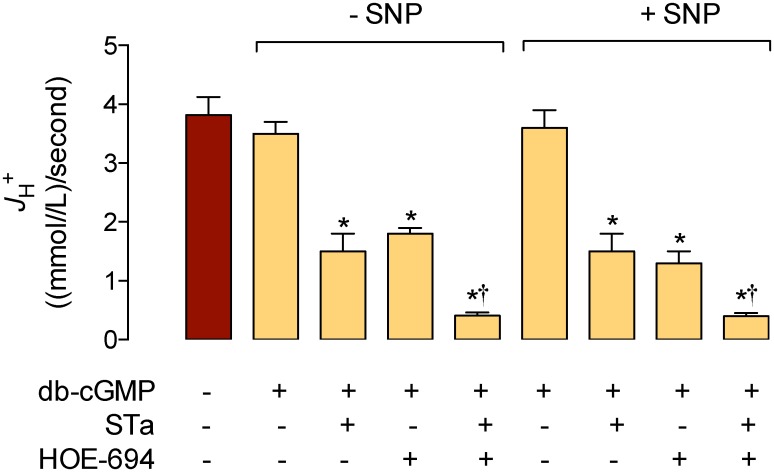
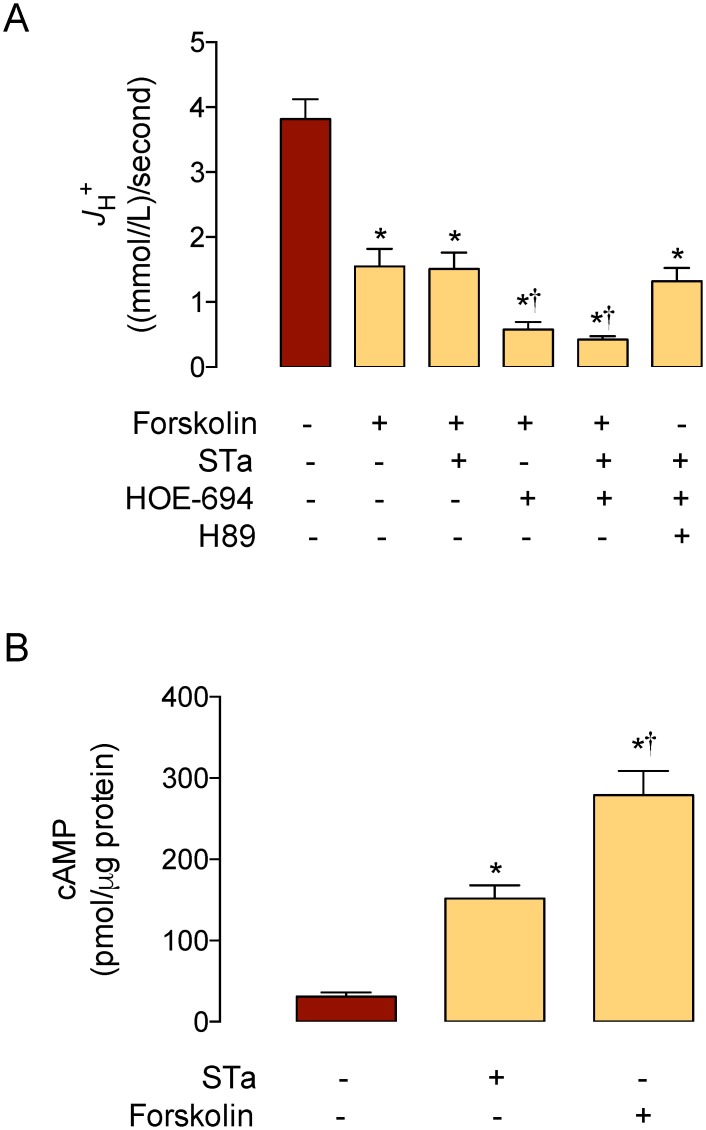
The enterotoxigenic Escherichia coli strains lead to diarrhoea in humans due to heat-labile and heat-stable (STa) enterotoxins. STa increases Cl-release in intestinal cells, including the human colonic carcinoma T84 cell line, involving increased cGMP and membrane alkalization due to reduced Na+/H+ exchangers (NHEs) activity. Since NHEs modulate intracellular pH (pHi), and NHE1, NHE2, and NHE4 are expressed in T84 cells, we characterized the STa role as modulator of these exchangers. pHi was assayed by the NH4Cl pulse technique and measured by fluorescence microscopy in BCECF-preloaded cells. pHi recovery rate (dpHi/dt) was determined in the absence or presence of 0.25 μmol/L STa (30 minutes), 25 μmol/L HOE-694 (concentration inhibiting NHE1 and NHE2), 500 μmol/L sodium nitroprusside (SNP, spontaneous nitric oxide donor), 100 μmol/L dibutyryl cyclic GMP (db-cGMP), 100 nmol/L H89 (protein kinase A inhibitor), or 10 μmol/L forskolin (adenylyl cyclase activator). cGMP and cAMP were measured in cell extracts by radioimmunoassay, and buffering capacity (ßi) and H+ efflux (JH+) was determined. NHE4 protein abundance was determined by western blotting. STa and HOE-694 caused comparable reduction in dpHi/dt and JH+ (63%), without altering basal pHi (range 7.144-7.172). STa did not alter ßi value in a range of 1.6 pHi units. The dpHi/dt and JH+ was almost abolished (94% inhibition) by STa + HOE-694. STa effect was unaltered by db-cGMP or SNP. However, STa and forskolin increased cAMP level. STa-decreased dpHi/dt and JH+ was mimicked by forskolin, and STa + HOE-694 effect was abolished by H89. Thus, incubation of T84 cells with STa results in reduced NHE4 activity leading to a lower capacity of pHi recovery requiring cAMP, but not cGMP. STa effect results in a causal phenomenon (STa/increased cAMP/increased PKA activity/reduced NHE4 activity) ending with intracellular acidification that could have consequences in the gastrointestinal cells function promoting human diarrhoea.
产肠毒素大肠杆菌菌株由于不耐热和耐热(STa)肠毒素而导致人类腹泻。STa会增加肠道细胞(包括人结肠癌细胞系T84细胞)中的氯离子释放,这涉及由于钠/氢交换体(NHEs)活性降低导致的环磷酸鸟苷(cGMP)增加和膜碱化。由于NHEs调节细胞内pH(pHi),并且NHE1、NHE2和NHE4在T84细胞中表达,我们对STa作为这些交换体调节剂的作用进行了表征。通过氯化铵脉冲技术测定pHi,并在预加载羧基荧光素乙酰甲酯(BCECF)的细胞中通过荧光显微镜进行测量。在不存在或存在0.25μmol/L STa(30分钟)、25μmol/L HOE-694(抑制NHE1和NHE2的浓度)、500μmol/L硝普钠(SNP,自发一氧化氮供体)、100μmol/L二丁酰环磷鸟苷(db-cGMP)、100nmol/L H89(蛋白激酶A抑制剂)或10μmol/L福斯可林(腺苷酸环化酶激活剂)的情况下测定pHi恢复率(dpHi/dt)。通过放射免疫测定法测量细胞提取物中的cGMP和环磷酸腺苷(cAMP),并测定缓冲能力(ßi)和氢离子外流(JH+)。通过蛋白质印迹法测定NHE4蛋白丰度。STa和HOE-694导致dpHi/dt和JH+出现类似程度的降低(约63%),而不会改变基础pHi(范围为7.144 - 7.172)。在1.6个pHi单位范围内,STa不会改变ßi值。STa + HOE-694几乎完全消除了dpHi/dt和JH+(约94%抑制)。db-cGMP或SNP不会改变STa的作用。然而,STa和福斯可林会增加cAMP水平。福斯可林模拟了STa降低的dpHi/dt和JH+,并且H89消除了STa + HOE-694的作用。因此,用STa孵育T84细胞会导致NHE4活性降低,从而导致pHi恢复能力降低,这需要cAMP而非cGMP。STa的作用导致了一种因果现象(STa/增加的cAMP/增加的蛋白激酶A活性/降低的NHE4活性),最终导致细胞内酸化,这可能会对胃肠道细胞功能产生影响,从而促进人类腹泻。