Budisavljevic Sanja, Kawadler Jamie M, Dell'Acqua Flavio, Rijsdijk Frühling V, Kane Fergus, Picchioni Marco, McGuire Philip, Toulopoulou Timothea, Georgiades Anna, Kalidindi Sridevi, Kravariti Eugenia, Murray Robin M, Murphy Declan G, Craig Michael C, Catani Marco
Department of Forensic and Neurodevelopmental Sciences, and Natbrainlab, Centre for Neuroimaging Sciences, Institute of Psychiatry, Psychology and Neuroscience, King's College London, London SE5 8AF, UK, NEMo Laboratory, Department of General Psychology, University of Padova, 35131 Padova, Italy,
Department of Forensic and Neurodevelopmental Sciences, and Natbrainlab, Centre for Neuroimaging Sciences, Institute of Psychiatry, Psychology and Neuroscience, King's College London, London SE5 8AF, UK.
Soc Cogn Affect Neurosci. 2016 May;11(5):746-57. doi: 10.1093/scan/nsv156. Epub 2015 Dec 28.
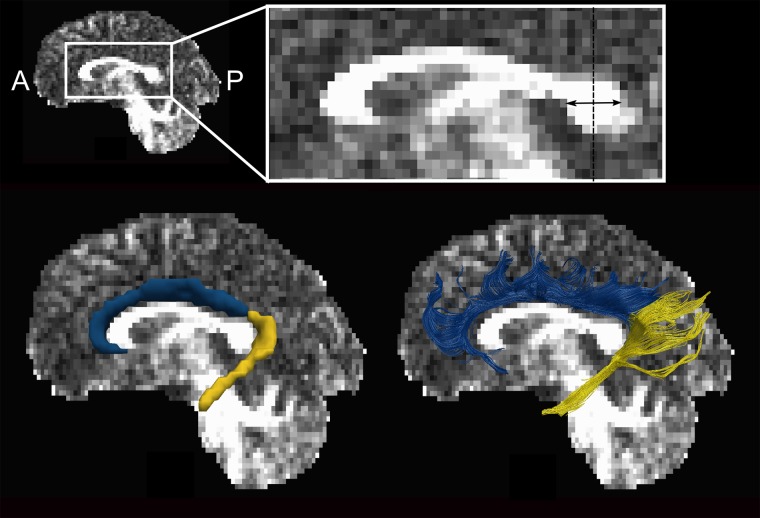
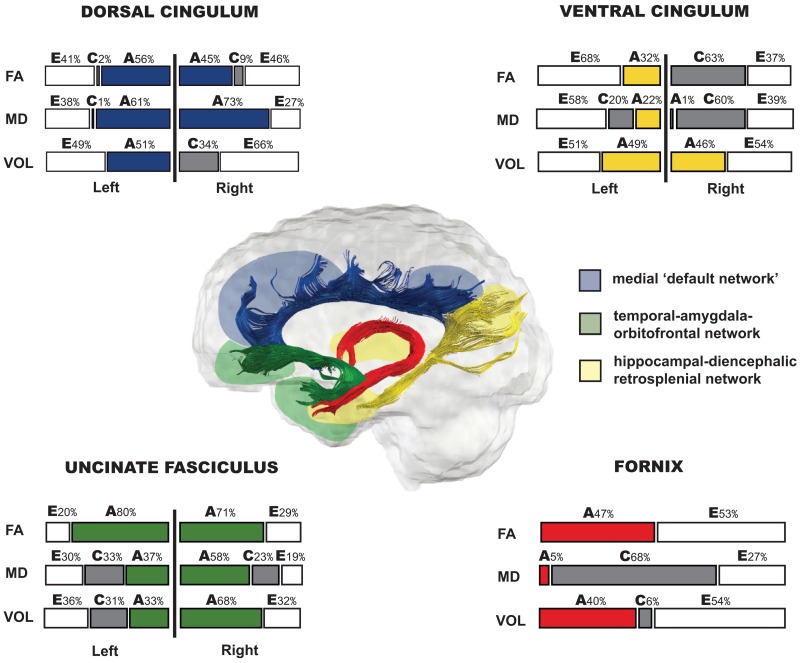
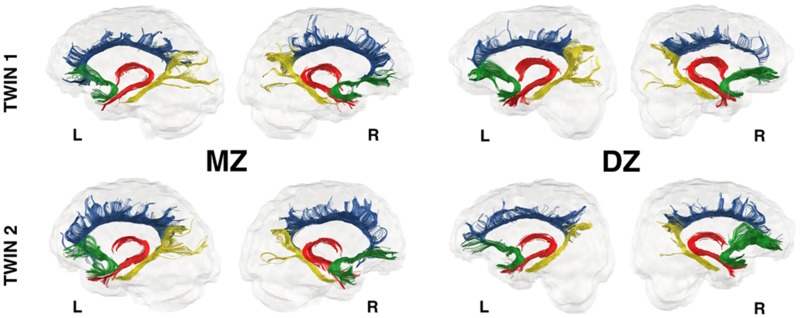
Individual differences in cognitive ability and social behaviour are influenced by the variability in the structure and function of the limbic system. A strong heritability of the limbic cortex has been previously reported, but little is known about how genetic factors influence specific limbic networks. We used diffusion tensor imaging tractography to investigate heritability of different limbic tracts in 52 monozygotic and 34 dizygotic healthy adult twins. We explored the connections that contribute to the activity of three distinct functional limbic networks, namely the dorsal cingulum ('medial default-mode network'), the ventral cingulum and the fornix ('hippocampal-diencephalic-retrosplenial network') and the uncinate fasciculus ('temporo-amygdala-orbitofrontal network'). Genetic and environmental variances were mapped for multiple tract-specific measures that reflect different aspects of the underlying anatomy. We report the highest heritability for the uncinate fasciculus, a tract that underpins emotion processing, semantic cognition, and social behaviour. High to moderate genetic and shared environmental effects were found for pathways important for social behaviour and memory, for example, fornix, dorsal and ventral cingulum. These findings indicate that within the limbic system inheritance of specific traits may rely on the anatomy of distinct networks and is higher for fronto-temporal pathways dedicated to complex social behaviour and emotional processing.
认知能力和社会行为的个体差异受边缘系统结构和功能变异性的影响。此前已有报道称边缘皮质具有很强的遗传性,但对于遗传因素如何影响特定的边缘网络却知之甚少。我们使用扩散张量成像纤维束示踪技术,对52对同卵健康成年双胞胎和34对异卵健康成年双胞胎的不同边缘束的遗传性进行了研究。我们探究了有助于三个不同功能性边缘网络活动的连接,即背侧扣带束(“内侧默认模式网络”)、腹侧扣带束和穹窿(“海马-间脑-压后皮质网络”)以及钩束(“颞叶-杏仁核-眶额网络”)。针对反映基础解剖结构不同方面的多种纤维束特异性测量指标,绘制了遗传和环境方差图。我们报告称,钩束的遗传性最高,该纤维束支持情绪处理、语义认知和社会行为。对于对社会行为和记忆重要的通路,例如穹窿、背侧和腹侧扣带束,发现了高到中等程度的遗传和共享环境效应。这些发现表明,在边缘系统中,特定性状的遗传可能依赖于不同网络的解剖结构,并且对于专门负责复杂社会行为和情绪处理的额颞通路来说更高。