Fernando Surani, Speicher David J, Bakr Mahmoud M, Benton Miles C, Lea Rodney A, Scuffham Paul A, Mihala Gabor, Johnson Newell W
School of Dentistry and Oral Health, Gold Coast Campus, Griffith University, Gold Coast, 4222, Queensland, Australia.
Population and Social Health Research Program, Menzies Health Institute Queensland, Gold Coast Campus, Griffith University, Gold Coast, 4222, Queensland, Australia.
BMC Oral Health. 2015 Dec 29;15:167. doi: 10.1186/s12903-015-0143-2.
Expenditure on dental and oral health services in Australia is $3.4 billion AUD annually. This is the sixth highest health cost and accounts for 7 % of total national health expenditure. Approximately 49 % of Australian children aged 6 years have caries experience in their deciduous teeth and this is rising. The aetiology of dental caries involves a complex interplay of individual, behavioural, social, economic, political and environmental conditions, and there is increasing interest in genetic predisposition and epigenetic modification.
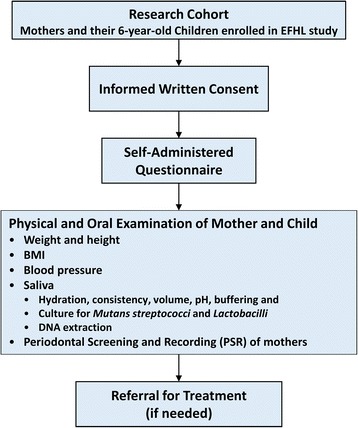
The Oral Health Sub-study; a cross sectional study of a birth cohort began in November 2012 by examining mothers and their children who were six years old by the time of initiation of the study, which is ongoing. Data from detailed questionnaires of families from birth onwards and data on mothers' knowledge, attitudes and practices towards oral health collected at the time of clinical examination are used. Subjects' height, weight and mid-waist circumference are taken and Body Mass Index (BMI) computed, using an electronic Bio-Impedance balance. Dental caries experience is scored using the International Caries Detection and Assessment System (ICDAS). Saliva is collected for physiological measures. Salivary Deoxyribose Nucleic Acid (DNA) is extracted for genetic studies including epigenetics using the SeqCap Epi Enrichment Kit. Targets of interest are being confirmed by pyrosequencing to identify potential epigenetic markers of caries risk.
This study will examine a wide range of potential determinants for childhood dental caries and evaluate inter-relationships amongst them. The findings will provide an evidence base to plan and implement improved preventive strategies.
澳大利亚每年在牙齿和口腔健康服务方面的支出为34亿澳元。这是第六高的医疗成本,占全国医疗总支出的7%。约49%的6岁澳大利亚儿童乳牙有龋齿经历,且这一比例在上升。龋齿的病因涉及个体、行为、社会、经济、政治和环境状况的复杂相互作用,人们对遗传易感性和表观遗传修饰的兴趣也在增加。
口腔健康子研究;一项对出生队列的横断面研究于2012年11月开始,研究对象为研究开始时6岁的母亲及其子女,该研究仍在进行中。使用从出生起对家庭进行详细问卷调查的数据,以及在临床检查时收集的母亲对口腔健康的知识、态度和行为数据。使用电子生物阻抗秤测量受试者的身高、体重和腰围中部,并计算体重指数(BMI)。使用国际龋齿检测和评估系统(ICDAS)对龋齿经历进行评分。收集唾液用于生理测量。使用SeqCap Epi富集试剂盒提取唾液脱氧核糖核酸(DNA)用于包括表观遗传学在内的基因研究。通过焦磷酸测序确认感兴趣的靶点,以确定龋齿风险的潜在表观遗传标记。
本研究将检查儿童龋齿的一系列潜在决定因素,并评估它们之间的相互关系。研究结果将为规划和实施改进的预防策略提供证据基础。