Shaffer John R, Wang Xiaojing, McNeil Daniel W, Weyant Robert J, Crout Richard, Marazita Mary L
Department of Human Genetics, Graduate School of Public Health, University of Pittsburgh, Pittsburgh, Pa., USA.
Caries Res. 2015;49(2):133-40. doi: 10.1159/000369103. Epub 2015 Jan 22.
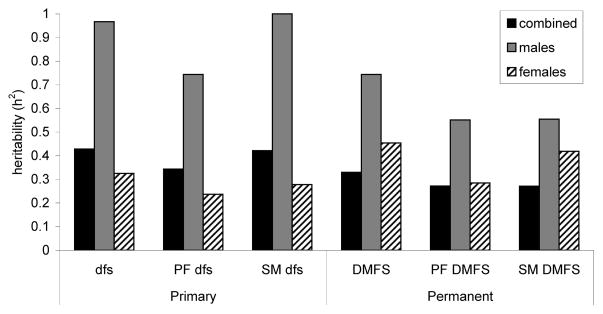
Many of the factors affecting susceptibility to dental caries are likely influenced by genetics. In fact, genetics accounts for up to 65% of inter-individual variation in dental caries experience. Sex differences in dental caries experience have been widely reported, with females usually exhibiting a higher prevalence and severity of disease across all ages. The cause for this sex bias is currently uncertain, although it may be partly due to the differential effects of genetic factors between the sexes: gene-by-sex interactions. In this family based study (N = 2,663; 740 families; ages 1-93 years), we assessed dental caries via intra-oral examination and generated six indices of caries experience (DMFS, dfs, and indices of both pit-and-fissure surface caries and smooth surface caries in both primary and permanent dentitions). We used likelihood-based methods to model the variance in caries experience conditional on the expected genetic sharing among relatives in our sample. This modeling framework allowed us to test two lines of evidence for gene-by-sex interactions: (1) whether the magnitude of the cumulative effect of genes differs between the sexes, and (2) whether different genes are involved. We observed significant evidence of gene-by-sex interactions for caries experience in both the primary and permanent dentitions. In the primary dentition, the magnitude of the effect of genes was greater in males than females. In the permanent dentition, different genes may play important roles in each of the sexes. Overall, this study provides the first direct evidence that sex differences in dental caries experiences may be explained, in part, by gene-by-sex interactions.
许多影响龋齿易感性的因素可能受到遗传因素的影响。事实上,在龋齿患病经历的个体差异中,遗传因素占比高达65%。龋齿患病经历中的性别差异已被广泛报道,在所有年龄段中,女性通常表现出更高的患病率和疾病严重程度。尽管这种性别差异可能部分归因于两性之间遗传因素的不同影响,即基因与性别的相互作用,但目前其原因尚不确定。在这项基于家庭的研究中(样本量N = 2,663;共740个家庭;年龄范围为1至93岁),我们通过口腔内检查评估龋齿情况,并生成了六个龋齿患病经历指标(DMFS、dfs,以及乳牙列和恒牙列中窝沟面龋和平滑面龋的指标)。我们使用基于似然性的方法,以样本中亲属间预期的基因共享情况为条件,对龋齿患病经历的方差进行建模。这种建模框架使我们能够检验基因与性别的相互作用的两条证据线索:(1)基因累积效应的大小在两性之间是否存在差异;(2)是否涉及不同的基因。我们在乳牙列和恒牙列的龋齿患病经历中均观察到了基因与性别的相互作用的显著证据。在乳牙列中,基因对男性的影响程度大于女性。在恒牙列中,不同的基因可能在两性中分别发挥重要作用。总体而言,本研究首次提供了直接证据,表明龋齿患病经历中的性别差异可能部分由基因与性别的相互作用所解释。