Matsumoto Kazuya, Ueki Masaru, Takeda Yohei, Harada Kenichi, Onoyama Takumi, Kawata Soichiro, Ikebuchi Yuichiro, Imamoto Ryu, Horie Yasushi, Murawaki Yoshikazu
Department of Gastroenterology, Tottori University Hospital, Yonago, Japan.
Center for Promoting Next-Generation Highly Advanced Medicine, Tottori University Hospital, Yonago, Japan.
Endosc Int Open. 2015 Dec;3(6):E662-4. doi: 10.1055/s-0034-1393076. Epub 2015 Sep 23.
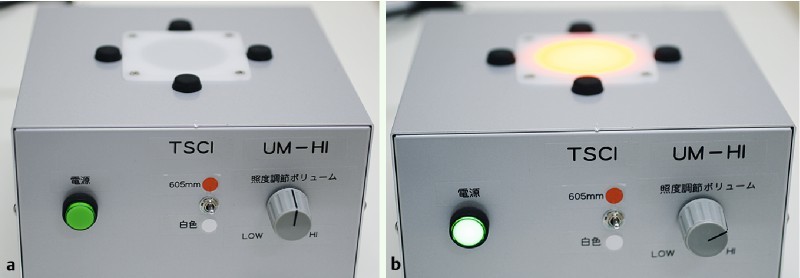
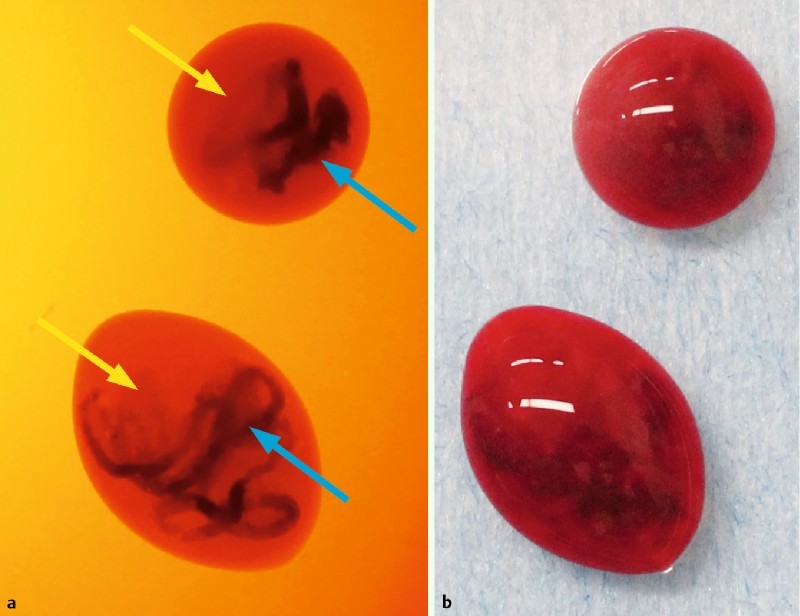
Specimens collected by fine needle are microscopic and contain blood; therefore, the presence of a target specimen within a sample is often difficult to confirm. Although rapid on-site evaluation (ROSE) during endoscopic ultrasound-guided fine needle aspiration biopsy (EUS-FNA) is beneficial, many health care facilities are unable to apply this technique due to a lack of cytopathologists. The aim of this study was to develop and validate a device that detects the target specimen within pancreatic tumor EUS-FNA samples.
Fifty-eight consecutive patients with solid pancreatic masses were studied for a preliminary case series at a tertiary-care university hospital (Tottori University Hospital, Yonago, Japan). The material collected was checked with a target sample check illuminator (TSCI) and was evaluated by one cytopathologist.
The agreement rate between the TSCI and histopathology was 93.7 %. Further testing procedures were not needed in 91.4 % of patients, and the mean number of needle punctures was 1.2 after a single pass using TSCI. No adverse events were encountered with the procedure.
With the introduction of the TSCI in EUS-FNA, it became possible to both collect the minimum necessary target samples by EUS-FNA and to end further procedures, even without performing ROSE.
细针采集的样本为微观样本且含有血液,因此,样本中目标样本的存在情况往往难以确认。尽管内镜超声引导下细针穿刺活检(EUS-FNA)期间的快速现场评估(ROSE)有益,但由于缺乏细胞病理学家,许多医疗机构无法应用该技术。本研究的目的是开发并验证一种能够检测胰腺肿瘤EUS-FNA样本中目标样本的装置。
在一家三级大学医院(日本鸟取大学医院,米子市)对58例连续的胰腺实性肿块患者进行了初步病例系列研究。采集的材料用目标样本检查照明器(TSCI)进行检查,并由一名细胞病理学家进行评估。
TSCI与组织病理学之间的符合率为93.7%。91.4%的患者无需进一步检测程序,使用TSCI单次穿刺后平均穿刺针数为1.2次。该操作未发生不良事件。
在EUS-FNA中引入TSCI后,即使不进行ROSE,也能够通过EUS-FNA采集最少必要的目标样本并结束进一步操作。