Perovic Olga, Iyaloo Samantha, Kularatne Ranmini, Lowman Warren, Bosman Noma, Wadula Jeannette, Seetharam Sharona, Duse Adriano, Mbelle Nontombi, Bamford Colleen, Dawood Halima, Mahabeer Yesholata, Bhola Prathna, Abrahams Shareef, Singh-Moodley Ashika
National Institute for Communicable Diseases at National Health Laboratory Service, Johannesburg, South Africa.
Department of Clinical Microbiology and Infectious Diseases, School of Pathology, Faculty of Health Science, University of Witwatersrand, Johannesburg, South Africa.
PLoS One. 2015 Dec 31;10(12):e0145429. doi: 10.1371/journal.pone.0145429. eCollection 2015.
We aimed to obtain an in-depth understanding on recent antimicrobial resistance trends and molecular epidemiology trends of S. aureus bacteraemia (SAB).
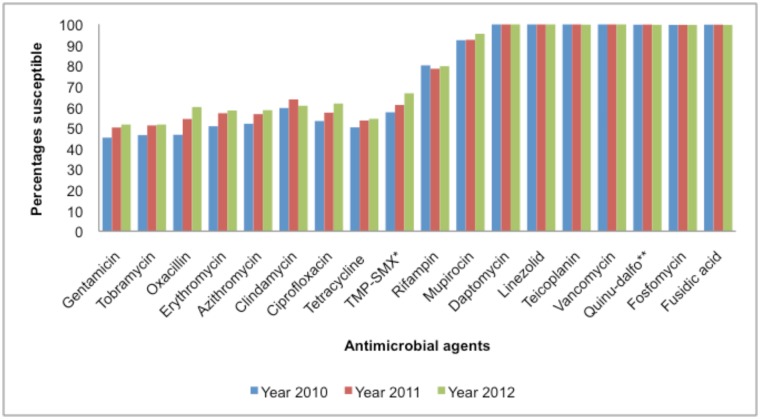
Thirteen academic centres in South Africa were included from June 2010 until July 2012. S. aureus susceptibility testing was performed on the MicroScan Walkaway. Real-time PCR using the LightCycler 480 II was done for mecA and nuc. SCCmec and spa-typing were finalized with conventional PCR. We selected one isolate per common spa type per province for multilocus sequence typing (MLST).
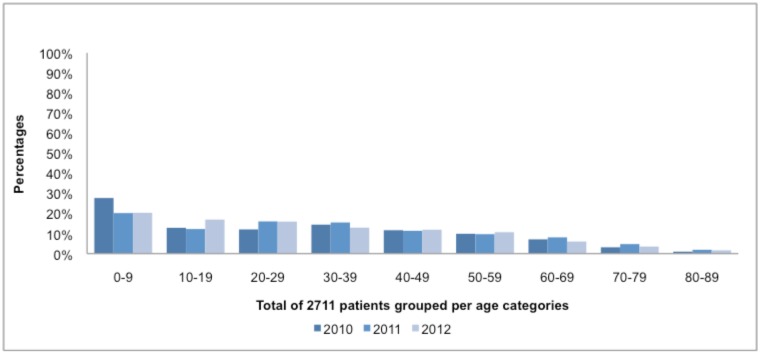
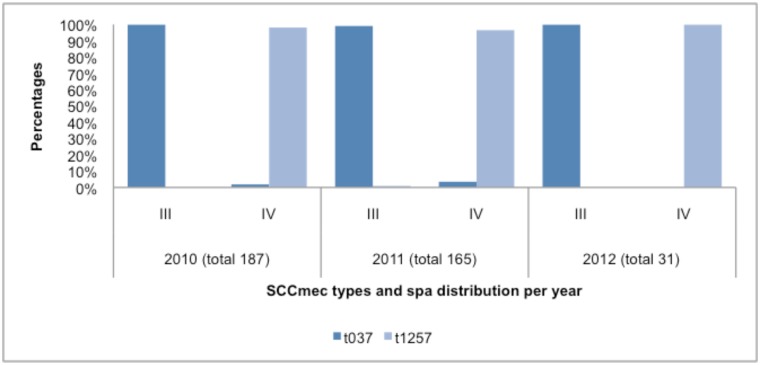
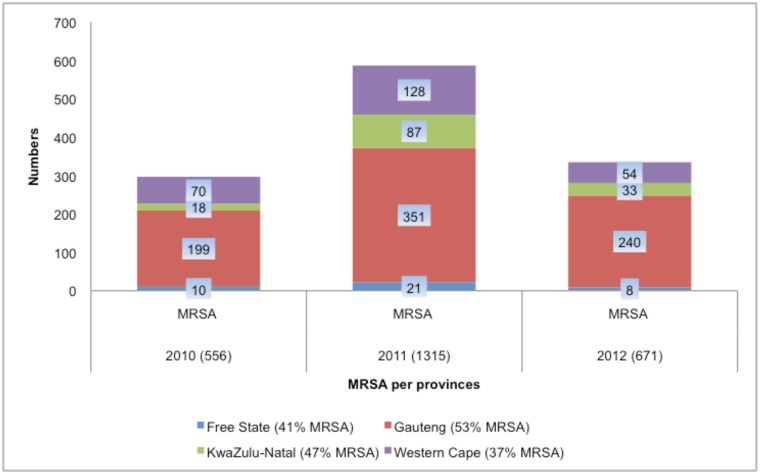
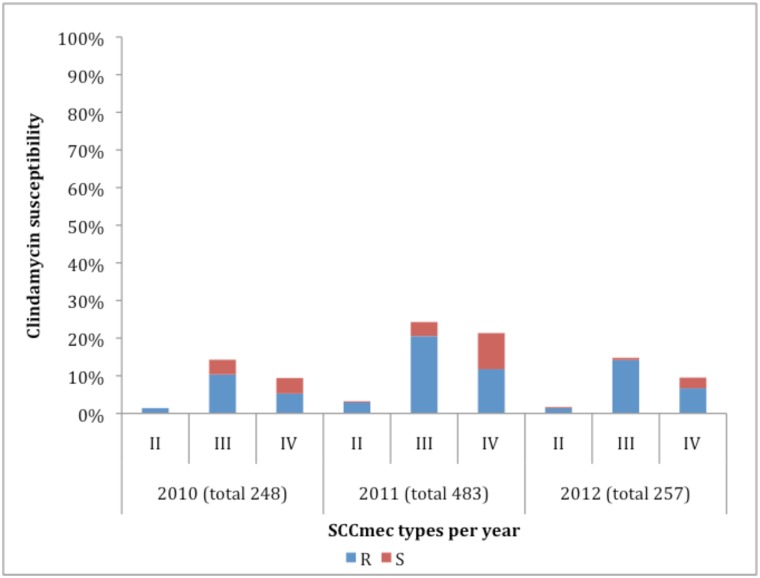
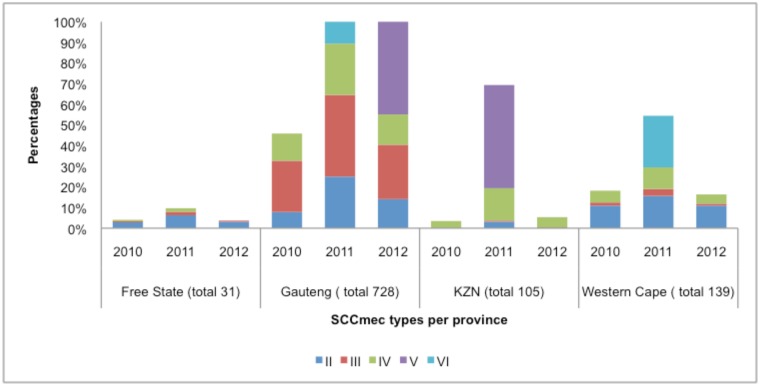
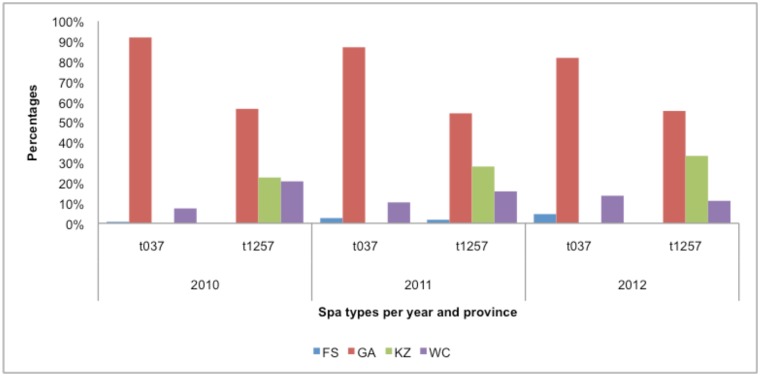
S. aureus from 2709 patients were included, and 1231 (46%) were resistant to methicillin, with a significant decline over the three-year period (p-value = 0.003). Geographical distribution of MRSA was significantly higher in Gauteng compared to the other provinces (P<0.001). Children <5 years were significantly associated with MRSA with higher rates compared to all other age groups (P = 0.01). The most prevalent SCCmec type was SCCmec type III (531 [41%]) followed by type IV (402 [31%]). Spa-typing discovered 47 different spa-types. The five (87%) most common spa-types were t037, t1257, t045, t064 and t012. Based on MLST, the commonest was ST612 clonal complex (CC8) (n = 7) followed by ST5 (CC5) (n = 4), ST36 (CC30) (n = 4) and ST239 (CC8) (n = 3).
MRSA rate is high in South Africa. Majority of the isolates were classified as SCCmec type III (41%) and type IV (31%), which are typically associated with hospital and community- acquired infections, respectively. Overall, this study reveals the presence of a variety of hospital-acquired MRSA clones in South Africa dominance of few clones, spa 037 and 1257. Monitoring trends in resistance and molecular typing is recommended to detect changing epidemiological trends in AMR patterns of SAB.
我们旨在深入了解金黄色葡萄球菌败血症(SAB)近期的抗菌药物耐药趋势和分子流行病学趋势。
纳入了南非的13个学术中心,时间跨度为2010年6月至2012年7月。在MicroScan Walkaway上进行金黄色葡萄球菌药敏试验。使用LightCycler 480 II进行mecA和nuc的实时PCR。通过常规PCR完成SCCmec和spa分型。我们在每个省份为每个常见的spa型选择一株菌株进行多位点序列分型(MLST)。
纳入了2709例患者的金黄色葡萄球菌,其中1231例(46%)对甲氧西林耐药,在三年期间显著下降(p值 = 0.003)。与其他省份相比,豪登省的耐甲氧西林金黄色葡萄球菌(MRSA)地理分布显著更高(P<0.001)。5岁以下儿童与MRSA显著相关,其发生率高于所有其他年龄组(P = 0.01)。最常见的SCCmec类型是III型(531例[41%]),其次是IV型(402例[31%])。Spa分型发现了47种不同的spa型。五种(87%)最常见的spa型是t037、t1257、t045、t064和t012。基于MLST,最常见的是ST612克隆复合体(CC8)(n = 7),其次是ST5(CC5)(n = 4)、ST36(CC30)(n = 4)和ST239(CC8)(n = 3)。
南非的MRSA发生率较高。大多数分离株被分类为SCCmec III型(41%)和IV型(31%),它们通常分别与医院获得性感染和社区获得性感染相关。总体而言,本研究揭示了南非存在多种医院获得性MRSA克隆,少数克隆占主导地位,即spa 037和1257。建议监测耐药趋势和分子分型,以检测SAB抗菌药物耐药模式不断变化的流行病学趋势。