Sit Pik San, Teh Cindy Shuan Ju, Idris Nuryana, Sam I-Ching, Syed Omar Sharifah Faridah, Sulaiman Helmi, Thong Kwai Lin, Kamarulzaman Adeeba, Ponnampalavanar Sasheela
Department of Medical Microbiology, Faculty of Medicine, University of Malaya, 50603, Kuala Lumpur, Malaysia.
Department of Medicine, Faculty of Medicine, University of Malaya, 50603, Kuala Lumpur, Malaysia.
BMC Infect Dis. 2017 Apr 13;17(1):274. doi: 10.1186/s12879-017-2384-y.
Methicillin-resistant Staphylococcus aureus (MRSA) is an established pathogen that causes hospital- and community-acquired infections worldwide. The prevalence rate of MRSA infections were reported to be the highest in Asia. As there is limited epidemiological study being done in Malaysia, this study aimed to determine the prevalence of MRSA infection and the molecular characteristics of MRSA bacteraemia.
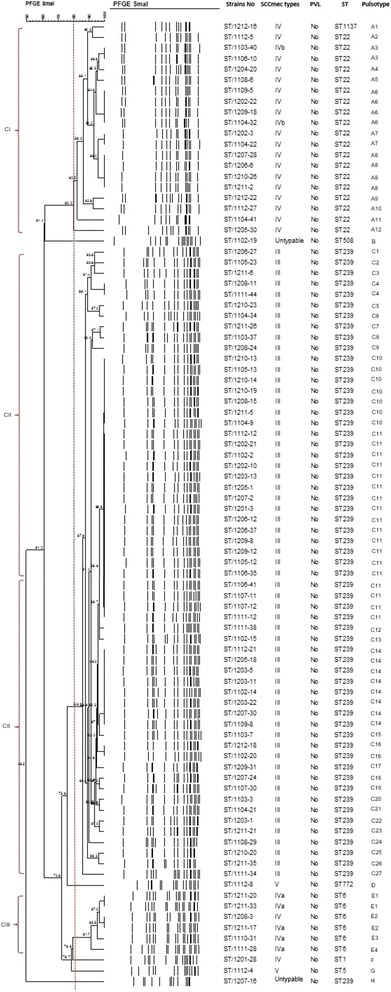
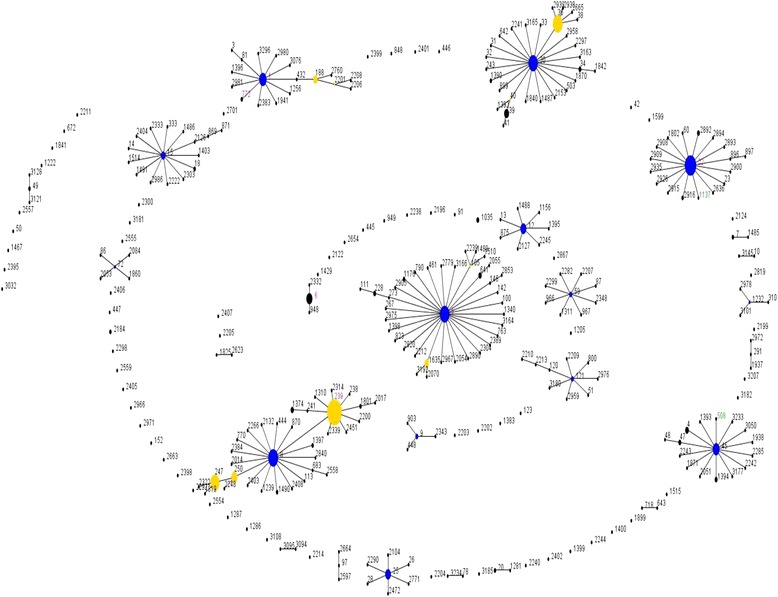
Two hundred and nine MRSA strains from year 2011 to 2012 were collected from a tertiary teaching hospital in Malaysia. The strains were characterized by antimicrobial susceptibility testing, staphylococcal cassette chromosome mec (SCCmec) typing, detection of Panton-Valentine leukocidin (PVL) gene, multilocus sequence typing (MLST) and pulsed-field gel electrophoresis (PFGE). Patient's demographic and clinical data were collected and correlated with molecular data by statistical analysis.
Male gender and patient >50 years of age (p < 0.0001) were significantly associated with the increased risk of MRSA acquisition. Fifty-nine percent of MRSA strains were HA-MRSA that carried SCCmec type II, III, IV and V while 31% were CA-MRSA strains with SCCmec III, IV and V. The prevalence of PVL gene among 2011 MRSA strains was 5.3% and no PVL gene was detected in 2012 MRSA strains. All of the strains were sensitive to vancomycin. However, vancomycin MIC creep phenomenon was demonstrated by the increased number of MRSA strains with MIC ≥1.5 μg/mL (p = 0.008) between 2011 and 2012. Skin disease (p = 0.034) and SCCmec type III (p = 0.0001) were found to be significantly associated with high vancomycin MIC. Forty-four percent of MRSA strains from blood, were further subtyped by MLST and PFGE. Most of the bacteraemia cases were primary bacteraemia and the common comorbidities were diabetes, hypertension and chronic kidney disease. The predominant pulsotype was pulsotype C exhibited by SCCmec III-ST239. This is a first study in Malaysia that reported the occurrence of MRSA clones such as SCCmec V-ST5, untypeable-ST508, SCCmec IV-ST1 and SCCmec IV-ST1137.
SCCmec type III remained predominant among the MRSA strains in this hospital. The occurrence of SCCmec IV and V among hospital strains and the presence of SCCmec III in CA-MRSA strains are increasing. MRSA strains causing bacteraemia over the two-year study period were found to be genetically diverse.
耐甲氧西林金黄色葡萄球菌(MRSA)是一种公认的病原体,在全球范围内引起医院获得性感染和社区获得性感染。据报道,MRSA感染的患病率在亚洲最高。由于马来西亚开展的流行病学研究有限,本研究旨在确定MRSA感染的患病率以及MRSA菌血症的分子特征。
从马来西亚一家三级教学医院收集了2011年至2012年的209株MRSA菌株。通过抗菌药物敏感性试验、葡萄球菌盒式染色体mec(SCCmec)分型、杀白细胞素(PVL)基因检测、多位点序列分型(MLST)和脉冲场凝胶电泳(PFGE)对菌株进行特征分析。收集患者的人口统计学和临床数据,并通过统计分析将其与分子数据相关联。
男性和年龄>50岁的患者(p<0.0001)与MRSA感染风险增加显著相关。59%的MRSA菌株为携带SCCmec II型、III型、IV型和V型的医院获得性MRSA(HA-MRSA),而31%为携带SCCmec III型、IV型和V型的社区获得性MRSA(CA-MRSA)菌株。2011年MRSA菌株中PVL基因的患病率为5.3%,2012年MRSA菌株中未检测到PVL基因。所有菌株对万古霉素敏感。然而,2011年至2012年间,MIC≥1.5μg/mL的MRSA菌株数量增加,出现了万古霉素MIC漂移现象(p=0.008)。发现皮肤病(p=0.034)和SCCmec III型(p=0.0001)与高万古霉素MIC显著相关。对44%的血源MRSA菌株进一步进行MLST和PFGE分型。大多数菌血症病例为原发性菌血症,常见的合并症为糖尿病、高血压和慢性肾脏病。主要的脉冲型为SCCmec III-ST239表现出的脉冲型C。这是马来西亚首次报道出现MRSA克隆,如SCCmec V-ST5、不可分型-ST508、SCCmec IV-ST1和SCCmec IV-ST1137。
SCCmec III型在该医院MRSA菌株中仍占主导地位。医院菌株中SCCmec IV型和V型的出现以及CA-MRSA菌株中SCCmec III型的存在正在增加。在为期两年的研究期间,发现引起菌血症的MRSA菌株具有遗传多样性。