Liu Jing, Dong Min, Sun Xiaorong, Li Wenwu, Xing Ligang, Yu Jinming
Department of Radiation Oncology and Shandong Key Laboratory of Radiation Oncology, Shandong Cancer Hospital and Institute, Jinan, Shandong, China.
Department of Oncology, the People's Hospital of Pingyi County, Pingyi, Shandong, China.
PLoS One. 2016 Jan 4;11(1):e0146195. doi: 10.1371/journal.pone.0146195. eCollection 2016.
The identification of surgical non-small cell lung cancer (NSCLC) patients with poor prognosis is a priority in clinical oncology because of their high 5-year mortality. This meta-analysis explored the prognostic value of maximal standardized uptake value (SUVmax), metabolic tumor volume (MTV) and total lesion glycolysis (TLG) on disease-free survival (DFS) and overall survival (OS) in surgical NSCLC patients.
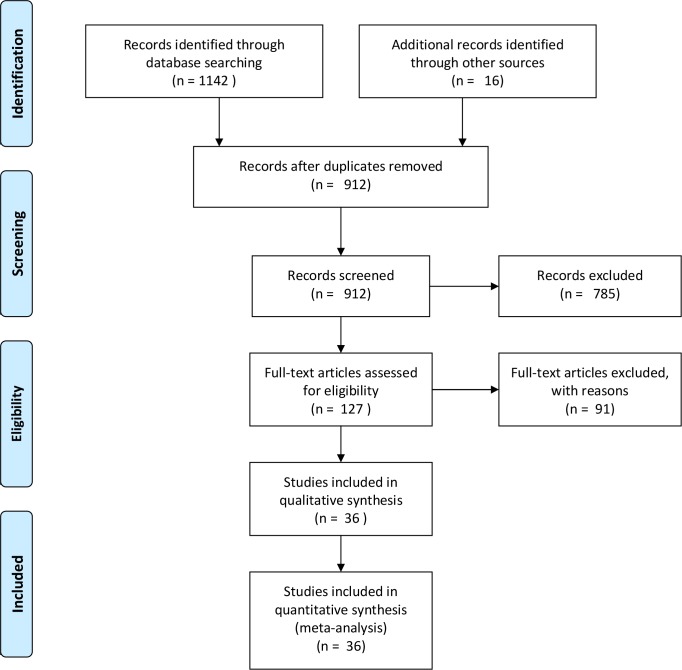
MEDLINE, EMBASE and Cochrane Libraries were systematically searched until August 1, 2015. Prospective or retrospective studies that evaluated the prognostic roles of preoperative 18F-FDG PET/CT with complete DFS and OS data in surgical NSCLC patients were included. The impact of SUVmax, MTV or TLG on survival was measured using hazard ratios (HR). Sub-group analyses were performed based on disease stage, pathological classification, surgery only and cut-off values.
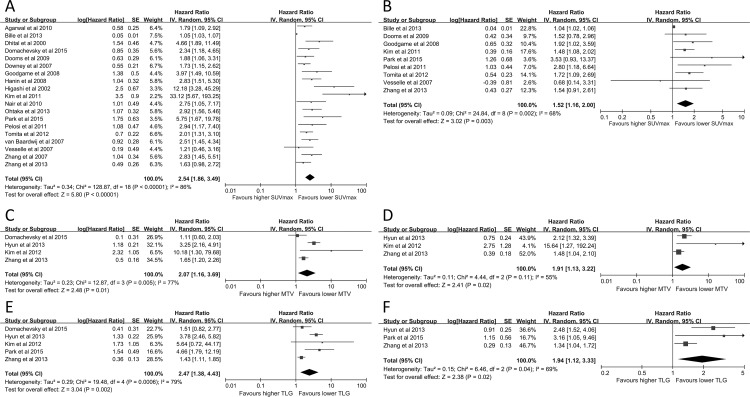
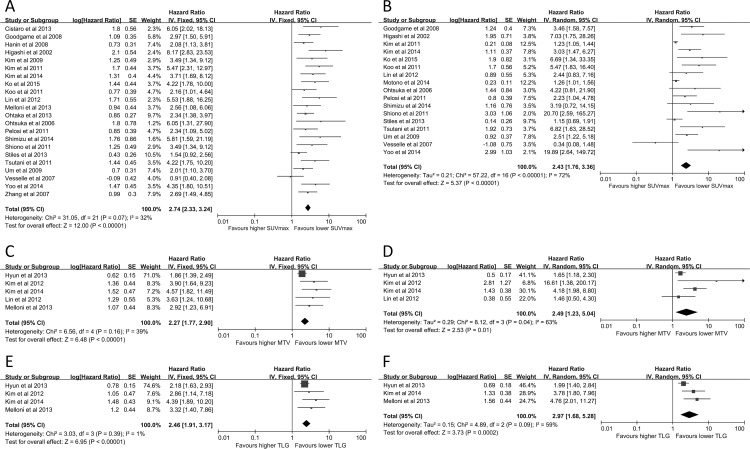
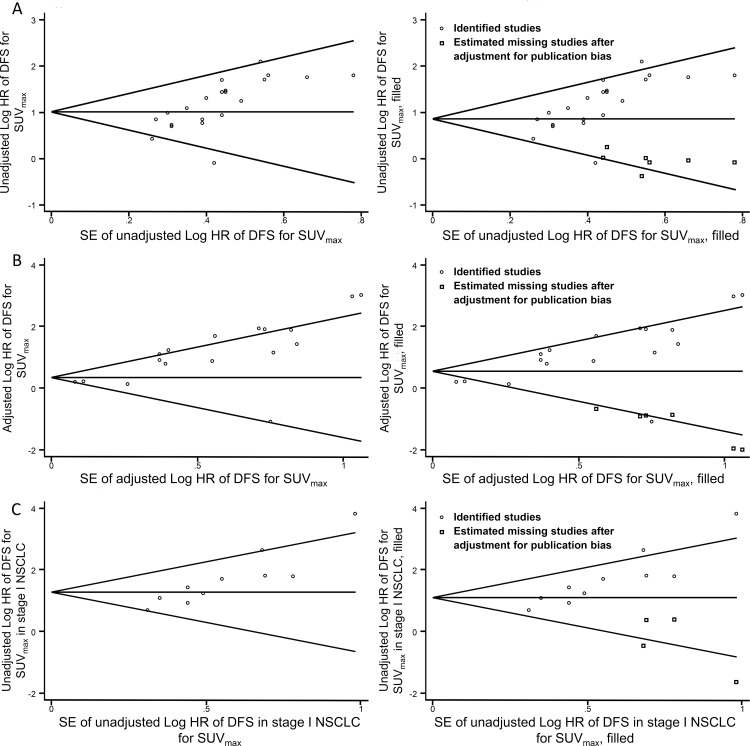
Thirty-six studies comprised of 5807 patients were included. The combined HRs for DFS were 2.74 (95%CI 2.33-3.24, unadjusted) and 2.43 (95%CI: 1.76-3.36, adjusted) for SUVmax, 2.27 (95%CI 1.77-2.90, unadjusted) and 2.49 (95%CI 1.23-5.04, adjusted) for MTV, and 2.46 (95%CI 1.91-3.17, unadjusted) and 2.97 (95%CI 1.68-5.28, adjusted) for TLG. The pooled HRs for OS were 2.54 (95%CI 1.86-3.49, unadjusted) and 1.52 (95%CI 1.16-2.00, adjusted) for SUVmax, 2.07 (95%CI 1.16-3.69, unadjusted) and 1.91 (95%CI 1.13-3.22, adjusted) for MTV, and 2.47 (95%CI 1.38-4.43, unadjusted) and 1.94 (95%CI 1.12-3.33, adjusted) for TLG. Begg's test detected publication bias, the trim and fill procedure was performed, and similar HRs were obtained. The prognostic role of SUVmax, MTV and TLG remained similar in the sub-group analyses.
High values of SUVmax, MTV and TLG predicted a higher risk of recurrence or death in patients with surgical NSCLC. We suggest the use of FDG PET/CT to select patients who are at high risk of disease recurrence or death and may benefit from aggressive treatments.
由于手术治疗的非小细胞肺癌(NSCLC)患者5年死亡率高,识别预后不良的患者是临床肿瘤学的首要任务。本荟萃分析探讨了最大标准化摄取值(SUVmax)、代谢肿瘤体积(MTV)和总病灶糖酵解(TLG)对手术NSCLC患者无病生存期(DFS)和总生存期(OS)的预后价值。
系统检索MEDLINE、EMBASE和Cochrane图书馆,检索截至2015年8月1日的文献。纳入评估术前18F-FDG PET/CT对手术NSCLC患者预后作用且有完整DFS和OS数据的前瞻性或回顾性研究。使用风险比(HR)衡量SUVmax、MTV或TLG对生存的影响。根据疾病分期、病理分类、单纯手术情况和临界值进行亚组分析。
纳入36项研究,共5807例患者。SUVmax的DFS合并HR分别为2.74(95%CI 2.33-3.24,未调整)和2.43(95%CI:1.76-3.36,调整),MTV分别为2.27(95%CI 1.77-2.90,未调整)和2.49(95%CI 1.23-5.04,调整),TLG分别为2.46(95%CI 1.91-3.17,未调整)和2.97(95%CI 1.68-5.28,调整)。OS的合并HR,SUVmax分别为2.54(95%CI 1.86-3.49,未调整)和1.52(95%CI 1.16-2.00,调整),MTV分别为2.07(95%CI 1.16-3.69,未调整)和1.91(95%CI 1.13-3.22,调整),TLG分别为2.47(95%CI 1.38-4.43,未调整)和1.94(95%CI 1.12-3.33,调整)。Begg检验检测到发表偏倚,进行了剪补法分析,得到了相似的HR。亚组分析中,SUVmax、MTV和TLG的预后作用保持相似。
SUVmax、MTV和TLG值高预示手术NSCLC患者复发或死亡风险更高。我们建议使用FDG PET/CT来选择疾病复发或死亡风险高且可能从积极治疗中获益的患者。