Doi Hanako, Kitajima Yuriko, Luo Lan, Yan Chan, Tateishi Seiko, Ono Yusuke, Urata Yoshishige, Goto Shinji, Mori Ryoichi, Masuzaki Hideaki, Shimokawa Isao, Hirano Akiyoshi, Li Tao-Sheng
Department of Stem Cell Biology, Atomic Bomb Disease Institute, Nagasaki University, 1-12-4 Sakamoto, Nagasaki 852-8523, Japan.
Department of Plastic and Reconstructive Surgery, Nagasaki University Graduate School of Biomedical Sciences, 1-12-4 Sakamoto, Nagasaki 852-8523, Japan.
Sci Rep. 2016 Jan 5;6:18844. doi: 10.1038/srep18844.
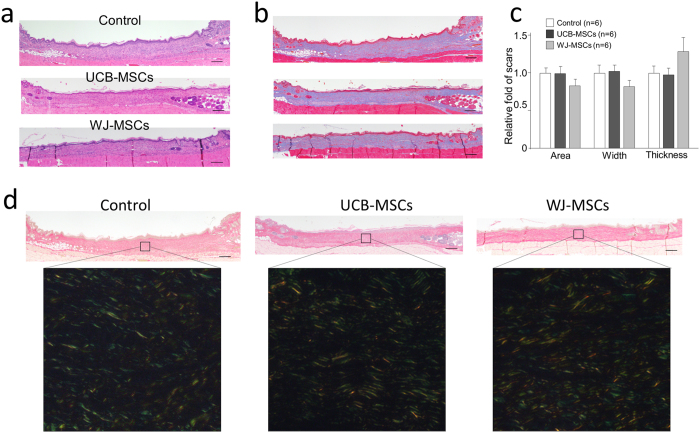
Postnatally, scars occur as a consequence of cutaneous wound healing. Scarless wound healing is highly desired for patients who have undergone surgery or trauma, especially to exposed areas. Based on the properties of mesenchymal stem cells (MSCs) for tissue repair and immunomodulation, we investigated the potential of MSCs for scarless wound healing. MSCs were expanded from umbilical cord blood (UCB-MSCs) and Wharton's jelly (WJ-MSCs) from healthy donors who underwent elective full-term pregnancy caesarean sections. UCB-MSCs expressed lower levels of the pre-inflammatory cytokines IL1A and IL1B, but higher levels of the extracellular matrix (ECM)-degradation enzymes MMP1 and PLAU compared with WJ-MSCs, suggesting that UCB-MSCs were more likely to favor scarless wound healing. However, we failed to find significant benefits for stem cell therapy in improving wound healing and reducing collagen deposition following the direct injection of 1.0 × 10(5) UCB-MSCs and WJ-MSCs into 5 mm full-thickness skin defect sites in nude mice. Interestingly, the implantation of UCB-MSCs tended to increase the expression of MMP2 and PLAU, two proteases involved in degradation of the extracellular matrix in the wound tissues. Based on our data, UCB-MSCs are more likely to be a favorable potential stem cell source for scarless wound healing, although a better experimental model is required for confirmation.
出生后,瘢痕是皮肤伤口愈合的结果。对于接受过手术或创伤的患者,尤其是暴露部位的患者,无瘢痕伤口愈合是非常理想的。基于间充质干细胞(MSCs)的组织修复和免疫调节特性,我们研究了MSCs促进无瘢痕伤口愈合的潜力。从接受择期足月妊娠剖宫产的健康供体的脐带血(UCB-MSCs)和华通氏胶(WJ-MSCs)中扩增MSCs。与WJ-MSCs相比,UCB-MSCs表达较低水平的促炎细胞因子IL1A和IL1B,但表达较高水平的细胞外基质(ECM)降解酶MMP1和PLAU,这表明UCB-MSCs更有可能促进无瘢痕伤口愈合。然而,在将1.0×10⁵个UCB-MSCs和WJ-MSCs直接注射到裸鼠的5mm全层皮肤缺损部位后,我们未能发现干细胞治疗在改善伤口愈合和减少胶原蛋白沉积方面有显著益处。有趣的是,UCB-MSCs的植入倾向于增加MMP2和PLAU的表达,这两种蛋白酶参与伤口组织中细胞外基质的降解。根据我们的数据,UCB-MSCs更有可能是促进无瘢痕伤口愈合的有利潜在干细胞来源,尽管需要更好的实验模型来证实。