Zhang Run-wu, Zhang Chang-wen, Ji Wei-xiao, Li Sheng-shi, Yan Shi-shen, Hu Shu-jun, Li Ping, Wang Pei-ji, Li Feng
School of Physics and Technology, University of Jinan, Jinan, Shandong, 250022, People's Republic of China.
School of Physics, State Key laboratory of Crystal Materials, Shandong University, Jinan, Shandong, 250100, People's Republic of China.
Sci Rep. 2016 Jan 5;6:18879. doi: 10.1038/srep18879.
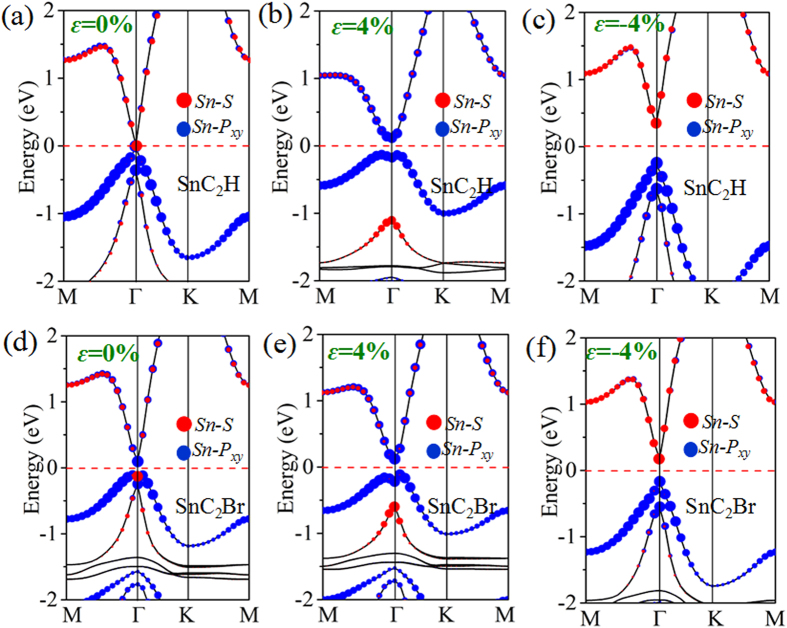
Quantum spin Hall (QSH) insulators feature edge states that topologically protected from backscattering. However, the major obstacles to application for QSH effect are the lack of suitable QSH insulators with a large bulk gap. Based on first-principles calculations, we predict a class of large-gap QSH insulators in ethynyl-derivative functionalized stanene (SnC2X; X = H, F, Cl, Br, I), allowing for viable applications at room temperature. Noticeably, the SnC2Cl, SnC2Br, and SnC2I are QSH insulators with a bulk gap of ~0.2 eV, while the SnC2H and SnC2F can be transformed into QSH insulator under the tensile strains. A single pair of topologically protected helical edge states is established for the edge of these systems with the Dirac point locating at the bulk gap, and their QSH states are confirmed with topological invariant Z2 = 1. The films on BN substrate also maintain a nontrivial large-gap QSH effect, which harbors a Dirac cone lying within the band gap. These findings may shed new light in future design and fabrication of large-gap QSH insulators based on two-dimensional honeycomb lattices in spintronics.
量子自旋霍尔(QSH)绝缘体具有受拓扑保护、不会发生背散射的边缘态。然而,QSH效应应用的主要障碍是缺乏具有大的体能隙的合适QSH绝缘体。基于第一性原理计算,我们预测了一类乙炔基衍生物功能化的锡烯(SnC2X;X = H、F、Cl、Br、I)中的大间隙QSH绝缘体,使其在室温下具有可行的应用。值得注意的是,SnC2Cl、SnC2Br和SnC2I是体能隙约为0.2 eV的QSH绝缘体,而SnC2H和SnC2F在拉伸应变下可转变为QSH绝缘体。这些体系的边缘建立了一对受拓扑保护的螺旋边缘态,狄拉克点位于体能隙处,并且它们的QSH态通过拓扑不变量Z2 = 1得到确认。在BN衬底上的薄膜也保持着非平凡的大间隙QSH效应,其带隙内存在一个狄拉克锥。这些发现可能为未来基于二维蜂窝晶格的大间隙QSH绝缘体在自旋电子学中的设计和制造提供新的思路。