Li Bob T, Lou Emil, Hsu Meier, Yu Helena A, Naidoo Jarushka, Zauderer Marjorie G, Sima Camelia, Johnson Melissa L, Daras Mariza, DeAngelis Lisa M, Fleisher Martin, Kris Mark G, Azzoli Christopher G
Thoracic Oncology Service, Division of Solid Tumor Oncology, Department of Medicine, Memorial Sloan Kettering Cancer Center, Weill Cornell Medical College, 300 E 66th Street, 12th Floor, New York, NY, 10065, United States of America.
Sydney Medical School, University of Sydney, Sydney, NSW, 2006, Australia.
PLoS One. 2016 Jan 5;11(1):e0146063. doi: 10.1371/journal.pone.0146063. eCollection 2016.
Lung cancers account for the majority of brain metastases which pose major therapeutic challenges. Biomarkers prognosticating for the development of brain metastases in patients with non-small cell lung cancers (NSCLC) may improve personalized care. Six serum proteomic biomarkers were previously investigated at Memorial Sloan Kettering but their associations with brain metastases were unknown.
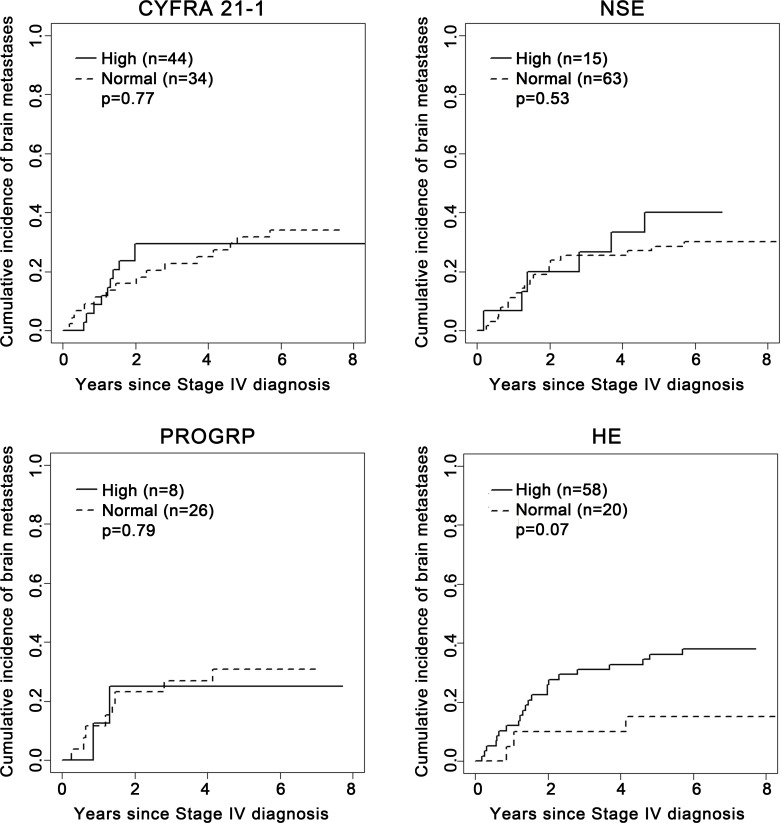
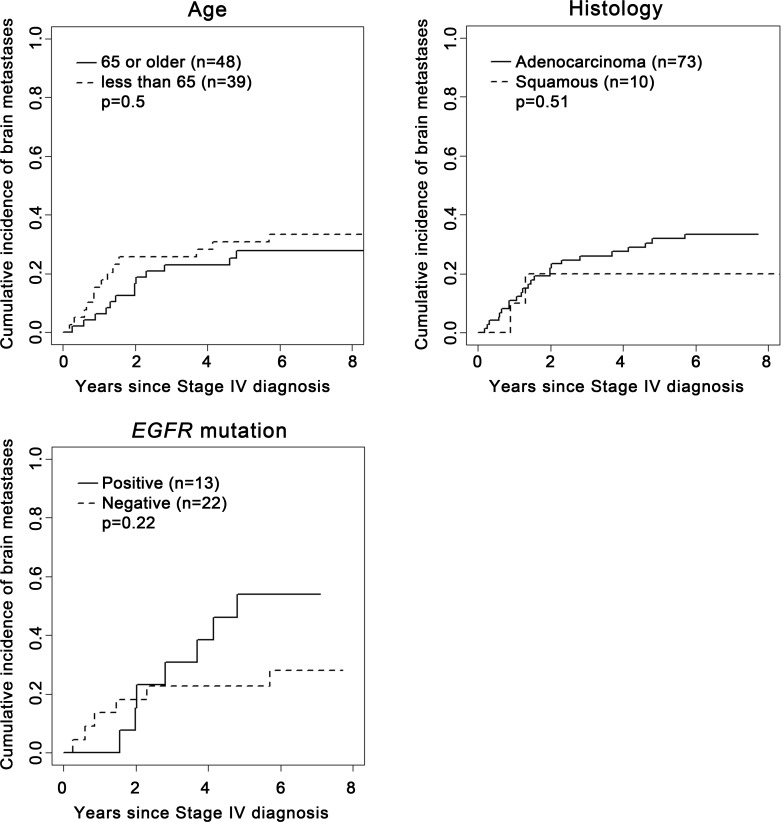
Serum NSE, CYFRA 21-1, ProGRP, SCC-Ag, TIMP1, and HE4 by ELISA-based proteomic assays were prospectively collected from consecutive patients with stage IV NSCLC. Pre-treatment serum biomarker levels as well as age, histology, and epidermal growth factor receptor (EGFR) mutation status were evaluated for association with the baseline presence of brain metastases using logistic regression and multivariable analysis. For patients without brain metastases at baseline, the cumulative incidence of subsequent brain metastases were compared according to baseline biomarkers and clinical factors using Gray's test.
A total of 118 patients were enrolled, 31 (26%; 95% CI 0.19-0.35) had brain metastases at baseline and a further 26 (22%; 95% CI 0.15-0.30) developed brain metastases subsequently. Pre-treatment serum biomarker levels were available in 104 patients. There was no significant association between the six serum biomarkers and the baseline presence or subsequent development of brain metastases. Age younger than 65 years was the only clinical factor significantly associated with brain metastasis at baseline (OR 3.00; 95% CI 1.22-7.34, P = 0.02) by multivariable analysis. A trend toward increased cumulative incidence of subsequent brain metastases was observed in patients with EGFR mutation (p = 0.2), but this was not statistically significant possibly due to small sample size.
Serum NSE, CYFRA 21-1, Pro-GRP, SCC-Ag, TIMP1, and HE4 are not significantly associated with brain metastases. Our methods taking into account follow-up time may be applied to independent datasets to identify a patient cohort with a higher biologic propensity for developing brain metastases. Such information may be useful for the study of agents targeting the development of brain metastases.
肺癌是脑转移瘤的主要病因,这带来了重大的治疗挑战。预测非小细胞肺癌(NSCLC)患者发生脑转移的生物标志物可能会改善个性化治疗。此前,纪念斯隆凯特琳癌症中心对六种血清蛋白质组生物标志物进行了研究,但它们与脑转移的关联尚不清楚。
通过基于酶联免疫吸附测定的蛋白质组学检测方法,前瞻性收集连续的IV期NSCLC患者的血清神经元特异性烯醇化酶(NSE)、细胞角蛋白19片段(CYFRA 21-1)、胃泌素释放肽前体(ProGRP)、鳞状细胞癌抗原(SCC-Ag)、基质金属蛋白酶组织抑制因子1(TIMP1)和人附睾蛋白4(HE4)。使用逻辑回归和多变量分析评估治疗前血清生物标志物水平以及年龄、组织学和表皮生长因子受体(EGFR)突变状态与脑转移基线存在情况的关联。对于基线时无脑转移的患者,使用Gray检验根据基线生物标志物和临床因素比较后续脑转移的累积发生率。
共纳入118例患者,31例(26%;95%可信区间0.19-0.35)在基线时存在脑转移,另有26例(22%;95%可信区间0.15-0.30)随后发生脑转移。104例患者有治疗前血清生物标志物水平数据。六种血清生物标志物与脑转移的基线存在情况或后续发生情况之间无显著关联。多变量分析显示,年龄小于65岁是与基线时脑转移显著相关的唯一临床因素(比值比3.00;95%可信区间1.22-7.34,P = 0.02)。在EGFR突变患者中观察到后续脑转移累积发生率有增加趋势(P = 0.2),但可能由于样本量小,这在统计学上不显著。
血清NSE、CYFRA 21-1、ProGRP、SCC-Ag、TIMP1和HE4与脑转移无显著关联。我们考虑随访时间的方法可应用于独立数据集,以识别具有更高发生脑转移生物学倾向的患者队列。此类信息可能有助于研究针对脑转移发生的药物。