Ma De-Ning, Chai Zong-Tao, Zhu Xiao-Dong, Zhang Ning, Zhan Di-Hua, Ye Bo-Gen, Wang Cheng-Hao, Qin Cheng-Dong, Zhao Yi-Ming, Zhu Wei-Ping, Cao Man-Qing, Gao Dong-Mei, Sun Hui-Chuan, Tang Zhao-You
Liver Cancer Institute, Zhongshan Hospital, Fudan University, Shanghai, 200032, China.
Key Laboratory of Carcinogenesis and Cancer Invasion (Fudan University), Ministry of Education, Shanghai, People's Republic of China.
J Hematol Oncol. 2016 Jan 6;9:1. doi: 10.1186/s13045-015-0229-y.
Our previous study reported that microRNA-26a (miR-26a) inhibited tumor progression by inhibiting tumor angiogenesis and intratumoral macrophage infiltration in hepatocellular carcinoma (HCC). The direct roles of miR-26a on tumor cell invasion remain poorly understood. In this study, we aim to explore the mechanism of miR-26a in modulating epithelial-mesenchymal transition (EMT) in HCC.
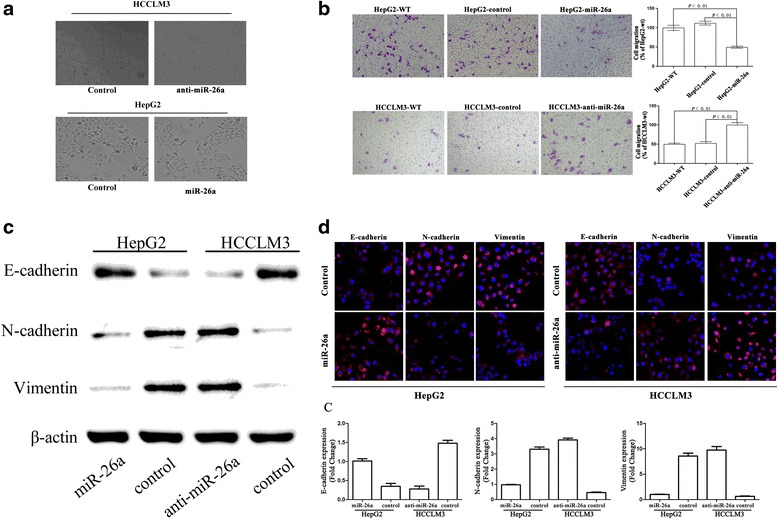
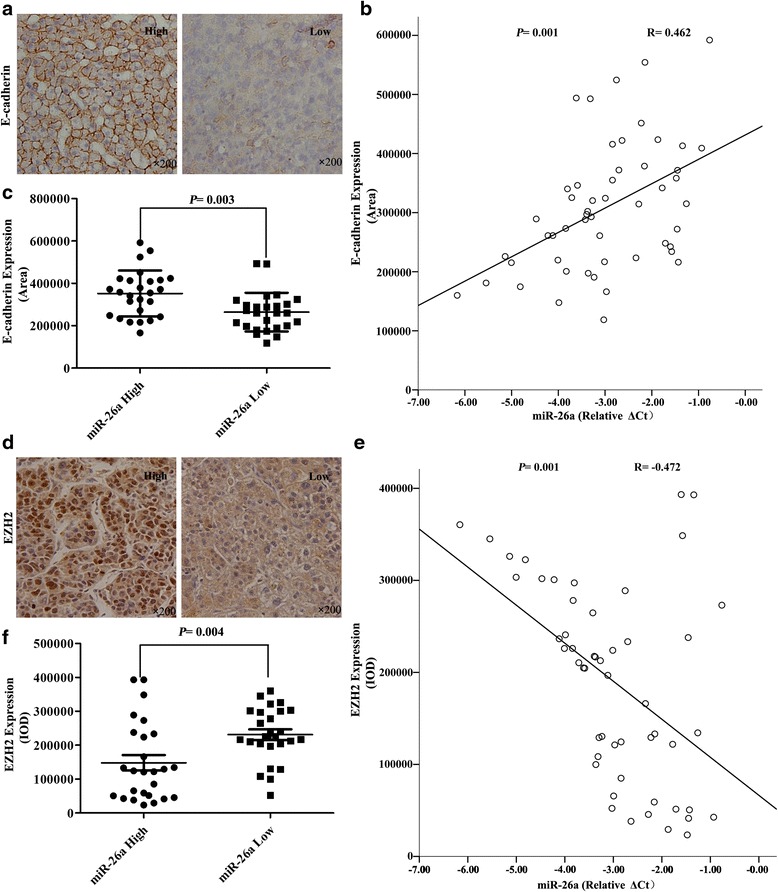
In vitro cell morphology and cell migration were compared between the hepatoma cell lines HCCLM3 and HepG2, which were established in the previous study. Overexpression and down-regulation of miR-26a were induced in these cell lines, and Western blot and immunofluorescence assays were used to detect the expression of EMT markers. Xenograft nude mouse models were used to observe tumor growth and pulmonary metastasis. Immunohistochemical assays were conducted to study the relationships between miR-26a expression and enhancer of zeste homolog 2 (EZH2) and E-cadherin expression in human HCC samples.
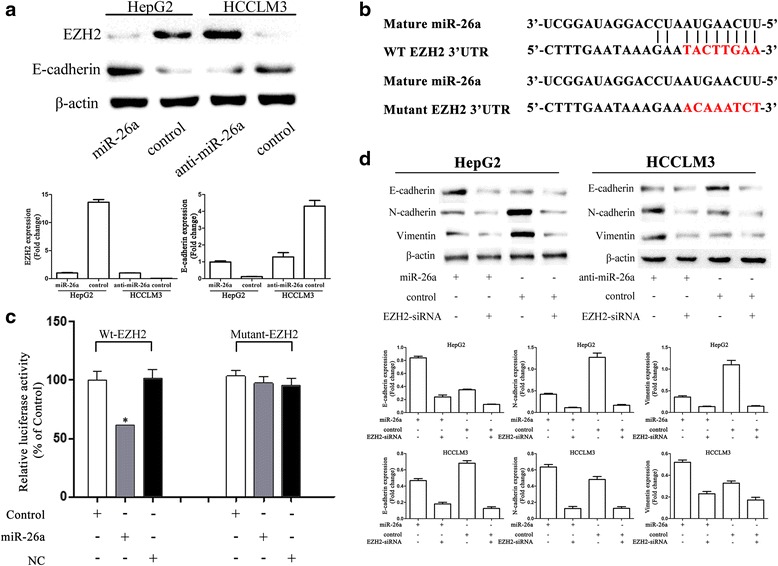
Down-regulation of miR-26a in HCCLM3 and HepG2 cells resulted in an EMT-like cell morphology and high motility in vitro and increased in tumor growth and pulmonary metastasis in vivo. Through down-regulation of EZH2 expression and up-regulation of E-cadherin expression, miR-26a inhibited the EMT process in vitro and in vivo. Luciferase reporter assay showed that miR-26a directly interacted with EZH2 messenger RNA (mRNA). Furthermore, the expression of miR-26a was positively correlated with E-cadherin expression and inversely correlated with EZH2 expression in human HCC tissue.
miR-26a inhibited the EMT process in HCC by down-regulating EZH2 expression.
我们之前的研究报道,微小RNA-26a(miR-26a)通过抑制肝细胞癌(HCC)中的肿瘤血管生成和肿瘤内巨噬细胞浸润来抑制肿瘤进展。miR-26a对肿瘤细胞侵袭的直接作用仍知之甚少。在本研究中,我们旨在探讨miR-26a在调节HCC上皮-间质转化(EMT)中的机制。
比较了在之前研究中建立的肝癌细胞系HCCLM3和HepG2的体外细胞形态和细胞迁移情况。在这些细胞系中诱导miR-26a的过表达和下调,并使用蛋白质免疫印迹和免疫荧光分析来检测EMT标志物的表达。使用异种移植裸鼠模型观察肿瘤生长和肺转移情况。进行免疫组织化学分析以研究miR-26a表达与人类HCC样本中zeste同源物2(EZH2)增强子和E-钙黏蛋白表达之间的关系。
HCCLM3和HepG2细胞中miR-26a的下调导致体外出现EMT样细胞形态和高迁移率,并导致体内肿瘤生长和肺转移增加。通过下调EZH2表达和上调E-钙黏蛋白表达,miR-26a在体外和体内均抑制了EMT过程。荧光素酶报告基因检测表明,miR-26a直接与EZH2信使核糖核酸(mRNA)相互作用。此外,在人类HCC组织中,miR-26a的表达与E-钙黏蛋白表达呈正相关,与EZH2表达呈负相关。
miR-26a通过下调EZH2表达抑制HCC中的EMT过程。