Strauss Juliette A, Shaw Christopher S, Bradley Helen, Wilson Oliver J, Dorval Thierry, Pilling James, Wagenmakers Anton J M
Research Institute for Sport and Exercise Sciences, Liverpool John Moores University, Liverpool, UK.
Centre for Physical Activity and Nutrition Research, School of Exercise and Nutrition Sciences, Deakin University, Geelong, Victoria, Australia.
Physiol Rep. 2016 Jan;4(1). doi: 10.14814/phy2.12662.
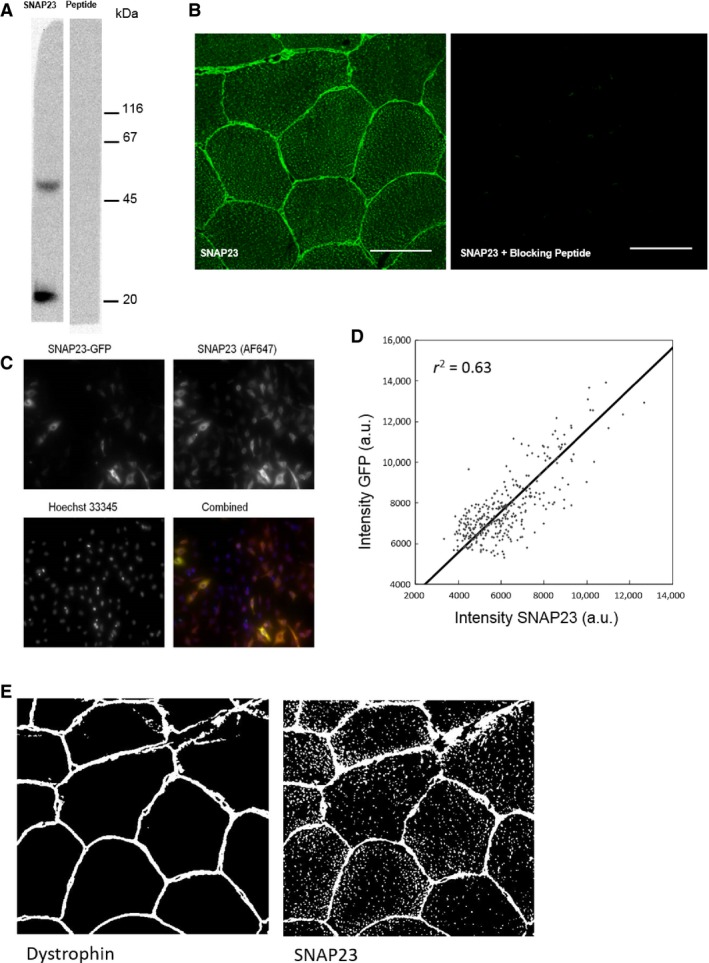
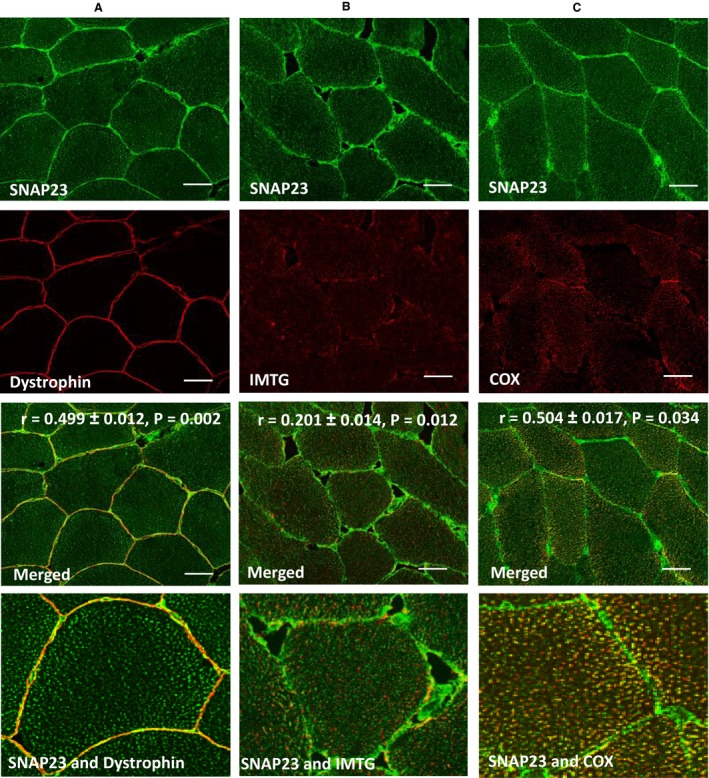
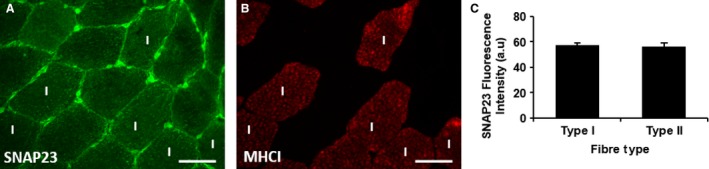
Synaptosomal-associated protein 23 (SNAP23) is a SNARE protein expressed abundantly in human skeletal muscle. Its established role is to mediate insulin-stimulated docking and fusion of glucose transporter 4 (GLUT4) with the plasma membrane. Recent in vitro research has proposed that SNAP23 may also play a role in the fusion of growing lipid droplets (LDs) and the channeling of LD-derived fatty acids (FAs) into neighboring mitochondria for β-oxidation. This study investigates the subcellular distribution of SNAP23 in human skeletal muscle using immunofluorescence microscopy to confirm that SNAP23 localization supports the three proposed metabolic roles. Percutaneous biopsies were obtained from the m. vastus lateralis of six lean, healthy males in the rested, overnight fasted state. Cryosections were stained with antibodies targeting SNAP23, the mitochondrial marker cytochrome c oxidase and the plasma membrane marker dystrophin, whereas intramuscular LDs were stained using the neutral lipid dye oil red O. SNAP23 displayed areas of intense punctate staining in the intracellular regions of all muscle fibers and continuous intense staining in peripheral regions of the cell. Quantitation of confocal microscopy images showed colocalization of SNAP23 with the plasma membrane marker dystrophin (Pearson's correlation coefficient r = 0.50 ± 0.01). The intense punctate intracellular staining colocalized primarily with the mitochondrial marker cytochrome C oxidase (r = 0.50 ± 0.012) and to a lesser extent with LDs (r = 0.21 ± 0.01) visualized with oil red O. We conclude that the observed subcellular distribution of SNAP23 in human skeletal muscle supports the three aforementioned metabolic roles.
突触体相关蛋白23(SNAP23)是一种在人类骨骼肌中大量表达的可溶性N-乙基马来酰亚胺敏感因子附着蛋白受体(SNARE)蛋白。其既定作用是介导胰岛素刺激的葡萄糖转运蛋白4(GLUT4)与质膜的对接和融合。最近的体外研究表明,SNAP23可能还在生长中的脂滴(LDs)融合以及将LD衍生的脂肪酸(FAs)输送到邻近线粒体进行β氧化过程中发挥作用。本研究使用免疫荧光显微镜研究了SNAP23在人类骨骼肌中的亚细胞分布,以确认SNAP23的定位支持上述三种代谢作用。从六名体重正常、健康的男性的股外侧肌获取经皮活检组织,这些男性处于静息、过夜禁食状态。冰冻切片用靶向SNAP23的抗体、线粒体标记物细胞色素c氧化酶和质膜标记物肌营养不良蛋白进行染色,而肌内LDs则使用中性脂质染料油红O进行染色。SNAP23在所有肌纤维的细胞内区域显示出强烈的点状染色区域,在细胞周边区域显示出连续的强烈染色。共聚焦显微镜图像定量分析显示,SNAP23与质膜标记物肌营养不良蛋白共定位(皮尔逊相关系数r = 0.50±0.01)。强烈的点状细胞内染色主要与线粒体标记物细胞色素C氧化酶共定位(r = 0.50±0.012);在较小程度上,与用油红O观察到的LDs共定位(r = 0.约01)。我们得出结论,在人类骨骼肌中观察到的SNAP23亚细胞分布支持上述三种代谢作用。