Leen Eoin N, Sorgeloos Frédéric, Correia Samantha, Chaudhry Yasmin, Cannac Fabien, Pastore Chiara, Xu Yingqi, Graham Stephen C, Matthews Stephen J, Goodfellow Ian G, Curry Stephen
Department of Life Sciences, Imperial College London, London, United Kingdom.
Division of Virology, Department of Pathology, University of Cambridge, Addenbrooke's Hospital, Cambridge, United Kingdom.
PLoS Pathog. 2016 Jan 6;12(1):e1005379. doi: 10.1371/journal.ppat.1005379. eCollection 2016 Jan.
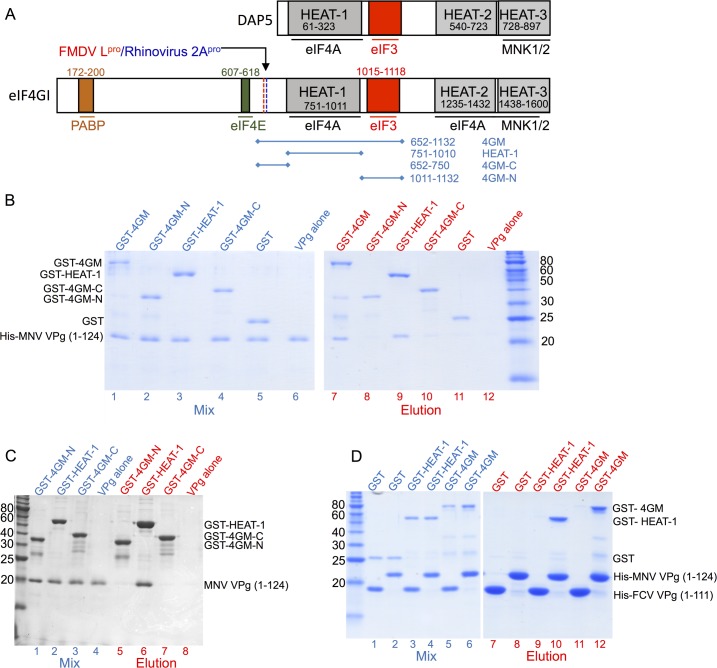
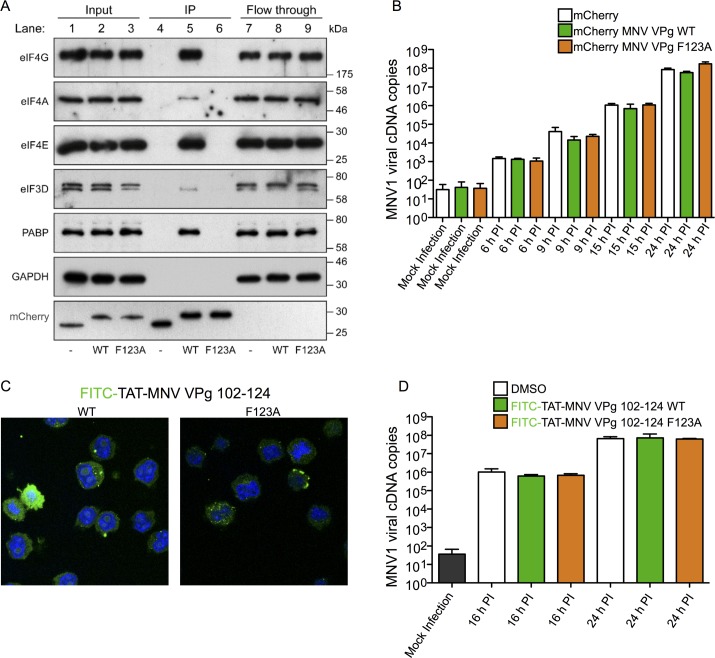
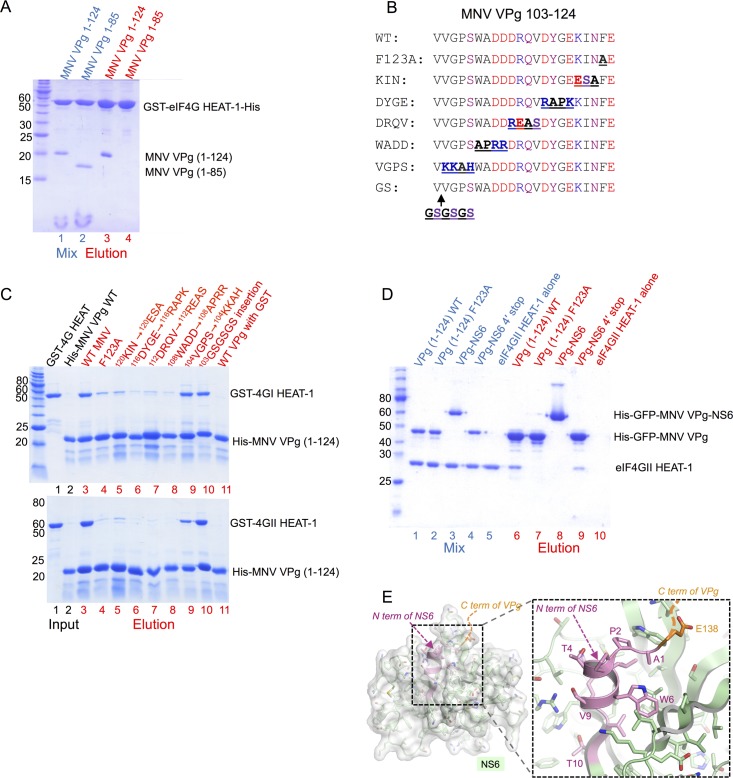
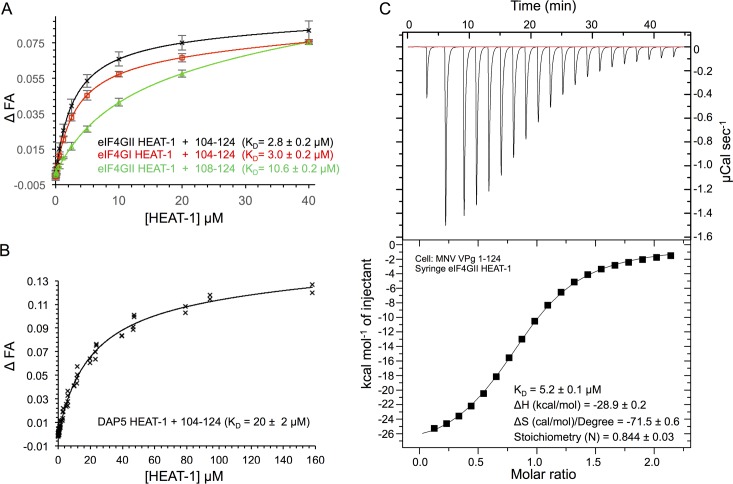
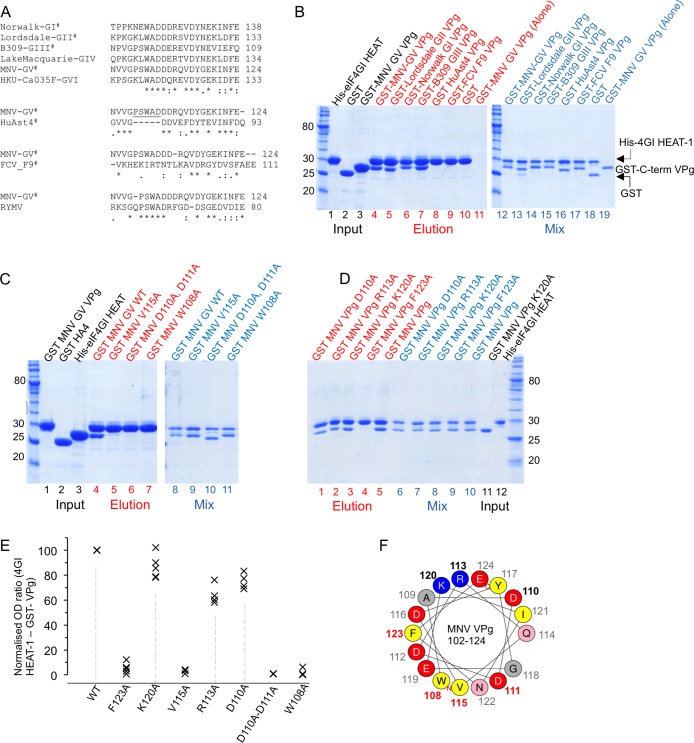
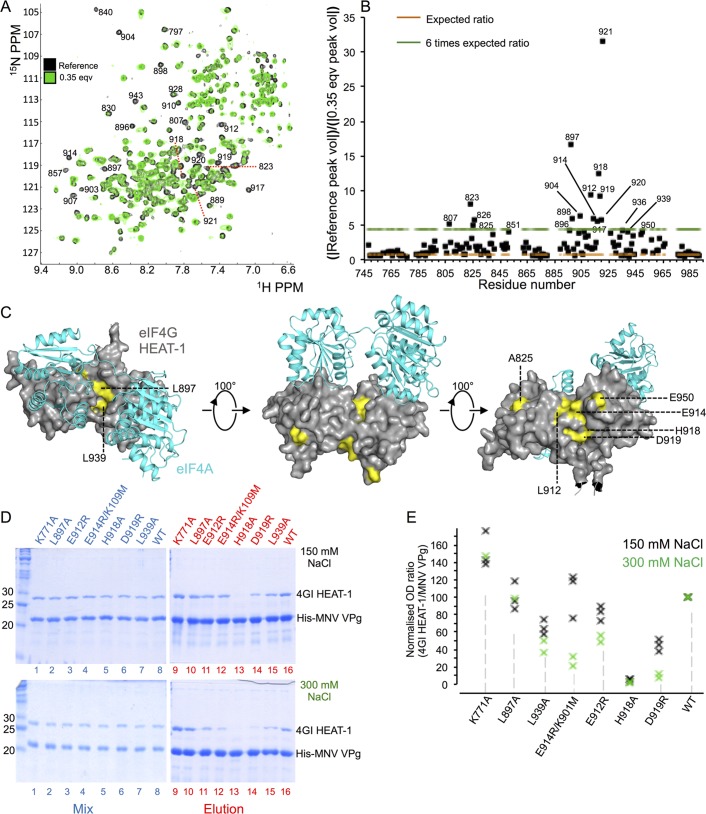
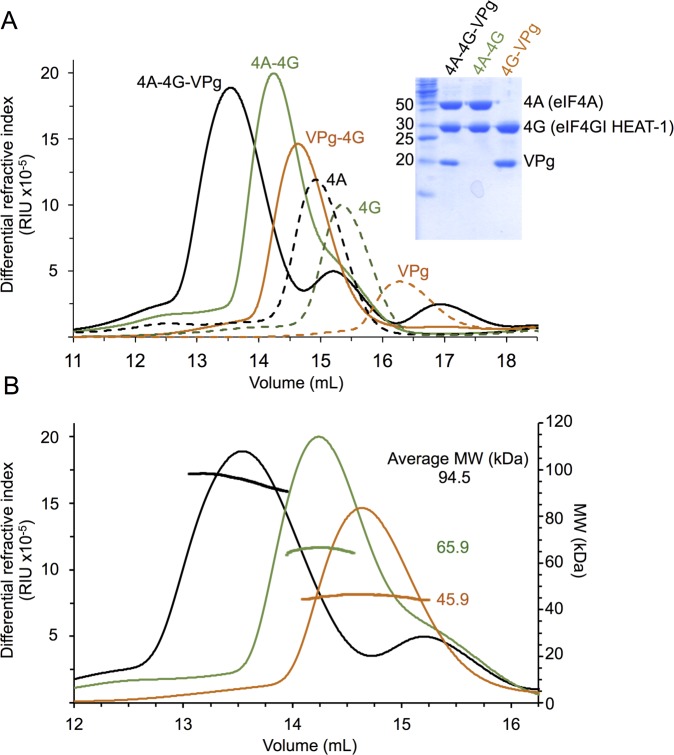
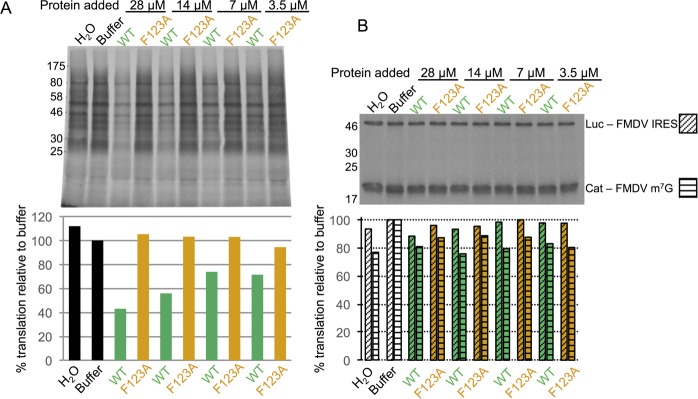
Translation initiation is a critical early step in the replication cycle of the positive-sense, single-stranded RNA genome of noroviruses, a major cause of gastroenteritis in humans. Norovirus RNA, which has neither a 5´ m7G cap nor an internal ribosome entry site (IRES), adopts an unusual mechanism to initiate protein synthesis that relies on interactions between the VPg protein covalently attached to the 5´-end of the viral RNA and eukaryotic initiation factors (eIFs) in the host cell. For murine norovirus (MNV) we previously showed that VPg binds to the middle fragment of eIF4G (4GM; residues 652-1132). Here we have used pull-down assays, fluorescence anisotropy, and isothermal titration calorimetry (ITC) to demonstrate that a stretch of ~20 amino acids at the C terminus of MNV VPg mediates direct and specific binding to the HEAT-1 domain within the 4GM fragment of eIF4G. Our analysis further reveals that the MNV C terminus binds to eIF4G HEAT-1 via a motif that is conserved in all known noroviruses. Fine mutagenic mapping suggests that the MNV VPg C terminus may interact with eIF4G in a helical conformation. NMR spectroscopy was used to define the VPg binding site on eIF4G HEAT-1, which was confirmed by mutagenesis and binding assays. We have found that this site is non-overlapping with the binding site for eIF4A on eIF4G HEAT-1 by demonstrating that norovirus VPg can form ternary VPg-eIF4G-eIF4A complexes. The functional significance of the VPg-eIF4G interaction was shown by the ability of fusion proteins containing the C-terminal peptide of MNV VPg to inhibit in vitro translation of norovirus RNA but not cap- or IRES-dependent translation. These observations define important structural details of a functional interaction between norovirus VPg and eIF4G and reveal a binding interface that might be exploited as a target for antiviral therapy.
翻译起始是诺如病毒正链单链RNA基因组复制周期中的关键早期步骤,诺如病毒是人类肠胃炎的主要病因。诺如病毒RNA既没有5´ m7G帽结构,也没有内部核糖体进入位点(IRES),它采用一种不同寻常的机制来起始蛋白质合成,该机制依赖于共价连接在病毒RNA 5´端的VPg蛋白与宿主细胞中的真核起始因子(eIFs)之间的相互作用。对于鼠诺如病毒(MNV),我们之前表明VPg与eIF4G的中间片段(4GM;第652 - 1132位氨基酸残基)结合。在此,我们利用下拉分析、荧光各向异性和等温滴定量热法(ITC)证明,MNV VPg C末端的一段约20个氨基酸介导了与eIF4G的4GM片段内HEAT-1结构域的直接和特异性结合。我们的分析进一步揭示,MNV C末端通过一个在所有已知诺如病毒中保守的基序与eIF4G HEAT-1结合。精细的诱变图谱分析表明,MNV VPg C末端可能以螺旋构象与eIF4G相互作用。利用核磁共振光谱法确定了eIF4G HEAT-1上的VPg结合位点,该位点通过诱变和结合分析得到证实。我们发现,通过证明诺如病毒VPg可以形成三元VPg-eIF4G-eIF4A复合物,该位点与eIF4G HEAT-1上eIF4A的结合位点不重叠。含有MNV VPg C末端肽的融合蛋白能够抑制诺如病毒RNA的体外翻译,但不能抑制帽依赖性或IRES依赖性翻译,这表明了VPg-eIF4G相互作用的功能意义。这些观察结果确定了诺如病毒VPg与eIF4G之间功能性相互作用的重要结构细节,并揭示了一个可能被用作抗病毒治疗靶点的结合界面。