Wang Lin-Yu, Tu Yi-Fang, Lin Yung-Chieh, Huang Chao-Ching
Department of Pediatrics, Chi Mei Medical Center, Tainan, 710, Taiwan.
Department of Childhood Education and Nursery, Chia Nan University of Pharmacy and Science, Tainan, Taiwan.
J Neuroinflammation. 2016 Jan 6;13:6. doi: 10.1186/s12974-015-0474-6.
In very preterm infants, white matter injury is a prominent brain injury, and hypoxic ischemia (HI) and infection are the two primary pathogenic factors of this injury. Microglia and microvascular endothelial cells closely interact; therefore, a common signaling pathway may cause neuroinflammation and blood-brain barrier (BBB) damage after injury to the immature brain. CXC chemokine ligand 5 (CXCL5) is produced in inflammatory and endothelial cells by various organs in response to insults. CXCL5 levels markedly increased in the amniotic cavity in response to intrauterine infection and preterm birth in clinical studies. The objective of this study is to determine whether CXCL5 signaling is a shared pathway of neuroinflammation and BBB injury that contributes to white matter injury in the immature brain.
Postpartum day 2 (P2) rat pups received lipopolysaccharide (LPS) followed by 90-min HI. Immunohistochemical analyses were performed to determine microglial activation, neutrophil infiltration, BBB damage, and myelin basic protein and glial fibrillary acidic protein expression. Immunofluorescence experiments were performed to determine the cellular distribution of CXCL5. Pharmacological tests were performed to inhibit or enhance CXCL5 activity.
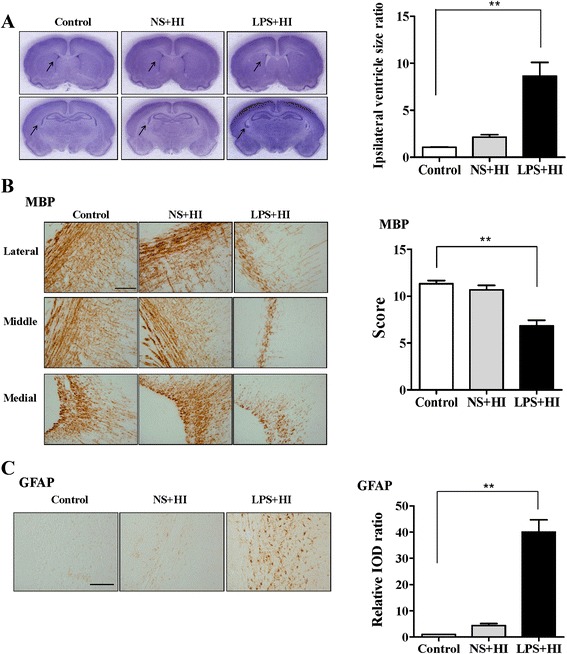
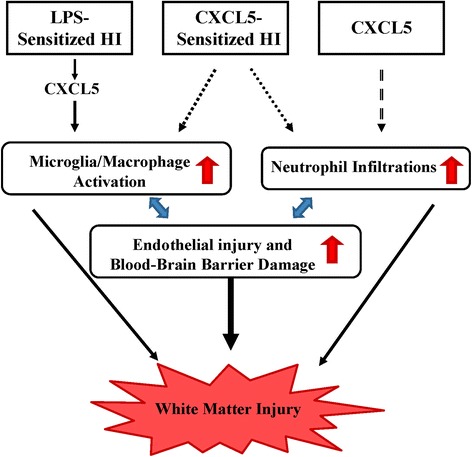
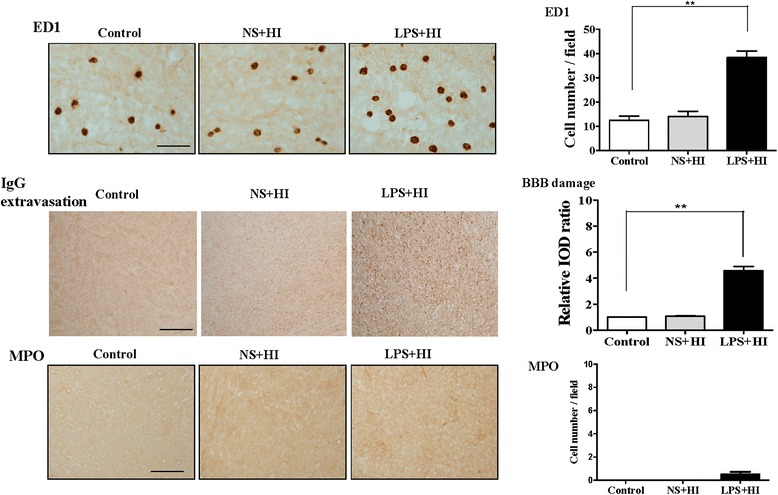
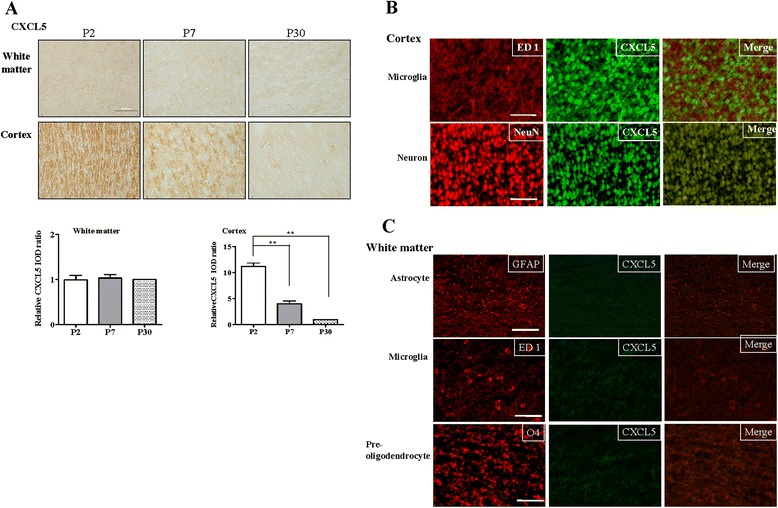
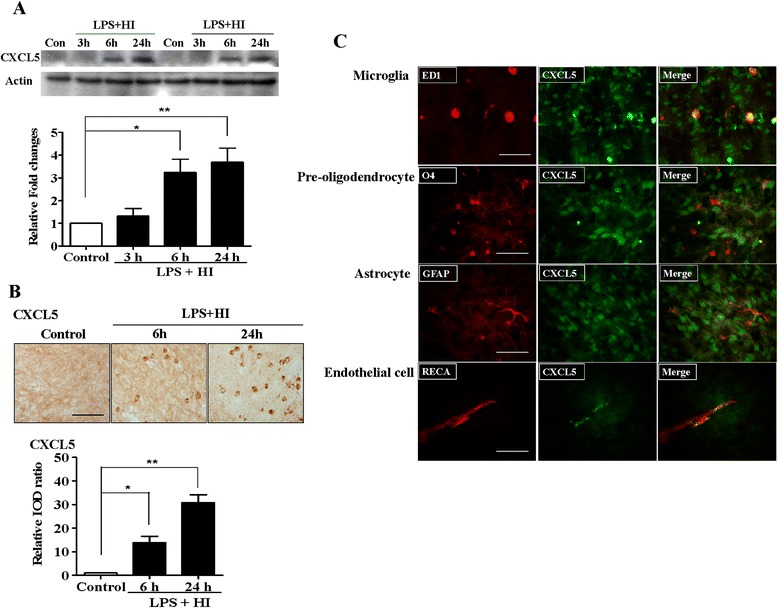
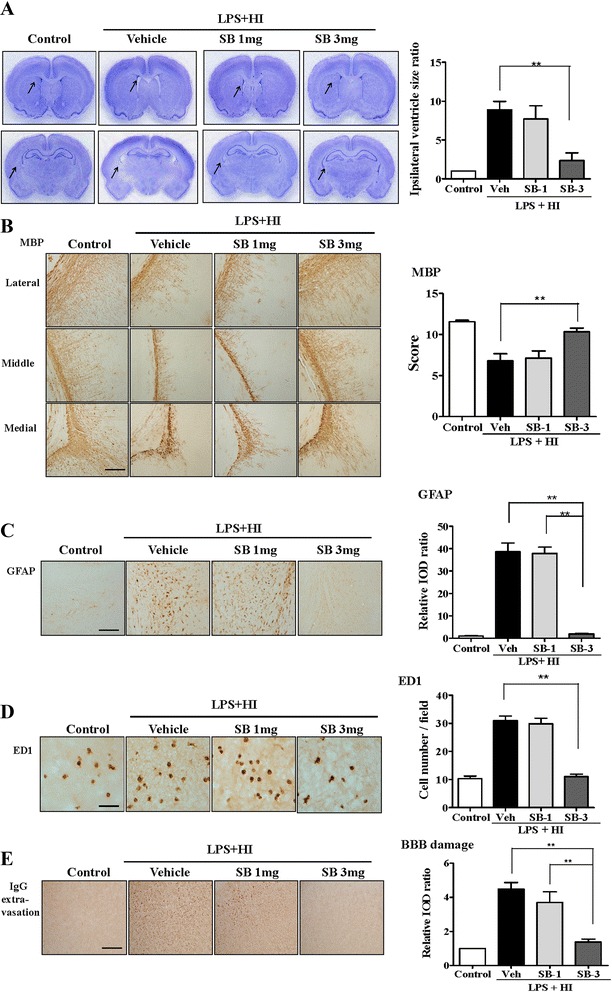
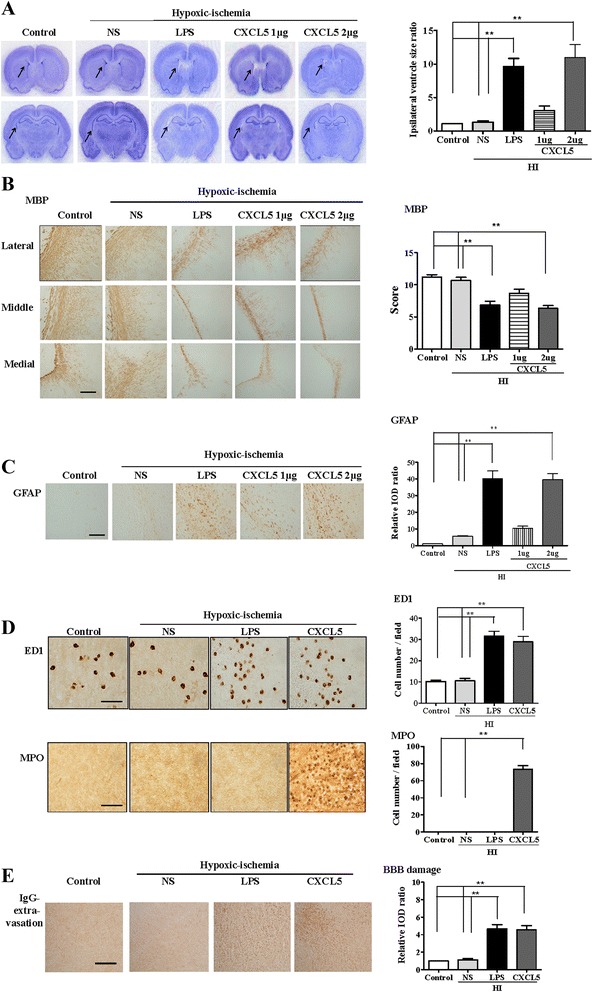
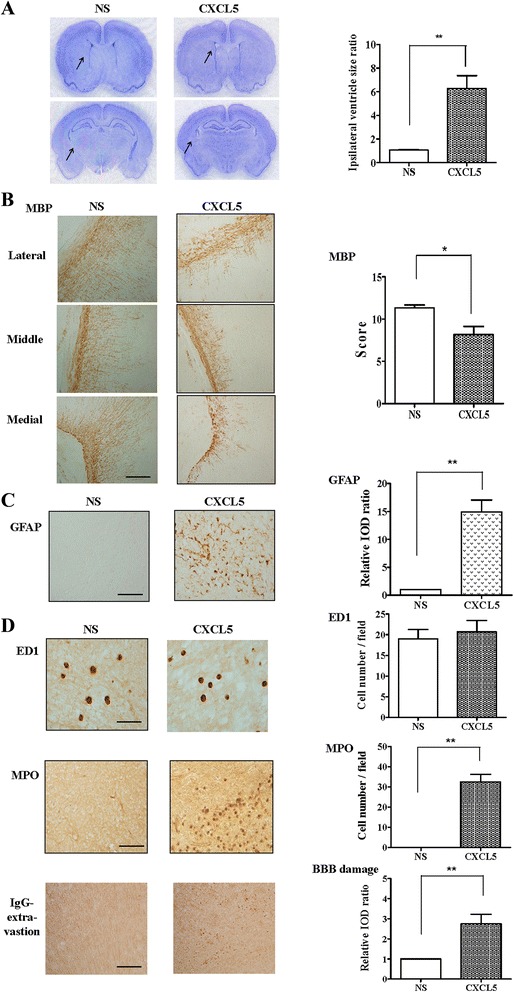
On P2, predominant increases in microglial activation and BBB damage were observed 24 h after LPS-sensitized HI induction, and white matter injury (decreased myelination and increased astrogliosis) was observed on P12 compared with controls. Immunohistochemical analyses revealed increased CXCL5 expression in the white matter 6 and 24 h after insult. Immunofluorescence experiments revealed upregulated CXCL5 expression in the activated microglia and endothelial cells 24 h after insult. CXCL5 inhibition by SB225002, a selective nonpeptide inhibitor of CXCR2, significantly attenuated microglial activation and BBB damage, increased myelination, and reduced astrogliosis in the white matter after LPS-sensitized HI. In addition, CXCL5-sensitized HI or CXCL5 alone significantly induced BBB damage and white matter injury in association with different neuroinflammation mechanisms. CXCL5-sensitized HI-induced microglial activation and neutrophil infiltration, whereas CXCL5 alone predominately caused neutrophil infiltration.
CXCL5 is a potential biomarker for white matter injury in preterm infants. Pharmacological blockade of CXCL5 signaling that attenuates dysregulated neuroinflammation can be used a therapeutic strategy against white matter injury in the immature brain.
在极早产儿中,白质损伤是一种突出的脑损伤,而缺氧缺血(HI)和感染是这种损伤的两个主要致病因素。小胶质细胞和微血管内皮细胞密切相互作用;因此,一个共同的信号通路可能在未成熟脑损伤后导致神经炎症和血脑屏障(BBB)损伤。CXC趋化因子配体5(CXCL5)由各种器官的炎症和内皮细胞在受到损伤刺激时产生。在临床研究中,羊膜腔内CXCL5水平在宫内感染和早产时显著升高。本研究的目的是确定CXCL5信号通路是否是导致未成熟脑白质损伤的神经炎症和血脑屏障损伤的共同通路。
产后第2天(P2)的大鼠幼崽接受脂多糖(LPS)处理,随后进行90分钟的HI。进行免疫组织化学分析以确定小胶质细胞活化、中性粒细胞浸润、血脑屏障损伤以及髓鞘碱性蛋白和胶质纤维酸性蛋白的表达。进行免疫荧光实验以确定CXCL5的细胞分布。进行药理学试验以抑制或增强CXCL5活性。
在P2时,LPS致敏的HI诱导后24小时观察到小胶质细胞活化和血脑屏障损伤显著增加,与对照组相比,在P12时观察到白质损伤(髓鞘形成减少和星形胶质细胞增生增加)。免疫组织化学分析显示,损伤后6小时和24小时白质中CXCL5表达增加。免疫荧光实验显示,损伤后24小时活化的小胶质细胞和内皮细胞中CXCL5表达上调。选择性CXCR2非肽抑制剂SB225002抑制CXCL5可显著减轻LPS致敏的HI后小胶质细胞活化和血脑屏障损伤,增加髓鞘形成,并减少白质中的星形胶质细胞增生。此外,CXCL5致敏的HI或单独的CXCL5与不同的神经炎症机制相关,显著诱导血脑屏障损伤和白质损伤。CXCL5致敏的HI诱导小胶质细胞活化和中性粒细胞浸润,而单独的CXCL5主要导致中性粒细胞浸润。
CXCL5是早产儿白质损伤的潜在生物标志物。对CXCL5信号通路进行药理学阻断以减轻失调的神经炎症可作为针对未成熟脑白质损伤的治疗策略。