Chen Lifang, Fang Jianqiao, Jin Xiaoming, Keeler Crystal Lynn, Gao Hong, Fang Zhen, Chen Qin
Department of Acupuncture and Moxibustion, The Third Affiliated Hospital of Zhejiang Chinese Medical University, Hangzhou City, Zhejiang Province, China.
Department of Acupuncture and Moxibustion, The Third Affiliated Hospital of Zhejiang Chinese Medical University, Hangzhou City, Zhejiang Province, China Zhejiang Chinese Medical University, Hangzhou City, Zhejiang Province, China.
BMJ Open. 2016 Jan 6;6(1):e010073. doi: 10.1136/bmjopen-2015-010073.
Stroke in young adults is not uncommon. Although the overall incidence of stroke has been recently declining, the incidence of stroke in young adults is increasing. Traditional vascular risk factors are the main cause of young ischaemic stroke. Acupuncture has been shown to benefit stroke rehabilitation and ameliorate the risk factors for stroke. The aims of this study were to determine whether acupuncture treatment will be effective in improving the activities of daily living (ADL), motor function and quality of life (QOL) in patients of young ischaemic stroke, and in preventing stroke recurrence by controlling blood pressure, lipids and body weight.
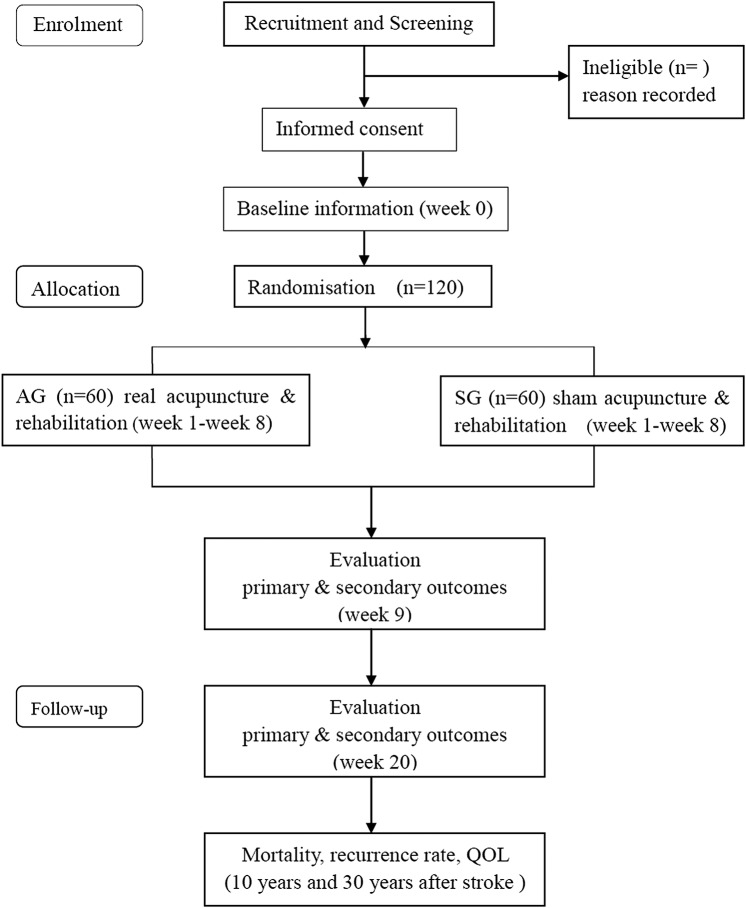
In this randomised, sham-controlled, participant-blinded and assessor-blinded clinical trial, 120 patients between 18 and 45 years of age with a recent (within 1 month) ischaemic stroke will be randomised for an 8-week acupuncture or sham acupuncture treatment. The primary outcome will be the Barthel Index for ADL. The secondary outcomes will include the Fugl-Meyer Assessment for motor function; the World Health Organization Quality of Life BREF (WHOQOL-BREF) for QOL; and risk factors that are measured by ambulatory blood pressure, the fasting serum lipid, body mass index and waist circumference. Incidence of adverse events and long-term mortality and recurrence rate during a 10-year and 30-year follow-up will also be investigated.
Ethics approval was obtained from the Ethics Committee of The Third Affiliated Hospital of Zhejiang Chinese Medical University. Protocol V.3 was approved in June 2013. The results will be disseminated in a peer-reviewed journal and presented at international congresses. The results will also be disseminated to patients by telephone during follow-up calls enquiring on the patient's post-study health status.
ChiCTR-TRC- 13003317; Pre-results.
年轻人中风并不罕见。尽管近期中风的总体发病率一直在下降,但年轻人中风的发病率却在上升。传统血管危险因素是年轻缺血性中风的主要原因。针灸已被证明有助于中风康复并改善中风危险因素。本研究的目的是确定针灸治疗对改善年轻缺血性中风患者的日常生活活动(ADL)、运动功能和生活质量(QOL)是否有效,以及通过控制血压、血脂和体重来预防中风复发。
在这项随机、假对照、参与者盲法和评估者盲法的临床试验中,120名年龄在18至45岁之间、近期(1个月内)发生缺血性中风的患者将被随机分为接受为期8周的针灸或假针灸治疗。主要结局将是ADL的Barthel指数。次要结局将包括运动功能的Fugl-Meyer评估;生活质量的世界卫生组织生活质量简表(WHOQOL-BREF);以及通过动态血压、空腹血脂、体重指数和腰围测量的危险因素。还将调查不良事件的发生率以及10年和30年随访期间的长期死亡率和复发率。
已获得浙江中医药大学附属第三医院伦理委员会的伦理批准。方案V.3于2013年6月获得批准。研究结果将在同行评审期刊上发表,并在国际大会上展示。研究结果还将在随访电话询问患者研究后健康状况时通过电话告知患者。
ChiCTR-TRC-13003317;预结果。