Piyadasa Hadeesha, Altieri Anthony, Basu Sujata, Schwartz Jacquie, Halayko Andrew J, Mookherjee Neeloffer
Manitoba Centre for Proteomics and Systems Biology, University of Manitoba, Winnipeg, Manitoba, R3E 3P4, Canada Department of Immunology, University of Manitoba, Winnipeg, Manitoba, R3E 0T5, Canada.
Department of Physiology and Pathophysiology, University of Manitoba, Winnipeg, Manitoba, R3E 0J9, Canada Biology of Breathing Group, Children's Hospital Research Institute of Manitoba, Winnipeg, Manitoba, R3E 3P4, Canada.
Biol Open. 2016 Jan 6;5(2):112-21. doi: 10.1242/bio.014464.
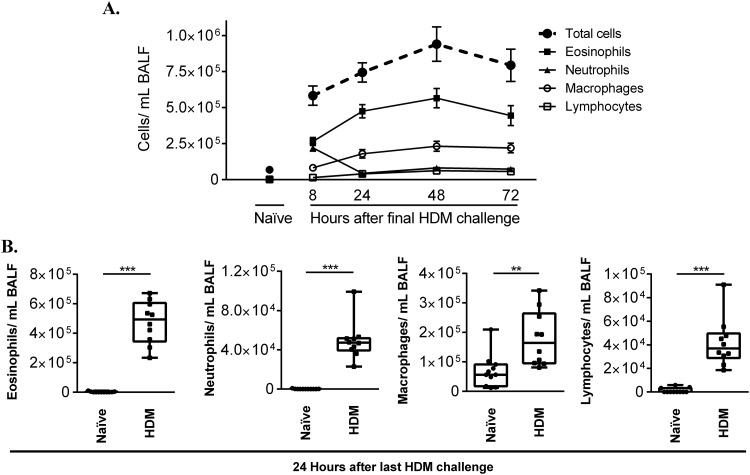
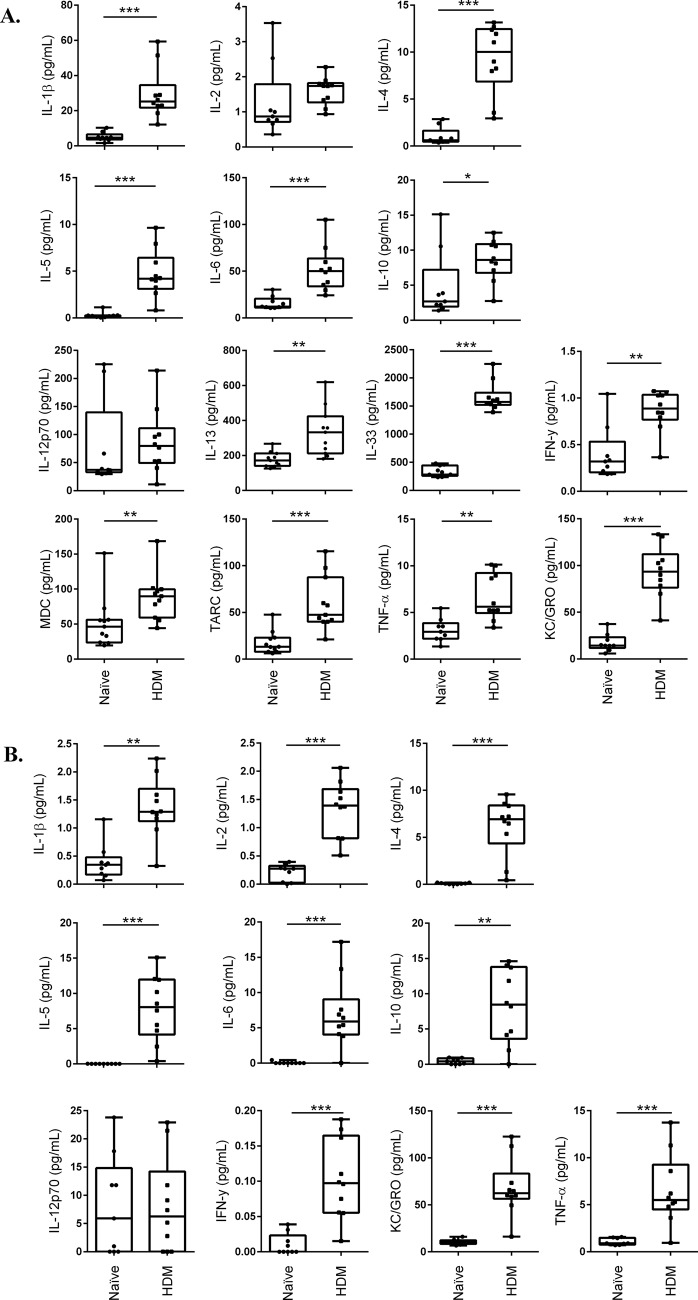
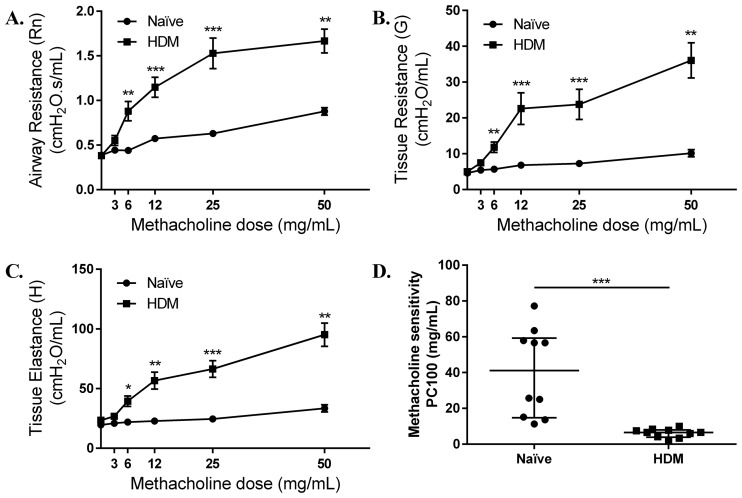
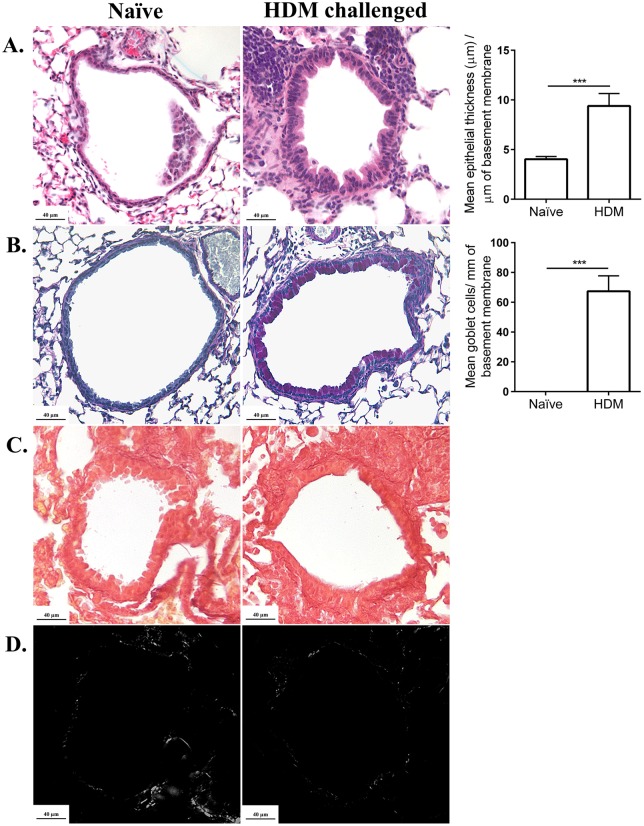
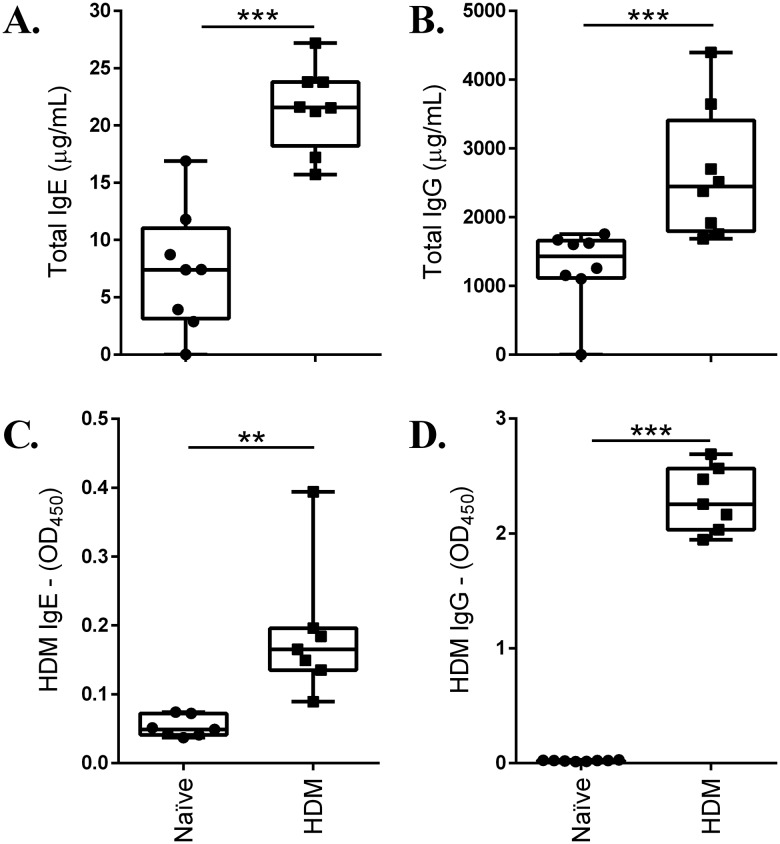
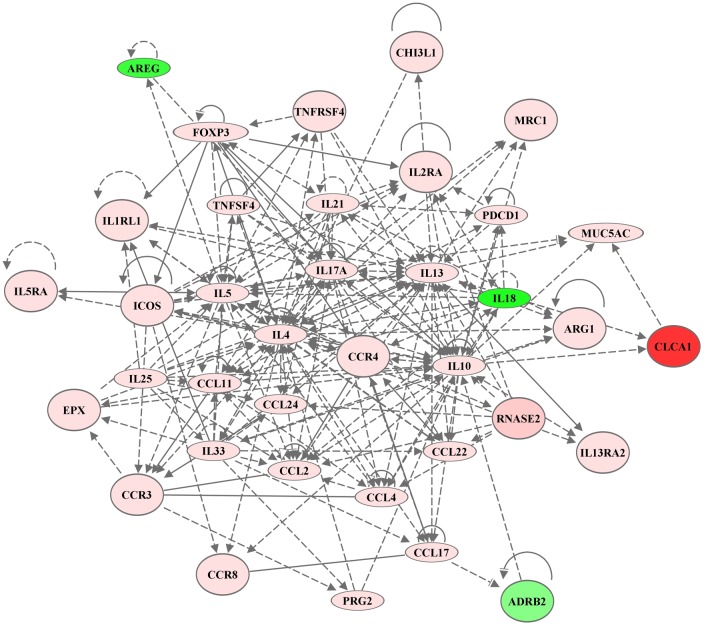
House dust mite (HDM) challenge is commonly used in murine models of allergic asthma for preclinical pathophysiological studies. However, few studies define objective readouts or biomarkers in this model. In this study we characterized immune responses and defined molecular markers that are specifically altered after HDM challenge. In this murine model, we used repeated HDM challenge for two weeks which induced hallmarks of allergic asthma seen in humans, including airway hyper-responsiveness (AHR) and elevated levels of circulating total and HDM-specific IgE and IgG1. Kinetic studies showed that at least 24 h after last HDM challenge results in significant AHR along with eosinophil infiltration in the lungs. Histologic assessment of lung revealed increased epithelial thickness and goblet cell hyperplasia, in the absence of airway wall collagen deposition, suggesting ongoing tissue repair concomitant with acute allergic lung inflammation. Thus, this model may be suitable to delineate airway inflammation processes that precede airway remodeling and development of fixed airway obstruction. We observed that a panel of cytokines e.g. IFN-γ, IL-1β, IL-4, IL-5, IL-6, KC, TNF-α, IL-13, IL-33, MDC and TARC were elevated in lung tissue and bronchoalveolar fluid, indicating local lung inflammation. However, levels of these cytokines remained unchanged in serum, reflecting lack of systemic inflammation in this model. Based on these findings, we further monitored the expression of 84 selected genes in lung tissues by quantitative real-time PCR array, and identified 31 mRNAs that were significantly up-regulated in lung tissue from HDM-challenged mice. These included genes associated with human asthma (e.g. clca3, ear11, il-13, il-13ra2, il-10, il-21, arg1 and chia1) and leukocyte recruitment in the lungs (e.g. ccl11, ccl12 and ccl24). This study describes a biosignature to enable broad and systematic interrogation of molecular mechanisms and intervention strategies for airway inflammation pertinent to allergic asthma that precedes and possibly potentiates airway remodeling and fibrosis.
屋尘螨(HDM)激发常用于过敏性哮喘的小鼠模型,以进行临床前病理生理学研究。然而,很少有研究在该模型中定义客观的读数或生物标志物。在本研究中,我们对免疫反应进行了表征,并定义了在HDM激发后发生特异性改变的分子标志物。在这个小鼠模型中,我们使用重复的HDM激发两周,诱导出人类过敏性哮喘的特征,包括气道高反应性(AHR)以及循环中总IgE和HDM特异性IgE及IgG1水平升高。动力学研究表明,在最后一次HDM激发后至少24小时会导致显著的AHR以及肺部嗜酸性粒细胞浸润。肺组织学评估显示上皮厚度增加和杯状细胞增生,而气道壁无胶原沉积,提示在急性过敏性肺部炎症的同时存在持续的组织修复。因此,该模型可能适合描绘在气道重塑和固定性气道阻塞发展之前的气道炎症过程。我们观察到一组细胞因子,如IFN-γ、IL-1β、IL-4、IL-5、IL-6、KC、TNF-α、IL-13、IL-33、MDC和TARC在肺组织和支气管肺泡灌洗液中升高,表明局部肺部炎症。然而,这些细胞因子在血清中的水平保持不变,反映出该模型中缺乏全身炎症。基于这些发现,我们通过定量实时PCR阵列进一步监测了肺组织中84个选定基因的表达,并鉴定出31个在HDM激发小鼠的肺组织中显著上调的mRNA。这些基因包括与人类哮喘相关的基因(如clca3、ear11、il-13、il-13ra2、il-10、il-21、arg1和chia1)以及肺部白细胞募集相关的基因(如ccl11、ccl12和ccl24)。本研究描述了一种生物标志物,可用于广泛而系统地探究与过敏性哮喘相关的气道炎症的分子机制和干预策略,这种气道炎症先于并可能加剧气道重塑和纤维化。