Department of Veterinary Physiology, College of Veterinary Science and Animal Husbandry, Veterinary University, Mathura, 281001 UP India.
Department of Veterinary Biochemistry, College of Veterinary Science and Animal Husbandry, Veterinary University, Mathura, 281001 UP India.
J Anim Sci Technol. 2016 Jan 6;58:2. doi: 10.1186/s40781-015-0082-0. eCollection 2016.
Heat stress adversely affects the physiological and metabolic status, and the productive performance of buffalo.
The present study was conducted to explicate the effect of misting and wallowing cooling strategies during heat stress in lactating Murrah buffalo. The study was conducted for three months (May-July) of which first two months were hot dry and last month was hot humid. Eighteen lactating buffaloes, offered the same basal diet, were blocked by days in milk, milk yield and parity, and then randomly allocated to three treatments: negative control (no cooling), cooling by misting, and cooling by wallowing.
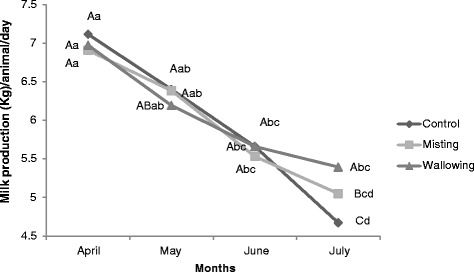
The results showed higher (P < 0.05) milk yield in buffaloes of misting and wallowing group compared to control during the experimental period however wallowing was found more (P < 0.05) effective during July (hot humid period). Both the treatments resulted into significant (P < 0.05) reduction in rectal temperature (RT) and respiratory rate (RR) compared to control animals during study period whereas wallowing was found to be effective on pulse rate (PR) only during July. Both treatments were resulted in mitigating the heat stress mediated decrease in packed cell volume (PCV), lymphocytopnoea and neutrophilia whereas decrease in total erythrocyte count (TEC) and monocytes was only mitigated by wallowing. Heat load induced alteration in serum creatinine and sodium concentration was significantly (P < 0.05) ameliorated by misting and wallowing whereas aspartate aminotransferase, alkaline phosphatase and superoxide dismutase activity, and reactive oxygen species concentration could be normalized neither by misting nor by wallowing. The significant (P < 0.05) increment in serum cortisol and prolactin levels observed in June and July period in control animals was significantly (P < 0.05) prevented by misting and wallowing.
It can be concluded that misting and wallowing were equally effective in May and June (hot dry period) whereas wallowing was more effective during hot humid period in preventing a decline in milk production and maintaining physiological, metabolic, endocrine and redox homeostasis.
热应激会对水牛的生理和代谢状态以及生产性能产生不利影响。
本研究旨在探讨在泌乳期摩拉水牛热应激期间喷雾和打滚冷却策略的影响。该研究进行了三个月(5 月至 7 月),其中前两个月为干热期,最后一个月为湿热期。18 头泌乳水牛,按产奶天数、产奶量和胎次分组,然后随机分为三组:负对照组(无冷却)、喷雾冷却组和打滚冷却组。
结果显示,在整个实验期间,喷雾和打滚组的水牛产奶量较高(P<0.05),但在 7 月(湿热期)打滚组更有效(P<0.05)。在整个研究期间,与对照组相比,两种处理都显著(P<0.05)降低了直肠温度(RT)和呼吸率(RR),而打滚组仅在 7 月对脉搏率(PR)有效。两种处理均减轻了热应激导致的红细胞压积(PCV)、淋巴细胞减少和中性粒细胞增多,而总红细胞计数(TEC)和单核细胞减少仅由打滚减轻。喷雾和打滚显著(P<0.05)改善了血清肌酐和钠浓度的热负荷诱导改变,而天冬氨酸氨基转移酶、碱性磷酸酶和超氧化物歧化酶活性以及活性氧浓度既不能通过喷雾也不能通过打滚来正常化。在 6 月和 7 月,对照组动物血清皮质醇和催乳素水平显著(P<0.05)升高,这一升高被喷雾和打滚显著(P<0.05)阻止。
可以得出结论,喷雾和打滚在 5 月和 6 月(干热期)同样有效,而在湿热期打滚更有效,可以防止产奶量下降,维持生理、代谢、内分泌和氧化还原平衡。