Galloso-Hernández Maykel Andrés, Soca-Pérez Mildrey, Dublin Devon, Alvarez-Díaz Carlos Armando, Iglesias-Gómez Jesús, Díaz-Gaona Cipriano, Rodríguez-Estévez Vicente
Department of Animal Production, Veterinary of Faculty, Córdoba University, 14071 Córdoba, Spain.
Experimental Station: "Indio Hatuey", Central España Republicana, Matanzas 44280, Cuba.
Animals (Basel). 2021 Apr 18;11(4):1162. doi: 10.3390/ani11041162.
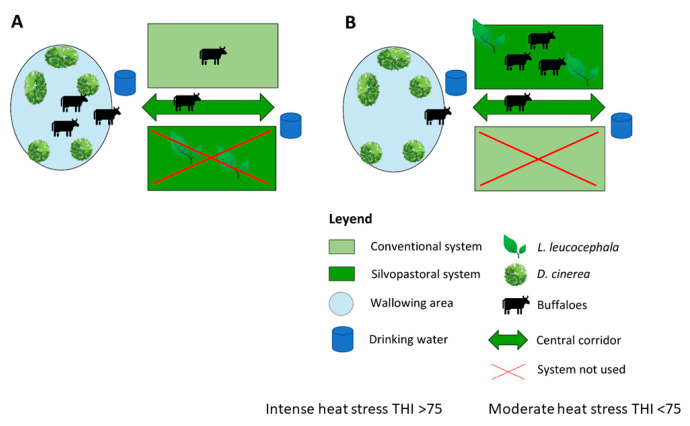
In the wake of climate change and global warming, the production systems of water buffaloes () are receiving increasing attention in the tropics, where the silvopastoral systems can improve animal welfare and production conditions. The objective of this study was to characterize the behavior of heifer buffaloes in a silvopastoral system (SPS) with (600 trees/ha) and in a conventional system (CVS), under intense heat stress and moderate heat stress in Cuba. We observed nine animals, with an average weight of 167.9 kg at the beginning of the study, during the daylight period, from 6:00 to 18:00 h, at 10 min intervals, for 12 days. Activities recorded were grazing, ingestion of tree leaves, rumination, water intake, walking, lying, standing, sheltering in the shade of trees, and wallowing. Sheltering in the shade of trees and wallowing were collectively considered as thermoregulatory behavior (TB). TB was different in both systems and conditions of heat stress ( < 0.05), with 4.06 in CVS and 3.81 h in SPS in the intense heat stress period, while it was 2.91 and 1.08 h for SPS and CVS, respectively, during the moderate heat stress period. The wallowing activity showed statistically significant differences ( < 0.05) in the intense heat stress season with 1.18 and 2.35 h for SPS and CVS, respectively. Time spent on feeding behavior was highest in the SPS system ( < 0.05). Longer times of thermoregulatory and feeding behavior indicate the importance of trees in animal welfare for this species in tropical conditions, thus supporting avoided deforestation and the replanting of trees in existing production systems and landscapes.
在气候变化和全球变暖的背景下,水牛养殖系统在热带地区受到越来越多的关注,在这些地区,林牧系统可以改善动物福利和生产条件。本研究的目的是在古巴的强烈热应激和中度热应激条件下,对林牧系统(SPS,每公顷600棵树)和传统系统(CVS)中育成期小母水牛的行为进行特征描述。我们观察了9头动物,在研究开始时平均体重为167.9千克,在白天6:00至18:00期间,每隔10分钟进行观察,共观察12天。记录的活动包括放牧、采食树叶、反刍、饮水、行走、躺卧、站立、在树荫下躲避和打滚。在树荫下躲避和打滚被统称为体温调节行为(TB)。在两种系统和热应激条件下,体温调节行为均存在差异(P<0.05),在强烈热应激期,传统系统中的体温调节行为时长为4.06小时,林牧系统中为3.81小时;而在中度热应激期,林牧系统和传统系统的体温调节行为时长分别为2.91小时和1.08小时。在强烈热应激季节,打滚活动存在统计学显著差异(P<0.05),林牧系统和传统系统的打滚时长分别为1.18小时和2.35小时。林牧系统中用于采食行为的时间最长(P<0.05)。较长时间的体温调节和采食行为表明,在热带条件下,树木对该物种动物福利具有重要意义,因此支持在现有生产系统和景观中避免森林砍伐并重新植树。