Johnson Chad Parker, Juranek Jenifer, Swank Paul R, Kramer Larry, Cox Charles S, Ewing-Cobbs Linda
University of Hawaii at Hilo, Department of Psychology, 200 W Kawili St., Hilo, HI 96720, United States.
University of Texas Health Science Center, Pediatrics, 7000 Fannin Street, Houston, TX 77030, United States.
Neuroimage Clin. 2015 Oct 19;9:668-77. doi: 10.1016/j.nicl.2015.10.009. eCollection 2015.
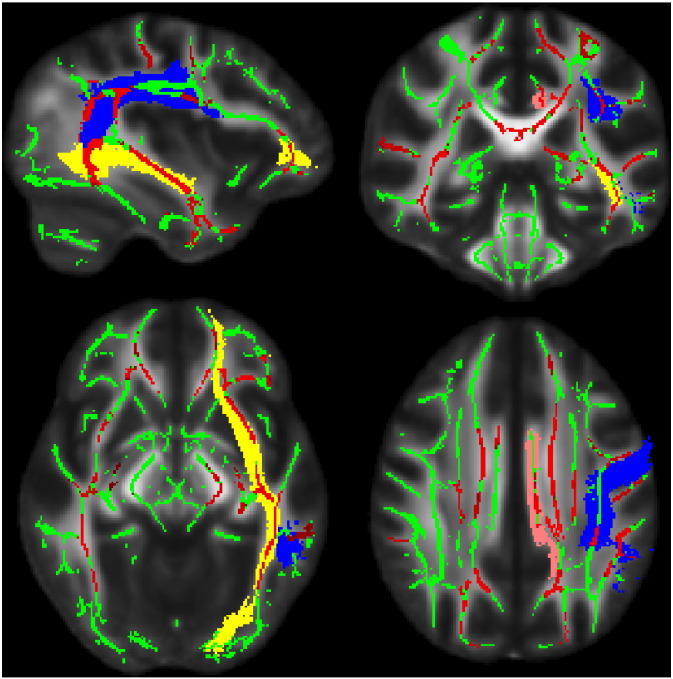
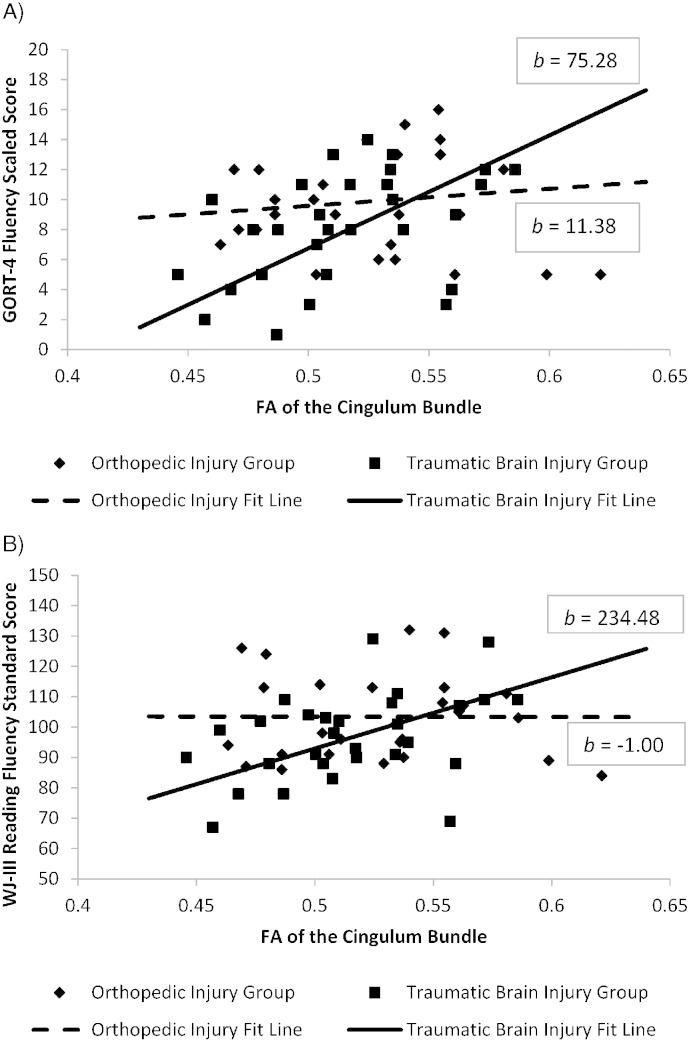
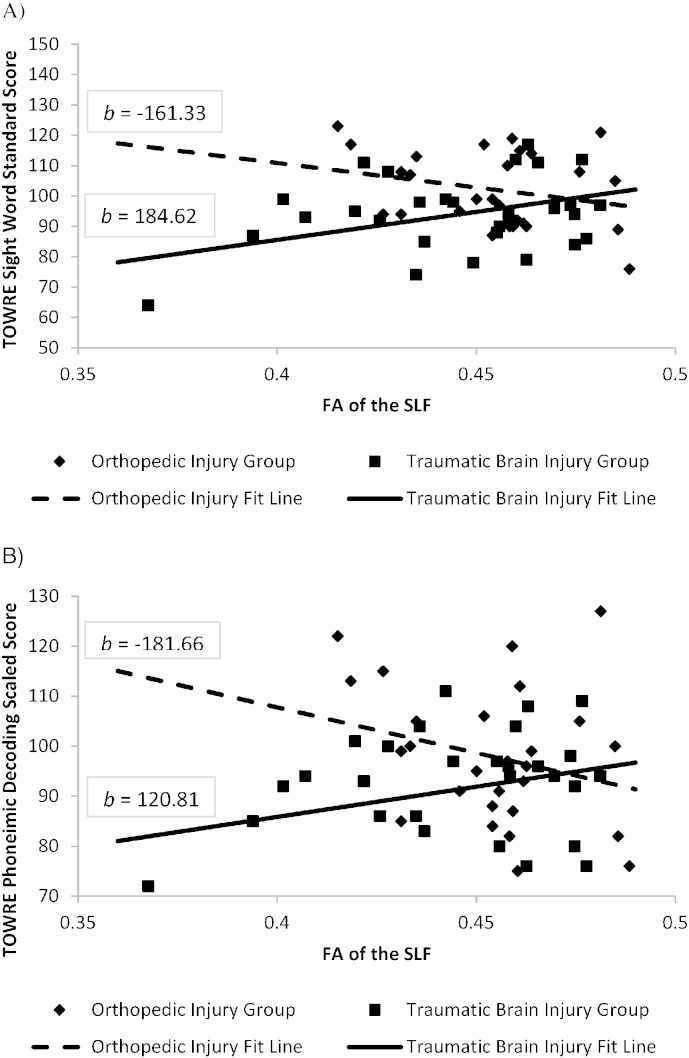
Pediatric traumatic brain injury often results in significant long-term deficits in mastery of reading ability. This study aimed to identify white matter pathways that, when damaged, predicted reading deficits in children. Based on the dual-route model of word reading, we predicted that integrity of the inferior fronto-occipital fasciculus would be related to performance in sight word identification while integrity of the superior longitudinal fasciculus would be related to performance in phonemic decoding. Reading fluency and comprehension were hypothesized to relate to the superior longitudinal fasciculus, inferior fronto-occipital fasciculus, and cingulum bundle. The connectivity of white matter pathways was used to predict reading deficits in children aged 6 to 16 years with traumatic brain injury (n = 29) and those with orthopedic injury (n = 27) using tract-based spatial statistics. Results showed that children with traumatic brain injury and reduced microstructural integrity of the superior longitudinal fasciculus demonstrated reduced word-reading ability on sight word and phonemic decoding tasks. Additionally, children with traumatic brain injury and microstructural changes involving the cingulum bundle demonstrated reduced reading fluency. Results support the association of a dorsal pathway via the superior longitudinal fasciculus with both sight word reading and phonemic decoding. No association was identified between the inferior fronto-occipital fasciculus and sight word reading or phonemic decoding. Reading fluency was associated with the integrity of the cingulum bundle. These findings support dissociable pathways predicting word reading and fluency using Diffusion Tensor Imaging and provide additional information for developing models of acquired reading deficits by specifying areas of brain damage which may predict reading deficits following recovery from the acute phase of TBI.
小儿创伤性脑损伤常常导致阅读能力掌握方面出现显著的长期缺陷。本研究旨在确定受损时可预测儿童阅读缺陷的白质通路。基于单词阅读的双通道模型,我们预测额枕下束的完整性与视觉单词识别表现有关,而弓状束的完整性与音素解码表现有关。阅读流畅性和阅读理解被假设与弓状束、额枕下束和扣带束有关。利用基于体素的空间统计学方法,通过白质通路的连通性来预测6至16岁创伤性脑损伤儿童(n = 29)和骨科损伤儿童(n = 27)的阅读缺陷。结果显示,创伤性脑损伤且弓状束微观结构完整性降低的儿童在视觉单词和音素解码任务中的单词阅读能力下降。此外,创伤性脑损伤且扣带束有微观结构变化的儿童阅读流畅性降低。结果支持通过弓状束的背侧通路与视觉单词阅读和音素解码均有关联。未发现额枕下束与视觉单词阅读或音素解码之间存在关联。阅读流畅性与扣带束的完整性有关。这些发现支持利用扩散张量成像来区分预测单词阅读和流畅性的通路,并通过明确可能预测创伤性脑损伤急性期恢复后阅读缺陷的脑损伤区域,为建立获得性阅读缺陷模型提供更多信息。