Meienberg Janine, Bruggmann Rémy, Oexle Konrad, Matyas Gabor
Center for Cardiovascular Genetics and Gene Diagnostics, Foundation for People with Rare Diseases, 8952, Schlieren-Zurich, Switzerland.
Interfaculty Bioinformatics Unit and Swiss Institute of Bioinformatics, University of Berne, 3012, Berne, Switzerland.
Hum Genet. 2016 Mar;135(3):359-62. doi: 10.1007/s00439-015-1631-9. Epub 2016 Jan 7.
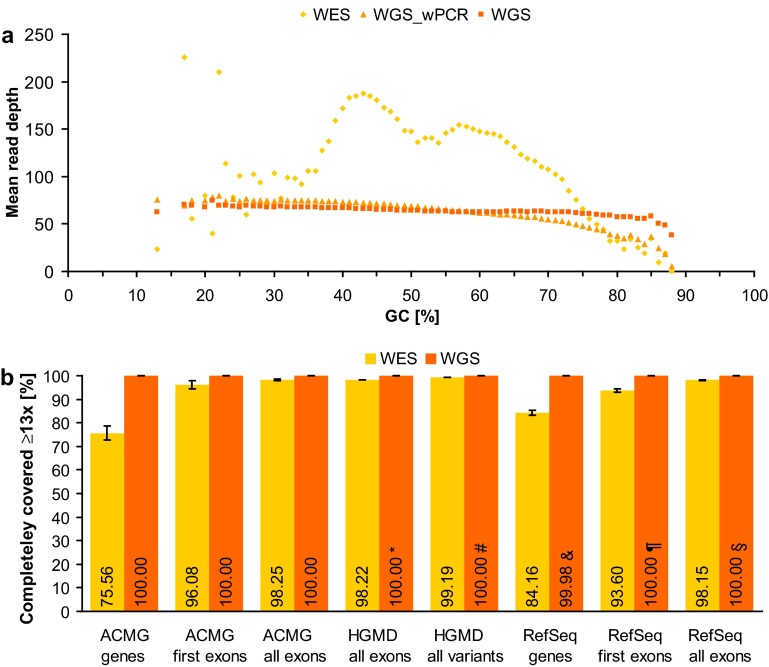
Current clinical next-generation sequencing is done by using gene panels and exome analysis, both of which involve selective capturing of target regions. However, capturing has limitations in sufficiently covering coding exons, especially GC-rich regions. We compared whole exome sequencing (WES) with the most recent PCR-free whole genome sequencing (WGS), showing that only the latter is able to provide hitherto unprecedented complete coverage of the coding region of the genome. Thus, from a clinical/technical point of view, WGS is the better WES so that capturing is no longer necessary for the most comprehensive genomic testing of Mendelian disorders.
当前的临床下一代测序是通过使用基因panel和外显子组分析来完成的,这两种方法都涉及对目标区域的选择性捕获。然而,捕获在充分覆盖编码外显子方面存在局限性,尤其是富含GC的区域。我们将全外显子组测序(WES)与最新的免PCR全基因组测序(WGS)进行了比较,结果表明只有后者能够提供迄今为止前所未有的对基因组编码区域的完整覆盖。因此,从临床/技术角度来看,WGS比WES更好,以至于对于孟德尔疾病的最全面基因组检测而言,不再需要捕获。