Yeung Edwina H, Sundaram Rajeshwari, Bell Erin M, Druschel Charlotte, Kus Christopher, Ghassabian Akhgar, Bello Scott, Xie Yunlong, Buck Louis Germaine M
Division of Intramural Population Health Research, Eunice Kennedy Shriver National Institute of Child Health and Human Development, Bethesda, Maryland.
Department of Environmental Health Sciences, University at Albany School of Public Health, Albany, New York3Department of Epidemiology and Biostatistics, University at Albany School of Public Health, Albany, New York.
JAMA Pediatr. 2016 Mar;170(3):251-8. doi: 10.1001/jamapediatrics.2015.4164.
An increasing percentage of births are conceived with assisted reproductive technology (ART) and other infertility treatment. Despite findings that such treatments may be associated with diminished gestation and birth size, scarce data exist regarding infertility treatments and children's development in the United States.
To assess the use and type of infertility treatment in relation to children's development through age 36 months.
DESIGN, SETTING, AND PARTICIPANTS: Prospective cohort study (conducted 2008-2014) that sampled based on infertility treatment and plurality. Included in the study were infants born between 2008 and 2010 in New York state (excluding New York City) whose parents completed developmental screening instruments through 36 months of age. A total of 4824 mothers (97% of 4989) completed 1 or more developmental screening instruments for 5841 children, including 1830 conceived with infertility treatment and 2074 twins.
Maternal self-report of any infertility treatment was further categorized into ART and ovulation induction/intrauterine insemination. Assisted reproductive technology use was previously validated by linkage with the Society for Assisted Reproductive Technology-Clinical Outcome Reporting System.
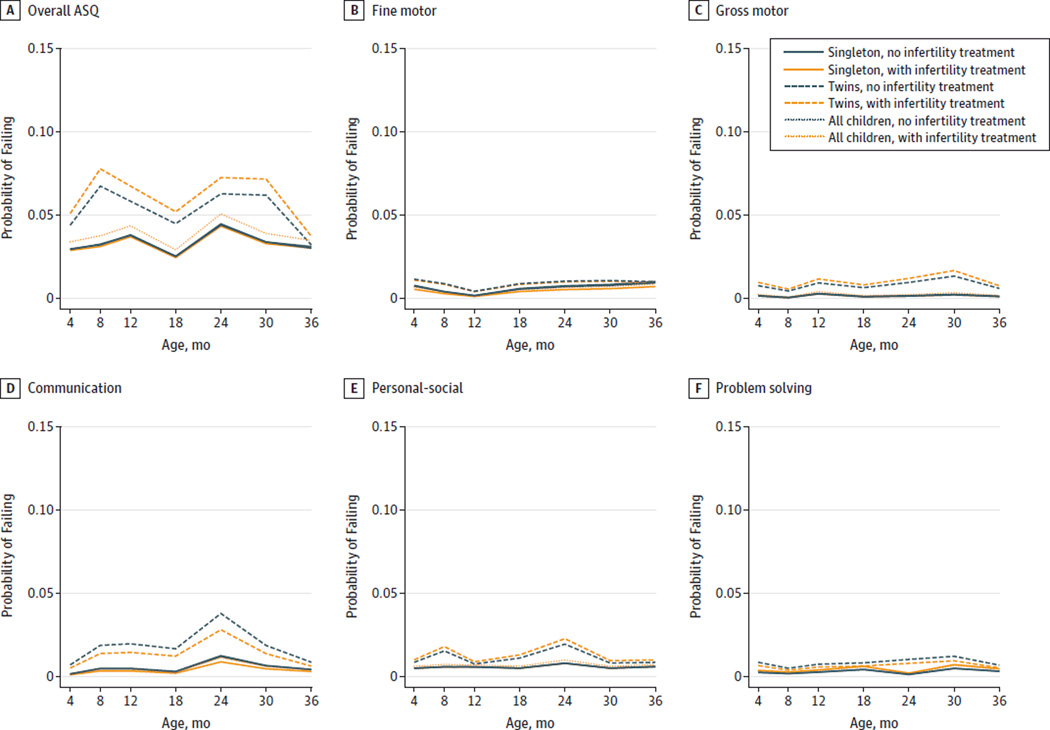
Five developmental domains (fine motor, gross motor, communication, personal-social functioning, and problem-solving ability), as measured by the parental completion of the Ages and Stages Questionnaires at 4, 8, 12, 18, 24, 30, and 36 months of age. Generalized linear mixed modeling techniques estimated adjusted odds ratios (aORs) and 95% CIs for use and type of infertility treatment in relation to failing a developmental domain. Data were stratified by plurality and weighted for the sampling scheme.
There were 1422 mothers (29.5%; mean [SD], age, 34.1 [5.2] years) who underwent infertility treatment. Infertility treatment was not associated with risk of their children failing any developmental domain (aOR, 1.33; 95% CI, 0.94-1.89). Assisted reproductive technology was associated with increased risk for failing any developmental domain but only when singletons and twins were evaluated together (aOR, 1.81; 95% CI, 1.21-2.72). Adjustment for birth weight further attenuated this estimate (aOR, 1.26; 95% CI, 0.82-1.93). After stratifying by plurality, type of treatment also was not significantly associated with failing any developmental domain for ovulation induction/intrauterine insemination (aOR, 1.00; 95% CI, 0.57-1.77 for singletons and aOR, 1.30; 95% CI, 0.76-2.21 for twins) or ART (aOR, 1.38; 95% CI, 0.78-2.43 for singletons and aOR, 1.58; 95% CI, 0.94-2.65 for twins).
After considering plurality, children's development through age 3 years was similar irrespective of infertility treatment or specific type. To our knowledge, these findings are among the first to focus on non-ART treatments in the United States.
通过辅助生殖技术(ART)及其他不孕治疗受孕的分娩比例日益增加。尽管有研究发现此类治疗可能与孕期缩短和出生体重降低有关,但在美国,关于不孕治疗与儿童发育的相关数据却很匮乏。
评估与36个月龄儿童发育相关的不孕治疗的使用情况及类型。
设计、背景和参与者:前瞻性队列研究(2008 - 2014年开展),根据不孕治疗情况和多胎情况进行抽样。研究纳入了2008年至2010年在纽约州(不包括纽约市)出生的婴儿,其父母完成了至36个月龄的发育筛查工具。共有4824名母亲(占4989名的97%)为5841名儿童完成了1项或多项发育筛查工具,其中包括1830名通过不孕治疗受孕的儿童和2074名双胞胎。
母亲自我报告的任何不孕治疗情况进一步分为ART和促排卵/宫内授精。辅助生殖技术的使用情况此前已通过与辅助生殖技术协会临床结果报告系统的关联进行了验证。
通过父母在儿童4、8、12、18、24、30和36个月龄时完成的《年龄与发育阶段问卷》来测量五个发育领域(精细运动、大运动、沟通、个人社交功能和解决问题能力)。广义线性混合模型技术估计了与发育领域未通过相关的不孕治疗使用情况及类型的调整比值比(aOR)和95%置信区间。数据按多胎情况分层,并根据抽样方案进行加权。
有1422名母亲(29.5%;平均[标准差]年龄为34.(5.2)岁)接受了不孕治疗。不孕治疗与她们的孩子在任何发育领域未通过的风险无关(aOR,1.33;95%置信区间,0.94 - 1.89)。辅助生殖技术与任何发育领域未通过的风险增加有关,但仅在将单胎和双胞胎一起评估时如此(aOR,1.81;95%置信区间,1.21 - 2.72)。对出生体重进行调整后,这一估计值进一步降低(aOR,1.26;95%置信区间,0.82 - 1.93)。按多胎情况分层后,促排卵/宫内授精(单胎的aOR,1.00;95%置信区间,0.57 - 1.77;双胞胎的aOR,1.30;95%置信区间,0.76 - 2.21)或ART(单胎的aOR,1.38;95%置信区间,0.78 - 2.43;双胞胎的aOR,1.58;95%置信区间,0.94 - 2.65)的治疗类型与任何发育领域未通过也均无显著关联。
在考虑多胎情况后,无论是否接受不孕治疗或具体治疗类型如何,3岁前儿童的发育情况相似。据我们所知,这些发现是美国首批关注非ART治疗的研究结果之一。