Dankoski Elyse C, Carroll Susan, Wightman Robert Mark
Curriculum in Neurobiology, University of North Carolina at Chapel Hill, Chapel Hill, North Carolina, USA.
Department of Chemistry, University of North Carolina at Chapel Hill, Chapel Hill, North Carolina, USA.
J Neurochem. 2016 Mar;136(6):1131-1141. doi: 10.1111/jnc.13528. Epub 2016 Jan 26.
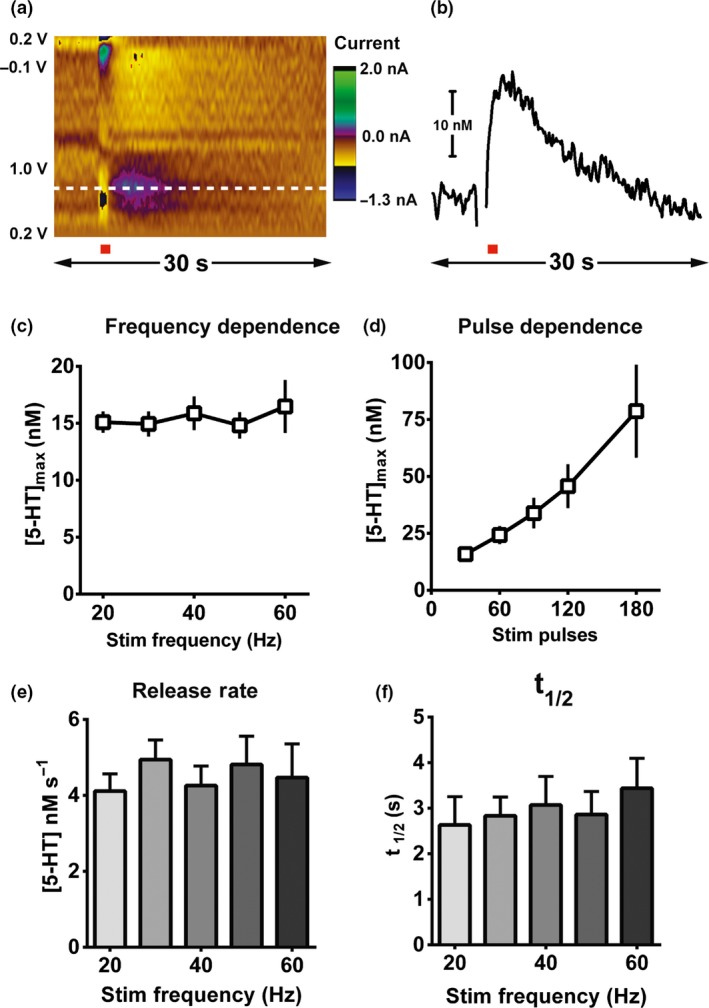
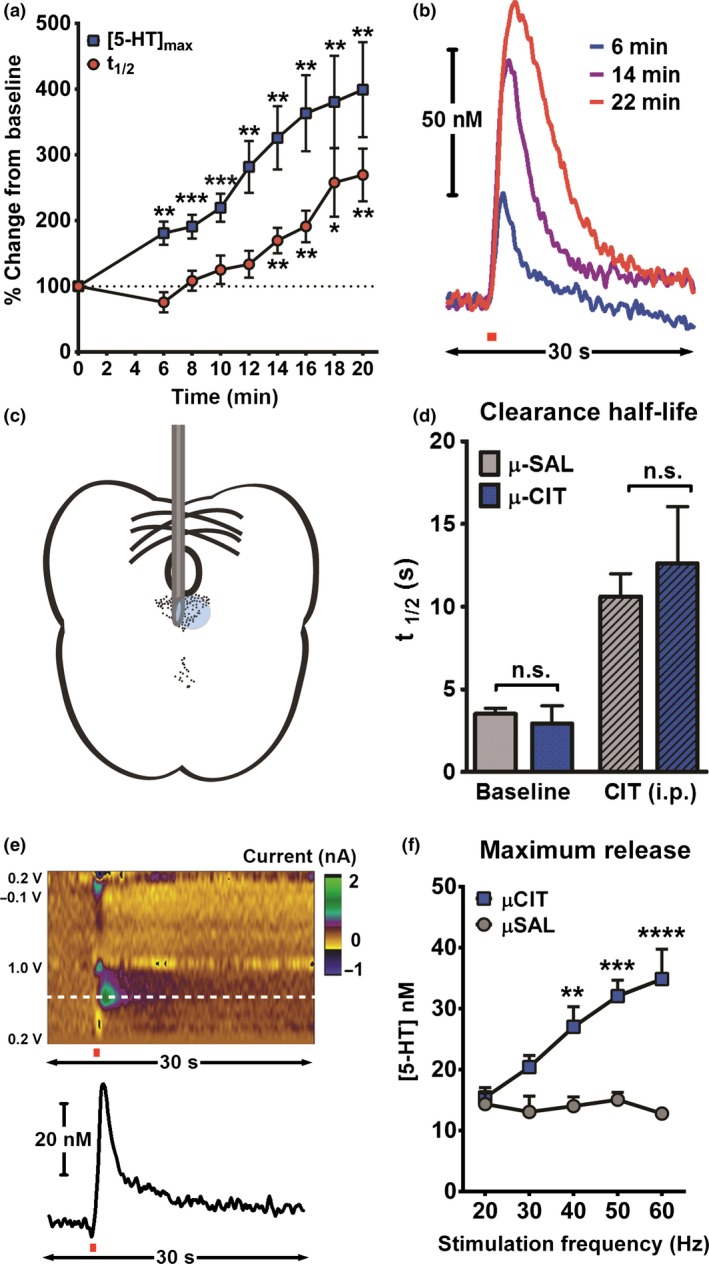
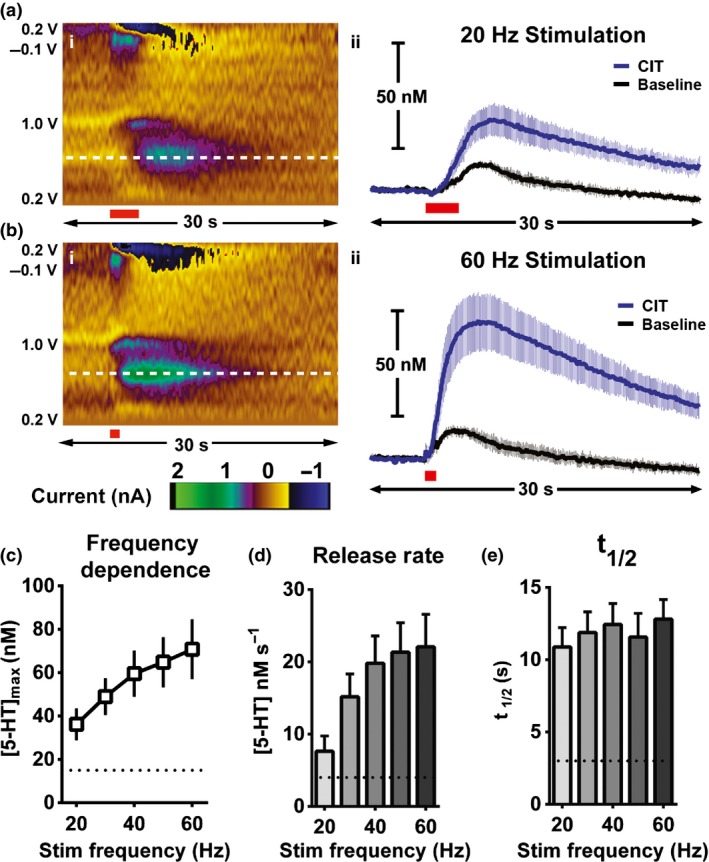
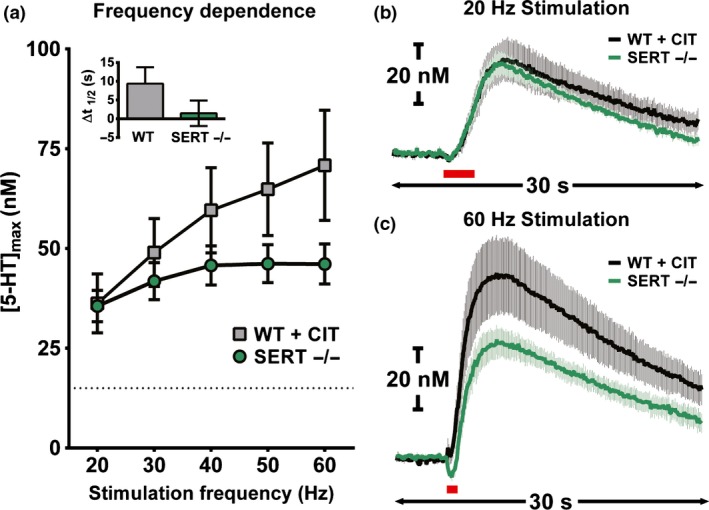
Selective serotonin reuptake inhibitors (SSRIs) were designed to treat depression by increasing serotonin levels throughout the brain via inhibition of clearance from the extracellular space. Although increases in serotonin levels are observed after acute SSRI exposure, 3-6 weeks of continuous use is required for relief from the symptoms of depression. Thus, it is now believed that plasticity in multiple brain systems that are downstream of serotonergic inputs contributes to the therapeutic efficacy of SSRIs. The onset of antidepressant effects also coincides with desensitization of somatodendritic serotonin autoreceptors in the dorsal raphe nucleus (DRN), suggesting that disrupting inhibitory feedback within the serotonin system may contribute to the therapeutic effects of SSRIs. Previously, we showed that chronic SSRI treatment caused a frequency-dependent facilitation of serotonin signaling that persisted in the absence of uptake inhibition. In this work, we use in vivo fast-scan cyclic voltammetry in mice to investigate a similar facilitation after a single treatment of the SSRI citalopram hydrobromide. Acute citalopram hydrobromide treatment resulted in frequency-dependent increases of evoked serotonin release in the substantia nigra pars reticulata. These increases were independent of changes in uptake velocity, but required SERT expression. Using microinjections, we show that the frequency-dependent enhancement in release is because of SERT inhibition in the DRN, demonstrating that SSRIs can enhance serotonin release by inhibiting uptake in a location distal to the terminal release site. The novel finding that SERT inhibition can disrupt modulatory mechanisms at the level of the DRN to facilitate serotonin release will help future studies investigate serotonin's role in depression and motivated behavior. In this work, stimulations of the dorsal raphe nucleus (DRN) evoke serotonin release that is recorded in the substantia nigra pars reticulata (SNpr) using in vivo fast-scan cyclic voltammetry. Systemic administration of a selective serotonin reuptake inhibitor (SSRI) causes both an increase in t and an increase in [5-HT] in the SNpr. Local application of SSRI to the DRN recapitulates the increase in [5-HT] observed in the SNpr without affecting uptake. Thus, SSRIs increase serotonin signaling via two distinct SERT-mediated mechanisms.
选择性5-羟色胺再摄取抑制剂(SSRIs)旨在通过抑制细胞外空间中的清除作用来提高全脑5-羟色胺水平,从而治疗抑郁症。虽然在急性暴露于SSRI后可观察到5-羟色胺水平升高,但缓解抑郁症状需要连续使用3至6周。因此,现在人们认为,5-羟色胺能输入下游的多个脑系统中的可塑性有助于SSRI的治疗效果。抗抑郁作用的起效也与中缝背核(DRN)中躯体树突状5-羟色胺自身受体的脱敏同时发生,这表明破坏5-羟色胺系统内的抑制性反馈可能有助于SSRI的治疗效果。此前,我们表明慢性SSRI治疗会导致5-羟色胺信号传导的频率依赖性促进,这种促进在不存在摄取抑制的情况下持续存在。在这项研究中,我们使用小鼠体内快速扫描循环伏安法来研究单次给予SSRI氢溴酸西酞普兰后的类似促进作用。急性氢溴酸西酞普兰治疗导致黑质网状部诱发的5-羟色胺释放呈频率依赖性增加。这些增加与摄取速度的变化无关,但需要5-羟色胺转运体(SERT)的表达。通过微量注射,我们表明释放的频率依赖性增强是由于DRN中的SERT抑制,这表明SSRI可以通过抑制终末释放部位远端的摄取来增强5-羟色胺释放。SERT抑制可破坏DRN水平的调节机制以促进5-羟色胺释放这一新发现将有助于未来研究探究5-羟色胺在抑郁症和动机行为中的作用。在这项研究中,使用体内快速扫描循环伏安法刺激中缝背核(DRN)诱发5-羟色胺释放,并在黑质网状部(SNpr)进行记录。全身给予选择性5-羟色胺再摄取抑制剂(SSRI)会导致SNpr中的t增加和[5-HT]增加。将SSRI局部应用于DRN可重现SNpr中观察到的[5-HT]增加,而不影响摄取。因此,SSRI通过两种不同的SERT介导机制增加5-羟色胺信号传导。