Chun Ji-Yeon, Jo Yeon-Ji, Min Sang-Gi, Hong Geun-Pyo
Department of Bioindustrial Technologies, Konkuk University, Seoul 143-701, Korea.
Korean J Food Sci Anim Resour. 2014;34(1):14-9. doi: 10.5851/kosfa.2014.34.1.14. Epub 2014 Feb 28.
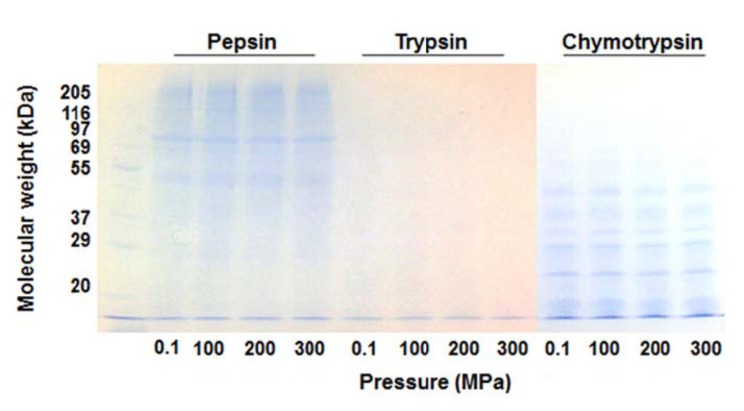
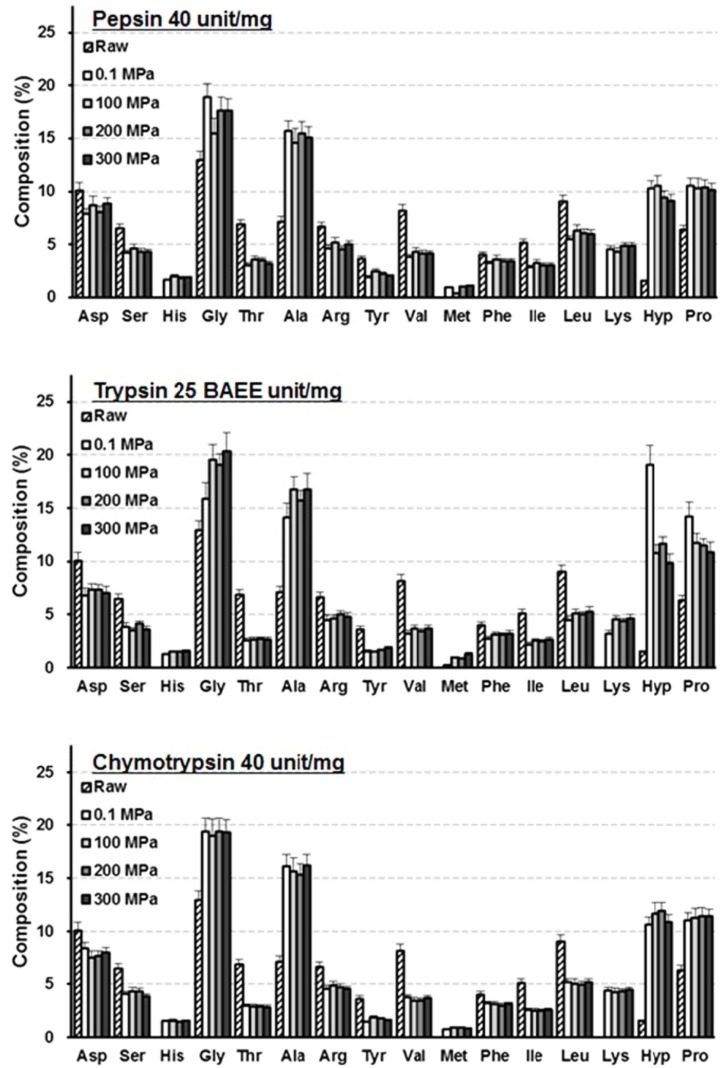
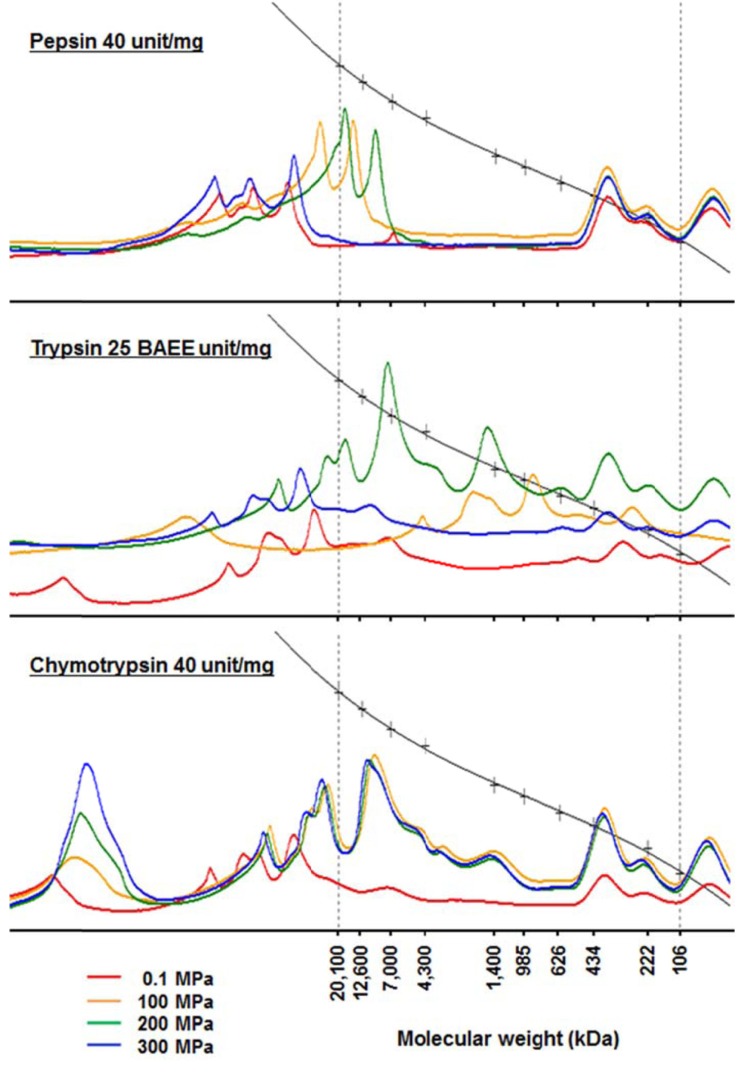
This study investigated the effects of protease treatments (trypsin, chymotrypsin, and pepsin) under various pressure levels (0.1-300 MPa) for the characteristics of porcine placenta hydrolysates. According to gel electrophoretic patterns, the trypsin showed the best placental hydrolyzing activity followed by chymotrypsin, regardless of the pressure levels. In particular, the peptide bands of tryptic-digested hydrolysate were not shown regardless of applied pressure levels. The peptide bands of hydrolysate treated chymotrypsin showed gradual decreases in molecular weights (M w) with increasing pressure levels. However, the pepsin did not show any evidences of placental hydrolysis even though the pressure levels were increased to 300 MPa. The gel permeation chromatography (GPC) profiles showed that the trypsin and pepsin had better placental hydrolyzing activities under high pressure (particularly at 200 MPa), with lower M w distributions of the hydrolysates. Pepsin also tend to lower the M w of peptides, while the major bands of hydrolysates being treated at 300 MPa were observed at more than 7,000 Da. There were some differences in amino acid compositions of the hydrolysates, nevertheless, the peptides were mainly composed of glycine (Gly), alanine (Ala), hydroxyproline (Hyp) and proline (Pro). Consequently, the results indicate that high pressure could enhance the placental hydrolyzing activities of the selected proteases and the optimum pressure levels at which the maximum protease activity is around 200 MPa.
本研究考察了在不同压力水平(0.1 - 300兆帕)下,蛋白酶处理(胰蛋白酶、糜蛋白酶和胃蛋白酶)对猪胎盘水解产物特性的影响。根据凝胶电泳图谱,无论压力水平如何,胰蛋白酶显示出最佳的胎盘水解活性,其次是糜蛋白酶。特别是,无论施加的压力水平如何,胰蛋白酶消化的水解产物均未显示出肽带。经糜蛋白酶处理的水解产物的肽带分子量(Mw)随压力水平升高而逐渐降低。然而,即使压力水平增加到300兆帕,胃蛋白酶也未显示出任何胎盘水解的迹象。凝胶渗透色谱(GPC)图谱表明,胰蛋白酶和胃蛋白酶在高压下(特别是在200兆帕)具有更好的胎盘水解活性,水解产物的Mw分布较低。胃蛋白酶也倾向于降低肽的Mw,而在300兆帕处理的水解产物的主要条带出现在7000道尔顿以上。水解产物的氨基酸组成存在一些差异,不过,肽主要由甘氨酸(Gly)、丙氨酸(Ala)、羟脯氨酸(Hyp)和脯氨酸(Pro)组成。因此,结果表明高压可以增强所选蛋白酶的胎盘水解活性,且最大蛋白酶活性的最佳压力水平约为200兆帕。