Bijkerk Roel, van der Pol Pieter, Khairoun Meriem, van Gijlswijk-Jansen Danielle J, Lievers Ellen, de Vries Aiko P J, de Koning Eelco J, de Fijter Hans W, Roelen Dave L, Vossen Rolf H A M, van Zonneveld Anton Jan, van Kooten Cees, Reinders Marlies E J
Department of Nephrology, Leiden University Medical Center, Albinusdreef 2, 2333 ZA, Leiden, the Netherlands.
Einthoven Laboratory for Experimental Vascular Medicine, Leiden University Medical Center, Leiden, the Netherlands.
Diabetologia. 2016 Apr;59(4):853-8. doi: 10.1007/s00125-015-3858-3. Epub 2016 Jan 15.
AIMS/HYPOTHESIS: High levels of circulating mannan-binding lectin (MBL) are associated with the development of diabetic nephropathy and hyperglycaemia-induced vasculopathy. Here, we aimed to assess the effect of glycaemic control on circulating levels of MBL and the relationship of these levels with vascular damage.
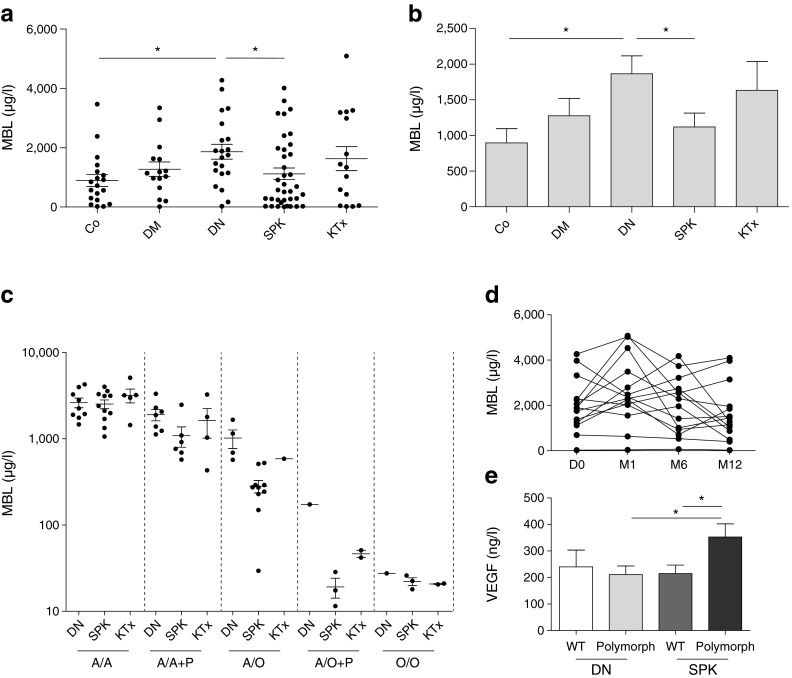
We assessed MBL levels and corresponding MBL2 genotype, together with vascular endothelial growth factor (VEGF) levels as a marker of vascular damage, in type 1 diabetes patients with diabetic nephropathy before and after simultaneous pancreas-kidney (SPK) transplantation. We included diabetic nephropathy patients (n = 21), SPK patients (n = 37), healthy controls (n = 19), type 1 diabetes patients (n = 15) and diabetic nephropathy patients receiving only a kidney transplant (n = 15). Fourteen diabetic nephropathy patients were followed up for 12 months after SPK.
We found elevated circulating MBL levels in diabetic nephropathy patients, and a trend towards elevated circulating MBL levels in type 1 diabetes patients, compared with healthy control individuals. MBL levels in SPK patients completely normalised and our data indicate that this predominantly occurs in patients with a polymorphism in the MBL2 gene. By contrast, MBL levels in kidney transplant only patients remained elevated, suggesting that glycaemic control but not reversal of renal failure is associated with decreased MBL levels. In line, levels of glucose and HbA1c, but not creatinine levels and estimated GFR, were correlated with MBL levels. VEGF levels were associated with levels of MBL and HbA1c in an MBL-polymorphism-dependent manner.
CONCLUSIONS/INTERPRETATION: Taken together, circulating MBL levels are associated with diabetic nephropathy and are dependent on glycaemic control, possibly in an MBL2-genotype-dependent manner.
目的/假设:循环中甘露聚糖结合凝集素(MBL)水平升高与糖尿病肾病及高血糖诱导的血管病变的发生有关。在此,我们旨在评估血糖控制对循环中MBL水平的影响以及这些水平与血管损伤的关系。
我们评估了1型糖尿病肾病患者在同期胰肾联合移植(SPK)前后的MBL水平及相应的MBL2基因型,同时评估了血管内皮生长因子(VEGF)水平作为血管损伤的标志物。我们纳入了糖尿病肾病患者(n = 21)、SPK患者(n = 37)、健康对照者(n = 19)、1型糖尿病患者(n = 15)以及仅接受肾移植的糖尿病肾病患者(n = 15)。14例糖尿病肾病患者在SPK后随访12个月。
我们发现,与健康对照个体相比,糖尿病肾病患者循环中MBL水平升高,1型糖尿病患者循环中MBL水平有升高趋势。SPK患者的MBL水平完全恢复正常,我们的数据表明这主要发生在MBL2基因存在多态性的患者中。相比之下,仅接受肾移植患者的MBL水平仍升高,提示血糖控制而非肾衰竭的逆转与MBL水平降低有关。同样,血糖和糖化血红蛋白水平而非肌酐水平及估算的肾小球滤过率与MBL水平相关。VEGF水平以MBL多态性依赖的方式与MBL水平及糖化血红蛋白水平相关。
结论/解读:综上所述,循环中MBL水平与糖尿病肾病相关,且可能以MBL2基因型依赖的方式依赖于血糖控制