van Gelder C M, Poelman E, Plug I, Hoogeveen-Westerveld M, van der Beek N A M E, Reuser A J J, van der Ploeg A T
Department of Pediatrics, Division of Metabolic Diseases and Genetics, Center for Lysosomal and Metabolic Diseases, Erasmus MC University Medical Center, Dr Molewaterplein 60, 3015 GJ, Rotterdam, The Netherlands.
Department of Clinical Genetics, Center for Lysosomal and Metabolic Diseases, Erasmus MC University Medical Center, Rotterdam, The Netherlands.
J Inherit Metab Dis. 2016 May;39(3):383-390. doi: 10.1007/s10545-015-9912-y. Epub 2016 Jan 14.
Though enzyme-replacement therapy (ERT) with alglucosidase alfa has significantly improved the prospects for patients with classic infantile Pompe disease, some 50 % of treated infants do not survive ventilator-free beyond the age of 3 years. We investigated whether higher and more frequent dosing of alglucosidase alfa improves outcome.
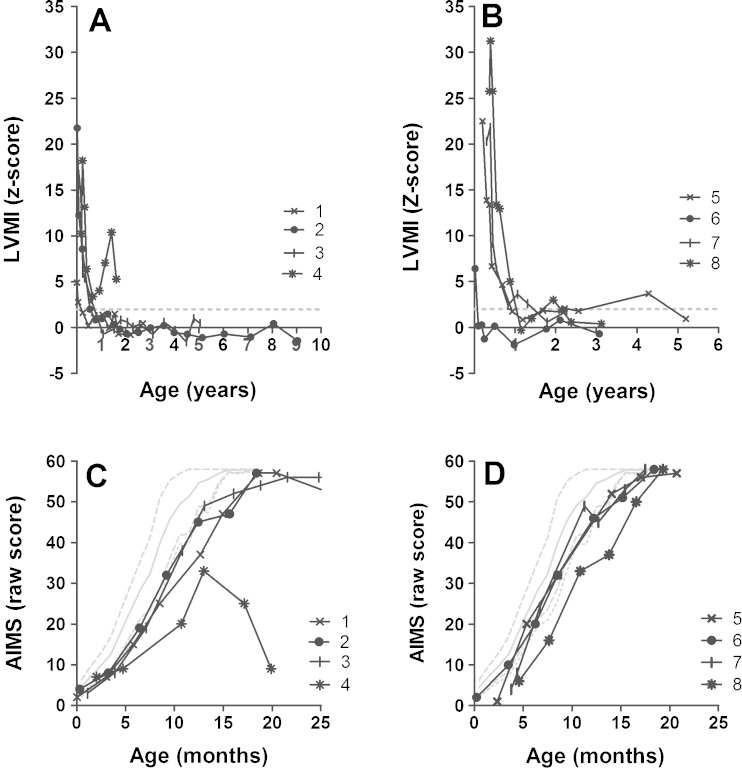
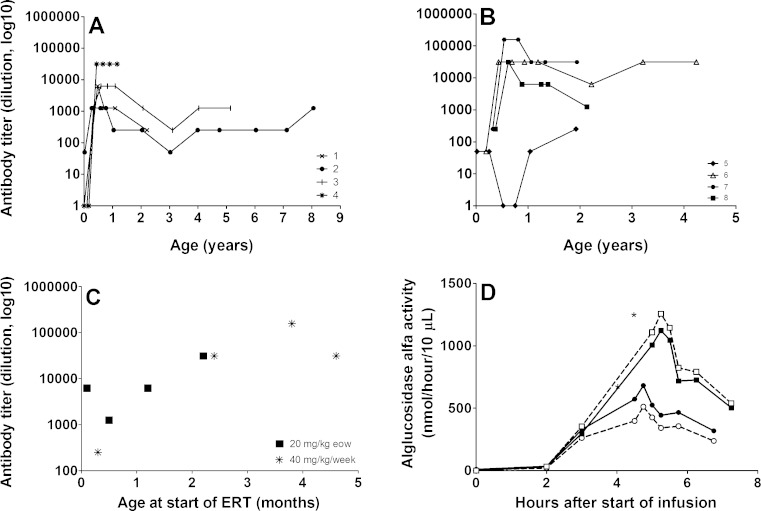
Eight cross-reactive immunological material (CRIM) positive patients were included in the study. All had fully deleterious mutations in both GAA alleles. Four received a dose of 20 mg/kg every other week (eow) and four received 40 mg/kg/week. Survival, ventilator-free survival, left-ventricular mass index (LVMI), motor outcome, infusion-associated reactions (IARs), and antibody formation were evaluated.
All eight patients were alive at study end, seven of them remained ventilator-free. The patient who became ventilator dependent was treated with 20 mg/kg eow. Three of the four patients receiving 20 mg/kg eow learned to walk; two of them maintained this ability at study end. All four patients receiving 40 mg/kg/week acquired and maintained the ability to walk at study end (ages of 3.3-5.6 years), even though their baseline motor functioning was poorer. There were no apparent differences between the two dose groups with respect to the effect of ERT on LVMI, the number of IARs and antibody formation.
Our data may suggest that a dose of 40 mg/kg/week improves outcome of CRIM positive patients over that brought by the currently recommended dose of 20 mg/kg eow. Larger studies are needed to draw definite conclusions.
尽管用阿糖苷酶α进行酶替代疗法(ERT)已显著改善了经典型婴儿庞贝病患者的预后,但约50%接受治疗的婴儿在3岁后无法脱离呼吸机存活。我们研究了更高剂量和更频繁给药的阿糖苷酶α是否能改善预后。
8名交叉反应免疫物质(CRIM)阳性患者纳入本研究。所有患者的两个GAA等位基因均有完全有害突变。4名患者每隔一周接受20mg/kg的剂量,另外4名患者接受40mg/kg/周的剂量。评估了生存率、无呼吸机生存率、左心室质量指数(LVMI)、运动结局、输液相关反应(IARs)和抗体形成情况。
研究结束时,所有8名患者均存活,其中7名仍未使用呼吸机。依赖呼吸机的患者接受的是20mg/kg每隔一周的治疗方案。接受20mg/kg每隔一周治疗方案的4名患者中有3名学会了走路;其中2名在研究结束时仍保持这一能力。接受40mg/kg/周治疗方案的所有4名患者在研究结束时(年龄为3.3 - 5.6岁)均获得并保持了行走能力,尽管他们的基线运动功能较差。在ERT对LVMI的影响、IARs数量和抗体形成方面,两个剂量组之间没有明显差异。
我们的数据可能表明,40mg/kg/周的剂量比目前推荐的20mg/kg每隔一周的剂量能改善CRIM阳性患者的预后。需要更大规模的研究才能得出明确结论。