Senft Asaf, Hoekstra Otto S, Castelijns Jonas A, Leemans C René, de Bree Remco
Department of Otolaryngology-Head and Neck Surgery, VU University Medical Center, Amsterdam, The Netherlands.
Department of Radiology and Nuclear Medicine, VU University Medical Center, Amsterdam, The Netherlands.
Eur Arch Otorhinolaryngol. 2016 Oct;273(10):3287-91. doi: 10.1007/s00405-016-3897-5. Epub 2016 Jan 14.
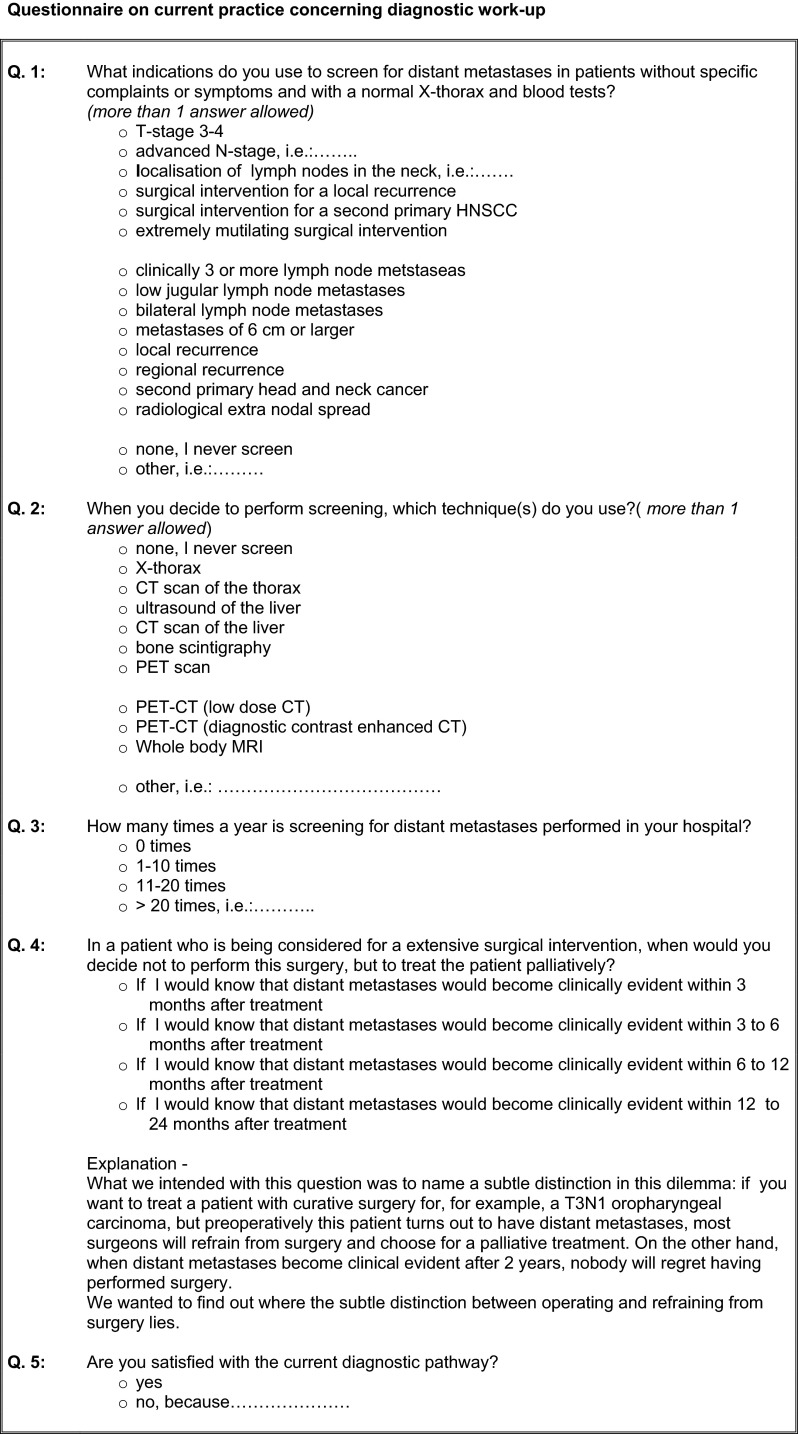
To evaluate the current practice and change in practice concerning screening for distant metastases in head and neck squamous cell carcinoma patients, we performed a survey with the same questionnaire as 10 years ago among the eight centers of the Dutch Head and Neck Society treating head and neck cancer in The Netherlands. Factors related to extensive lymph node metastases are the most frequent indication for screening for distant metastases. The combinations of whole body PET-CT and contrast-enhanced chest CT are nowadays the diagnostic techniques for routinely screening for distant metastases. Screening for distant metastases is performed more frequently than 10 years ago. Although the sensitivity of the diagnostic pathway needs to be improved, most centers are satisfied with the current diagnostic pathway. A reduction of variation in indications and diagnostic techniques used for screening for distant metastases is observed during the last 10 years. In future guidelines patients' selection and diagnostic tests need to be specified in more detail.
为评估目前头颈部鳞状细胞癌患者远处转移筛查的实践情况及实践变化,我们在荷兰头颈部协会治疗头颈癌的八个荷兰中心,使用与10年前相同的问卷进行了一项调查。与广泛淋巴结转移相关的因素是远处转移筛查最常见的指征。如今,全身PET-CT和增强胸部CT联合是常规筛查远处转移的诊断技术。远处转移筛查比10年前更频繁。尽管诊断途径的敏感性有待提高,但大多数中心对目前的诊断途径感到满意。在过去10年中,观察到用于远处转移筛查的指征和诊断技术的差异有所减少。在未来的指南中,需要更详细地规定患者选择和诊断测试。