Department of Orthopaedic Surgery, Tissue Engineering Group, Faculty of Medicine, University of Malaya, Kuala Lumpur 50603, Malaysia.
Institute of Biological Sciences, Faculty of Science, University of Malaysia, Kuala Lumpur 50603, Malaysia.
Cell Death Dis. 2016 Jan 14;7(1):e2058. doi: 10.1038/cddis.2015.275.
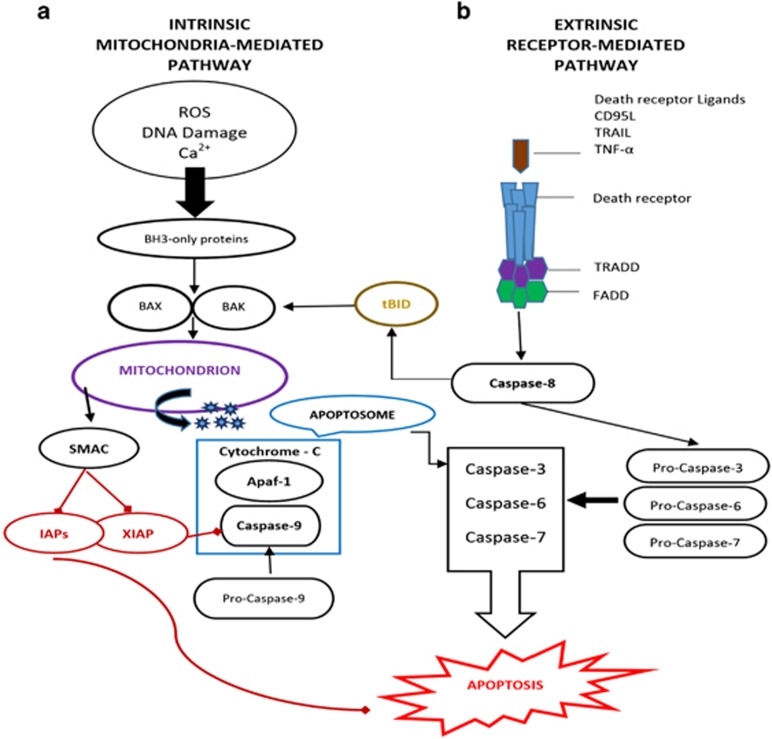
Underneath the intricacy of every cancer lies mysterious events that impel the tumour cell and its posterity into abnormal growth and tissue invasion. Oncogenic mutations disturb the regulatory circuits responsible for the governance of versatile cellular functions, permitting tumour cells to endure deregulated proliferation, resist to proapoptotic insults, invade and erode normal tissues and above all escape apoptosis. This disruption of apoptosis has been highly implicated in various malignancies and has been exploited as an anticancer strategy. Owing to the fact that apoptosis causes minimal inflammation and damage to the tissue, apoptotic cell death-based therapy has been the centre of attraction for the development of anticancer drugs. Increased understanding of the molecular pathways underlying apoptosis has enabled scientists to establish unique approaches targeting apoptosis pathways in cancer therapeutics. In this review, we reconnoitre the two major pathways (intrinsic and extrinsic) targeted cancer therapeutics, steering toward chief modulators of these pathways, such as B-cell lymphoma 2 protein family members (pro- and antiapoptotic), inhibitor of apoptosis proteins, and the foremost thespian of extrinsic pathway regulator, tumour necrosis factor-related apoptosis-inducing agent. Together, we also will have a look from clinical perspective to address the agents (drugs) and therapeutic strategies adopted to target these specific proteins/pathways that have entered clinical trials.
在每一种癌症的复杂性之下,都存在着促使肿瘤细胞及其后代异常生长和组织侵袭的神秘事件。致癌突变扰乱了负责管理多样化细胞功能的调节回路,使肿瘤细胞能够忍受不受调节的增殖、抵抗促凋亡的损伤、侵袭和侵蚀正常组织,最重要的是逃避凋亡。这种凋亡的中断与各种恶性肿瘤高度相关,并被用作抗癌策略。由于凋亡对组织造成的炎症和损伤最小,基于凋亡细胞死亡的治疗已成为开发抗癌药物的焦点。对凋亡分子途径的深入了解使科学家能够建立针对癌症治疗中凋亡途径的独特方法。在这篇综述中,我们探讨了靶向癌症治疗的两种主要途径(内在和外在),并针对这些途径的主要调节剂,如 B 细胞淋巴瘤 2 蛋白家族成员(促凋亡和抗凋亡)、凋亡抑制蛋白,以及外在途径调节剂的主要演员,肿瘤坏死因子相关凋亡诱导剂。我们还将从临床角度来看待已进入临床试验的针对这些特定蛋白/途径的药物和治疗策略。