Howe George W, Beach Steven R H, Brody Gene H, Wyman Peter A
Department of Psychology, George Washington University Washington, DC, USA.
Center for Family Research, University of Georgia Athens, GA, USA.
Front Psychol. 2016 Jan 7;6:1911. doi: 10.3389/fpsyg.2015.01911. eCollection 2015.
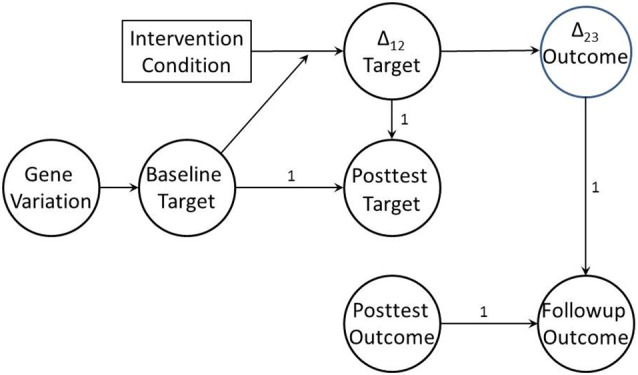
In this paper we present and discuss a novel research approach, the baseline target moderated mediation (BTMM) design, that holds substantial promise for advancing our understanding of how genetic research can inform prevention research. We first discuss how genetically informed research on developmental psychopathology can be used to identify potential intervention targets. We then describe the BTMM design, which employs moderated mediation within a longitudinal study to test whether baseline levels of intervention targets moderate the impact of the intervention on change in that target, and whether change in those targets mediates causal impact of preventive or treatment interventions on distal health outcomes. We next discuss how genetically informed BTMM designs can be applied to both microtrials and full-scale prevention trials. We use simulated data to illustrate a BTMM, and end with a discussion of some of the advantages and limitations of this approach.
在本文中,我们提出并讨论了一种新颖的研究方法——基线目标调节中介(BTMM)设计,该设计在推进我们对基因研究如何为预防研究提供信息的理解方面具有巨大潜力。我们首先讨论了关于发展性精神病理学的基因信息研究如何用于识别潜在的干预目标。然后我们描述了BTMM设计,该设计在纵向研究中采用调节中介来测试干预目标的基线水平是否调节干预对该目标变化的影响,以及这些目标的变化是否介导预防或治疗干预对远端健康结果的因果影响。接下来,我们讨论了基因信息BTMM设计如何应用于微型试验和全面预防试验。我们使用模拟数据来说明一个BTMM,并最后讨论这种方法的一些优点和局限性。