Augusteyn Robert C, Maceo Heilman Bianca, Ho Arthur, Parel Jean-Marie
Vision Cooperative Research Centre, Sydney, Australia 2School of Optometry and Vision Science, University of New South Wales, Sydney, Australia 3Ophthalmic Biophysics Center, Bascom Palmer Eye Institute, University of Miami Miller School of Medicine, Miam.
Ophthalmic Biophysics Center, Bascom Palmer Eye Institute, University of Miami Miller School of Medicine, Miami, Florida, United States 4Department of Biomedical Engineering, University of Miami College of Engineering, Coral Gables, Florida, United States.
Invest Ophthalmol Vis Sci. 2016 Jan 1;57(1):105-14. doi: 10.1167/iovs.15-18169.
To examine ocular growth in nonhuman primates (NHPs) from measurements on ex vivo eyes.
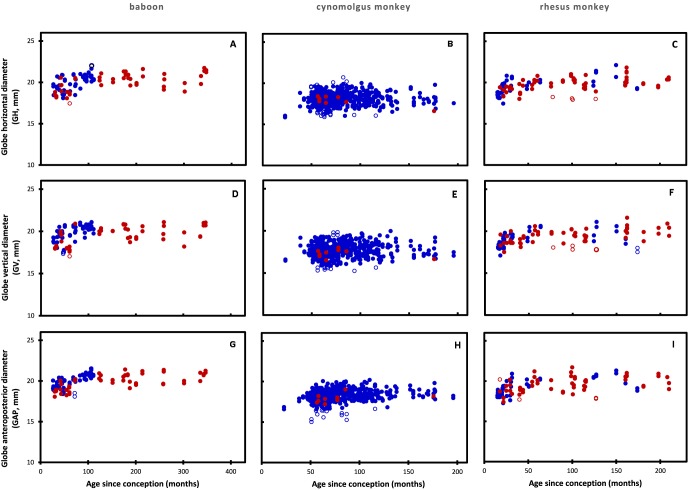
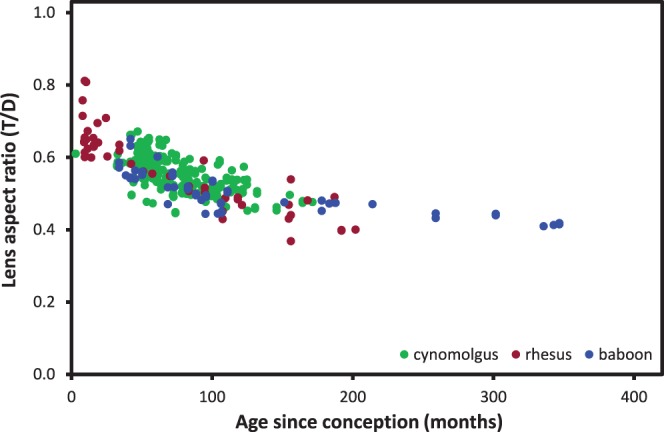
We obtained NHP eyes from animals that had been killed as part of other studies or because of health-related issues. Digital calipers were used to measure the horizontal, vertical, and anteroposterior globe diameters as well as corneal horizontal and vertical diameters of excised globes from 98 hamadryas baboons, 551 cynomolgus monkeys, and 112 rhesus monkeys, at ages ranging from 23 to 360 months. Isolated lens sagittal thickness and equatorial diameter were measured by shadowphotogrammetry. Wet and fixed dry weights were obtained for lenses.
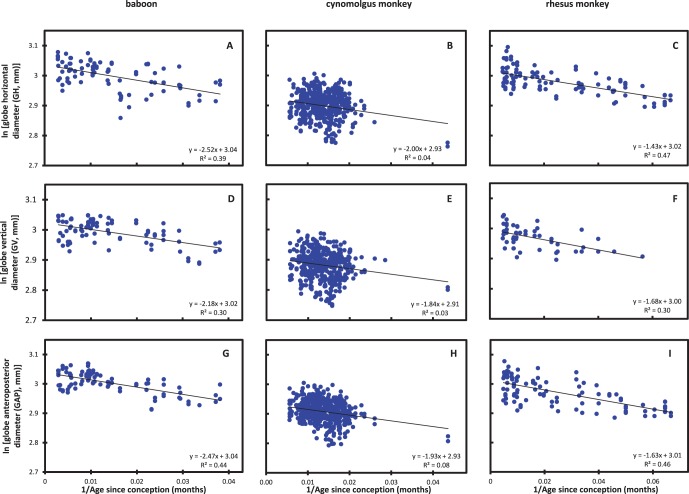
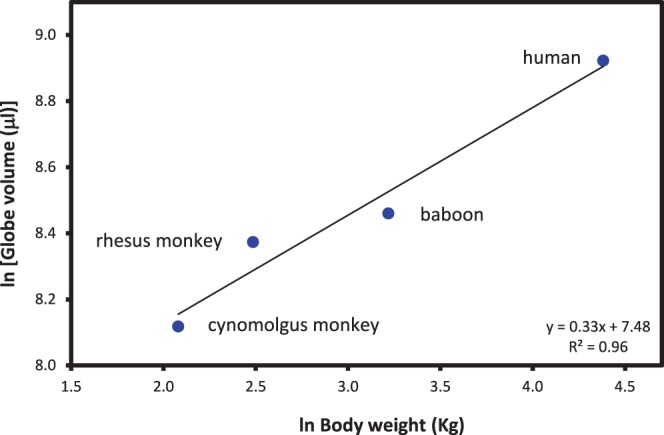
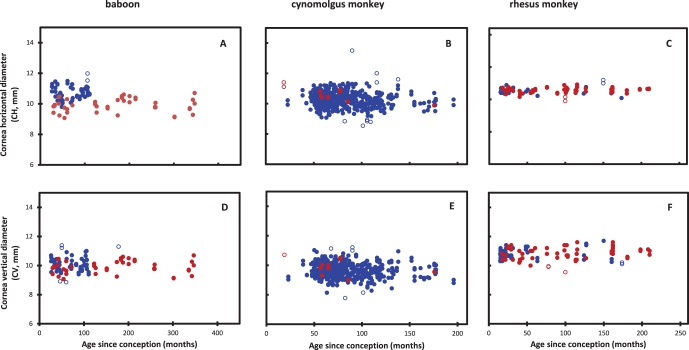
Nonhuman primate globe growth continues throughout life, slowing toward an asymptotic maximum. The final globe size scales with negative allometry to adult body size. Corneal growth ceases at around 20 months. Lens diameter increases but thickness decreases with increasing age. Nonhuman primate lens wet and dry weight accumulation is monophasic, continuing throughout life toward asymptotic maxima. The dry/wet weight ratio reaches a maximum of 0.33.
Nonhuman primate ocular globe and lens growth differ in several respects from those in humans. Although age-related losses of lens power and accommodative amplitude are similar, lens growth and properties are different indicating care should be taken in extrapolating NHP observations to the study of human accommodation.
通过对离体眼睛的测量来研究非人灵长类动物(NHPs)的眼球生长情况。
我们从作为其他研究一部分而被处死或因健康相关问题而死亡的动物身上获取NHPs的眼睛。使用数字卡尺测量了98只阿拉伯狒狒、551只食蟹猴和112只恒河猴在23至360个月龄时切除眼球的水平、垂直和前后径以及角膜水平和垂直径。通过阴影摄影测量分离晶状体的矢状厚度和赤道直径。获取晶状体的湿重和固定干重。
非人灵长类动物的眼球生长在整个生命过程中持续进行,朝着渐近最大值减缓。最终眼球大小与成年体型呈负异速生长比例。角膜生长在大约20个月时停止。晶状体直径随年龄增加而增大,但厚度减小。非人灵长类动物晶状体的湿重和干重积累是单相的,在整个生命过程中朝着渐近最大值持续增加。干重/湿重比最高达到0.33。
非人灵长类动物的眼球和晶状体生长在几个方面与人类不同。尽管与年龄相关的晶状体屈光力和调节幅度的丧失相似,但晶状体生长和特性不同,这表明在将NHPs的观察结果外推至人类调节研究时应谨慎。