McDonnold Mollie, Mele Lisa M, Myatt Leslie, Hauth John C, Leveno Kenneth J, Reddy Uma M, Mercer Brian M
Department of Obstetrics and Gynecology, University of Texas Medical Center, Galveston, Texas.
Biostatistics Center, The George Washington University, Washington, District of Columbia.
Am J Perinatol. 2016 May;33(6):618-24. doi: 10.1055/s-0035-1569986. Epub 2016 Jan 20.
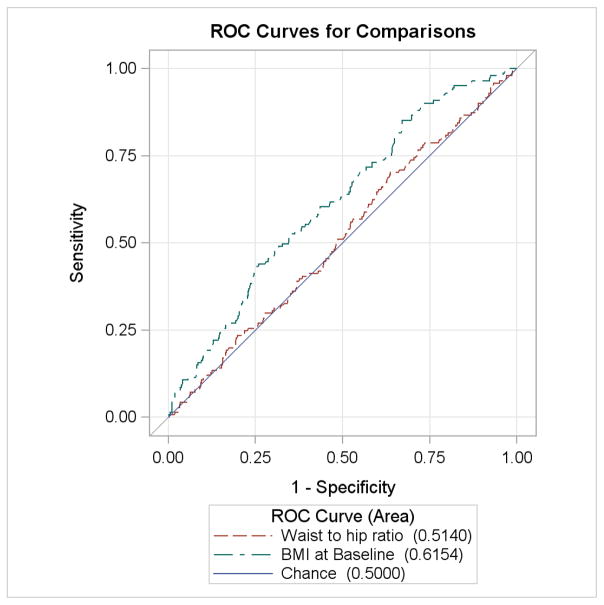
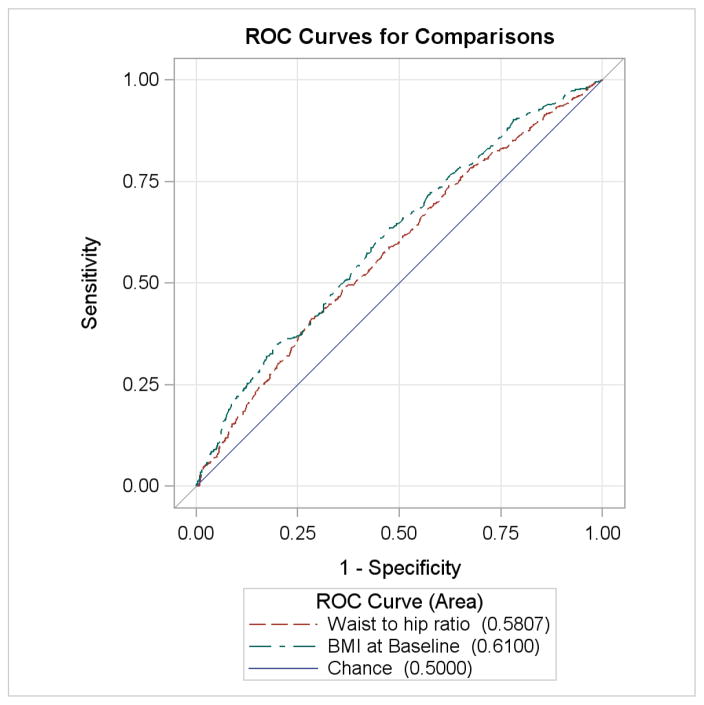
Objective In nonpregnant populations the waist-to-hip ratio (WHR) is a better predictor of obesity-related outcomes than body mass index (BMI). Our objective was to determine, in pregnancy, the relationship between these measures of obesity, and large-for-gestational age (LGA) and cesarean delivery (CD). Methods This is a secondary analysis of data from the Combined Antioxidant and Preeclampsia Prediction Study. Women with a WHR of ≥ 0.85 and 0.80 to 0.84 at 9 to 16 weeks gestation were compared with those with a WHR < 0.80. Women with early pregnancy BMI ≥ 30.0 kg/m(2) (obese) and 25.0 to 29.9 kg/m(2) (overweight) were compared with those < 25.0 kg/m(2). LGA was defined as > 90% by Alexander nomogram. Univariable analysis, logistic regression, and receiver operating characteristic curves were used. Results Data from 2,276 women were analyzed. After correcting for potential confounders, only BMI ≥ 30 was significantly associated with LGA (adjusted odds ratio [aOR]: 2.07, 1.35-3.16) while BMI 25.0-29.9 (aOR: 1.5, 0.98-2.28), WHR 0.8-0.84 (aOR: 1.33, 0.83-2.13), and WHR ≥ 0.85 (aOR: 1.05, 0.67-1.65) were not. Risk for CD was increased for women with elevated WHR and with higher BMI compared with normal. Conclusion WHR is not associated with LGA. While BMI performed better than WHR, neither was a strong predictor of LGA or need for CD in low-risk nulliparous women.
在非孕人群中,腰臀比(WHR)比体重指数(BMI)能更好地预测肥胖相关结局。我们的目的是确定孕期这些肥胖指标与大于胎龄儿(LGA)及剖宫产(CD)之间的关系。方法:这是对联合抗氧化剂与子痫前期预测研究数据的二次分析。将妊娠9至16周时WHR≥0.85及0.80至0.84的女性与WHR<0.80的女性进行比较。将孕早期BMI≥30.0kg/m²(肥胖)及25.0至29.9kg/m²(超重)的女性与BMI<25.0kg/m²的女性进行比较。LGA根据亚历山大胎儿发育曲线定义为>90%。采用单变量分析、逻辑回归及受试者工作特征曲线进行分析。结果:分析了2276名女性的数据。校正潜在混杂因素后,仅BMI≥30与LGA显著相关(校正比值比[aOR]:2.07,1.35 - 3.16),而BMI 25.0 - 29.9(aOR:1.5,0.98 - 2.28)、WHR 0.8 - 0.84(aOR:1.33,0.83 - 2.13)及WHR≥0.85(aOR:1.05,0.67 - 1.65)则无此关联。与正常情况相比,WHR升高及BMI较高的女性剖宫产风险增加。结论:WHR与LGA无关。虽然BMI比WHR表现更好,但在低风险初产妇中,两者都不是LGA或剖宫产需求的强预测指标。