Gao Xiao, Yan Yan, Xiang Shiting, Zeng Guangyu, Liu Shiping, Sha Tingting, He Qiong, Li Hongyan, Tan Shan, Chen Cheng, Li Ling, Yan Qiang
Department of Epidemiology and Health Statistics, Xiangya School of Public Health, Central South University, Changsha, Hunan Province, China.
Department of Maternal and Child Health, Kaifu District Health Bureau, Changsha, China.
PLoS One. 2017 Jun 2;12(6):e0177418. doi: 10.1371/journal.pone.0177418. eCollection 2017.
The aim of this study was to examine the mutual effect of pre-pregnancy body mass index (BMI), waist circumference (WC) and gestational weight gain (GWG) on obesity-related adverse pregnancy outcomes.
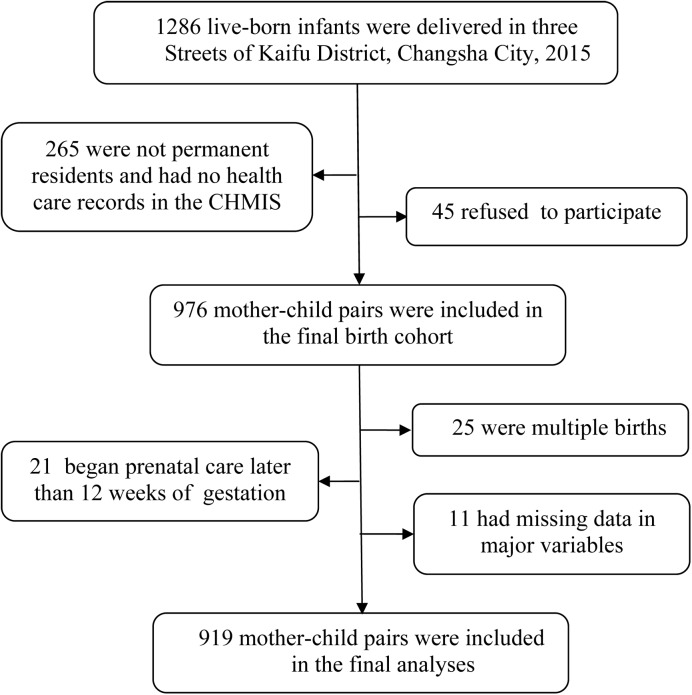
This birth cohort study was conducted in three Streets in Changsha, China, including a total of 976 mother-child pairs. All data was collected within 15 days after deliveries from a self-administered questionnaire, maternal health manual and perinatal health care information system. Multivariate logistic regression models were conducted to estimate the effects of maternal pre-pregnancy BMI, WC and GWG on obesity-related adverse pregnancy outcomes including gestational diabetes mellitus (GDM), primary cesarean section (P-CS), large for gestational age (LGA) and composite outcome (one or more adverse pregnancy outcomes).
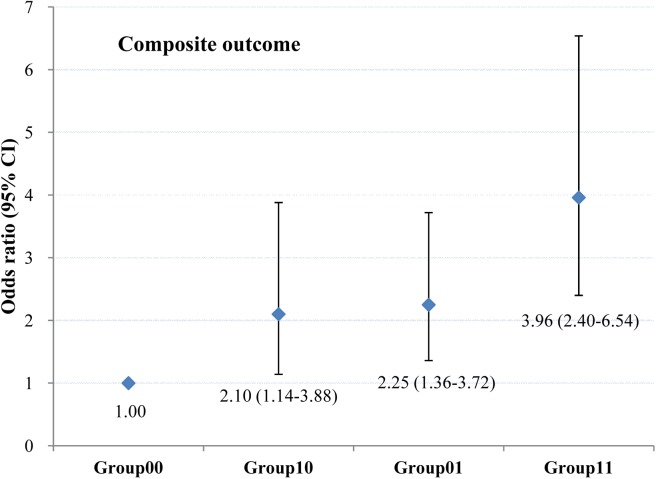
After controlling for all confounders, both maternal pre-pregnancy overweight/obesity and central adiposity contributed to increased risks of GDM [ORs 95% CIs = 2.19 (1.02-4.76) and 2.26 (1.11-4.60), respectively], P-CS [ORs 95% CIs = 1.66 (1.05-2.65) and 1.71 (1.11-2.63), respectively], LGA [ORs 95% CIs = 1.93 (1.07-3.50) and 2.14 (1.21-3.75), respectively] and composite outcome [ORs 95% CIs = 1.82 (1.15-2.87) and 1.98 (1.30-3.01), respectively] compared with mothers with normal pre-pregnancy weight and normal WC. Excessive GWG was found to be associated with an increased risk of LGA [OR 95% CI = 1.74 (1.05-2.89)], but was not significantly related to higher risks of GDM, P-CS and composite outcome [ORs 95% CIs = 0.90 (0.47-1.72), 1.08 (0.77-1.52), and 1.30 (0.94-1.79), respectively]. In terms of the joint effect of maternal pregestational BMI and WC on obesity-related composite outcome, mothers with both pre-pregnancy overweight and central adiposity had the highest risk of composite outcome [OR 95% CI = 3.96 (2.40-6.54)], compared with mothers without pre-pregnancy overweight or central adiposity.
The results of this study suggest that maternal pre-pregnancy overweight/obesity and central adiposity may contribute to multiple obesity-related adverse pregnancy outcomes, excessive weight gain during pregnancy is associated with an increased risk of LGA. Healthcare providers should carry out health education, and guide women to keep an ideal BMI and WC prior to pregnancy and help them gain optimal weight during pregnancy based on their pre-pregnancy BMI and WC.
本研究旨在探讨孕前体重指数(BMI)、腰围(WC)和孕期体重增加(GWG)对肥胖相关不良妊娠结局的相互影响。
本出生队列研究在中国长沙的三个街道进行,共纳入976对母婴。所有数据均在产后15天内通过自填问卷、孕产妇健康手册和围产期保健信息系统收集。采用多因素logistic回归模型评估孕产妇孕前BMI、WC和GWG对肥胖相关不良妊娠结局的影响,包括妊娠期糖尿病(GDM)、初次剖宫产(P-CS)、大于胎龄儿(LGA)和复合结局(一种或多种不良妊娠结局)。
在控制所有混杂因素后,与孕前体重正常且WC正常的母亲相比,孕产妇孕前超重/肥胖和中心性肥胖均增加了GDM [比值比(OR)95%可信区间(CI)分别为2.19(1.02 - 4.76)和2.26(1.11 - 4.60)]、P-CS [OR 95% CI分别为1.66(1.05 - 2.65)和1.71(1.11 - 2.63)]、LGA [OR 95% CI分别为1.93(1.07 - 3.50)和2.14(1.21 - 3.75)]和复合结局[OR 95% CI分别为1.82(1.15 - 2.87)和1.98(1.30 - 3.01)]的风险。发现孕期体重过度增加与LGA风险增加相关[OR 95% CI = 1.74(1.05 - 2.89)],但与GDM、P-CS和复合结局风险升高无显著相关性[OR 95% CI分别为0.90(0.47 - 1.72)、1.08(0.77 - 1.52)和1.30(0.94 - 1.79)]。就孕产妇孕前BMI和WC对肥胖相关复合结局的联合影响而言,与无孕前超重或中心性肥胖的母亲相比,孕前超重且有中心性肥胖的母亲复合结局风险最高[OR 95% CI = 3.96(2.40 - 6.54)]。
本研究结果表明,孕产妇孕前超重/肥胖和中心性肥胖可能导致多种肥胖相关不良妊娠结局,孕期体重过度增加与LGA风险增加相关。医疗保健提供者应开展健康教育,指导女性在孕前保持理想的BMI和WC,并根据其孕前BMI和WC帮助她们在孕期获得最佳体重。