Zhao Mei-Jun, Song Yan-Feng, Niu Hai-Tao, Tian Ying-Xia, Yang Xu-Guang, Xie Kun, Jing Yu-Hong, Wang De-Gui
Department of Anatomy and Histology, School of Basic Medical Sciences, Lanzhou University, Lanzhou, China.
Department of Urology, Affiliated Hospital of Qingdao University, Qingdao, China.
Oncotarget. 2016 Feb 23;7(8):8956-67. doi: 10.18632/oncotarget.6909.
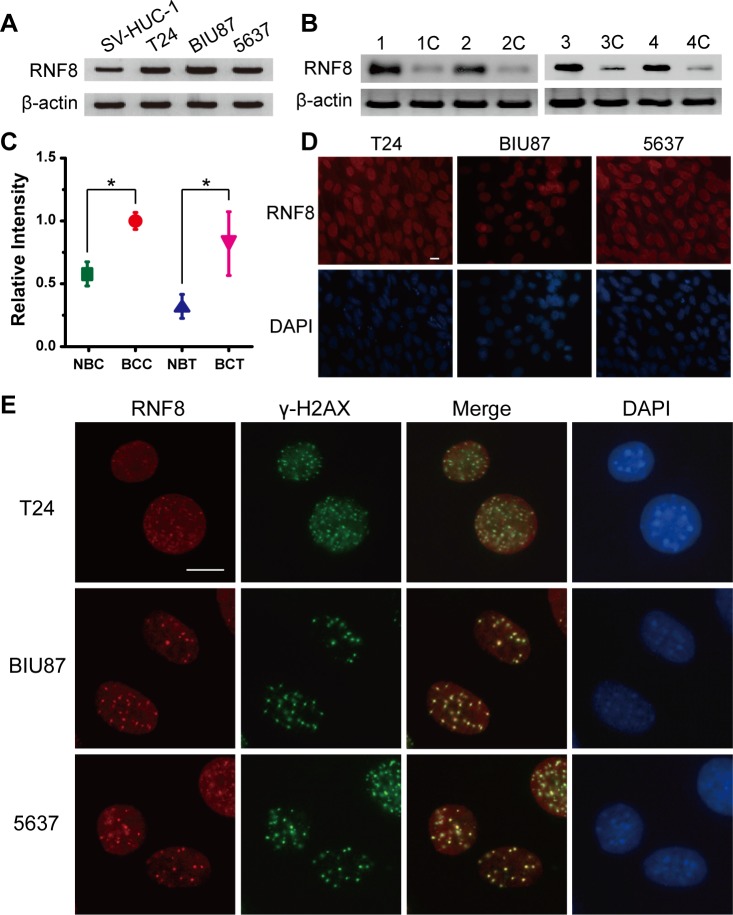
The ubiquitin ligase RNF8 promotes the DNA damage response (DDR). We observed that the expression of RNF8 was increased in bladder cancer cells and that this change in RNF8 expression could be reversed by adenovirus-mediated shRNA treatment. Moreover, we found that RNF8 knockdown sensitized bladder cancer cells to radiotherapy, as demonstrated by reduced cell survival. Additionally, the absence of RNF8 induced a high rate of apoptosis and impaired double-strand break repair signaling after radiotherapy. Furthermore, experiments on nude mice showed that combining shRNF8 treatment with radiotherapy suppressed implanted bladder tumor growth and enhanced apoptotic cell death in vivo. Altogether, our results indicated that RNF8 might be a novel target for bladder cancer treatment.
泛素连接酶RNF8促进DNA损伤反应(DDR)。我们观察到RNF8在膀胱癌细胞中的表达增加,并且这种RNF8表达的变化可通过腺病毒介导的shRNA处理逆转。此外,我们发现敲低RNF8使膀胱癌细胞对放疗敏感,这通过细胞存活率降低得以证明。另外,RNF8的缺失导致放疗后凋亡率升高以及双链断裂修复信号受损。此外,裸鼠实验表明,将shRNF8处理与放疗相结合可抑制体内植入的膀胱肿瘤生长并增强凋亡性细胞死亡。总之,我们的结果表明RNF8可能是膀胱癌治疗的一个新靶点。