
一项关于使用胎心监护仪支持分娩管理决策的智能系统的研究——INFANT研究方案。
A study of an intelligent system to support decision making in the management of labour using the cardiotocograph - the INFANT study protocol.
作者信息
Brocklehurst Peter
机构信息
UCL EGA Institute for Women's Health, 74 Huntley Street, WC1E 6 AU, London, UK.
出版信息
BMC Pregnancy Childbirth. 2016 Jan 20;16:10. doi: 10.1186/s12884-015-0780-0.
BACKGROUND
Continuous electronic fetal heart rate monitoring in labour is widely used but its potential for improving fetal and neonatal outcomes has not been realised. The most likely reason is the difficulty of interpreting the fetal heart rate trace correctly during labour. Computerised interpretation of the fetal heart rate and intelligent decision-support has the potential to deliver this improvement in care. This trial will test whether the addition of decision support software to aid the interpretation of the cardiotocogram (CTG) during labour will reduce the number of 'poor neonatal outcomes' in those women judged to require continuous electronic fetal heart rate monitoring.
METHODS AND DESIGN
An individually randomised controlled trial of 46,000 women who are judged to require continuous electronic fetal monitoring in labour.
ELIGIBILITY CRITERIA
Women admitted to a participating labour ward who are judged to require continuous electronic fetal monitoring, have a singleton or twin pregnancy, are ≥ 35 weeks' gestation, have no known gross fetal abnormality and are ≥ 16 years of age.
EXCLUSION CRITERIA
Triplets or higher order pregnancy, elective caesarean section prior to the onset of labour, planned admission to NICU. Trial interventions: Computerised interpretation of the CTG with decision-support.
PRIMARY OUTCOMES
Short term: A composite of 'poor neonatal outcome' including stillbirth after trial entry, early neonatal death except deaths due to congenital anomalies, significant morbidity: neonatal encephalopathy, admissions to the neonatal unit with 48 h for > 48 h with evidence of feeding difficulties, respiratory illness or encephalopathy where there is evidence of compromise at birth. Long term: Developmental assessment at the age of 2 years in a subset of 7000 surviving babies.
DATA COLLECTION
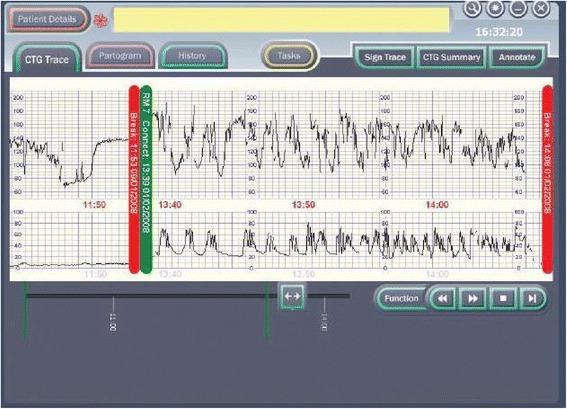
For all participating women and babies, labour variables and outcomes will be stored automatically and contemporaneously onto the Guardian® system.
DISCUSSION
The results of this trial will have importance for pregnant women and for health professionals who provide care for them.
TRIAL REGISTRATION
Current Controlled Trials ISRCTN98680152 assigned 30.09.2008.
背景
分娩期间持续电子胎心监护被广泛应用,但其改善胎儿及新生儿结局的潜力尚未实现。最可能的原因是分娩期间正确解读胎心率曲线存在困难。计算机化的胎心率解读及智能决策支持有潜力改善这种护理情况。本试验将测试在分娩期间添加决策支持软件以辅助解读胎心监护图(CTG)是否会减少那些被判定需要持续电子胎心监护的女性中“不良新生儿结局”的数量。
方法与设计
一项针对46000名被判定在分娩期间需要持续电子胎心监护的女性的个体随机对照试验。
入选标准
入住参与试验的分娩病房、被判定需要持续电子胎心监护、单胎或双胎妊娠、妊娠≥35周、无已知严重胎儿异常且年龄≥16岁的女性。
排除标准
三胎或多胎妊娠、分娩发动前择期剖宫产、计划入住新生儿重症监护病房。试验干预措施:带有决策支持的CTG计算机化解读。
主要结局
短期:“不良新生儿结局”的综合指标,包括试验入组后的死产、除先天性异常导致的死亡外的早期新生儿死亡、严重发病情况:新生儿脑病、因喂养困难、呼吸系统疾病或脑病在出生时有受损证据而在48小时内入住新生儿病房超过48小时。长期:在一组7000名存活婴儿2岁时进行发育评估。
数据收集
对于所有参与试验的女性和婴儿,分娩变量和结局将自动并同步存储到Guardian®系统中。
讨论
本试验的结果对孕妇及为她们提供护理的医护人员具有重要意义。
试验注册
当前受控试验ISRCTN98680152,于2008年9月30日分配。

 Zotero 插件