Brown Larry R, Komoroske Lisa M, Wagner R Wayne, Morgan-King Tara, May Jason T, Connon Richard E, Fangue Nann A
California Water Science Center, United States Geological Survey, Sacramento, California, United States of America.
National Research Council under Contract to Southwest Fisheries Science Center, National Marine Fisheries Service, National Oceanic and Atmospheric Administration, La Jolla, California, United States of America.
PLoS One. 2016 Jan 21;11(1):e0146724. doi: 10.1371/journal.pone.0146724. eCollection 2016.
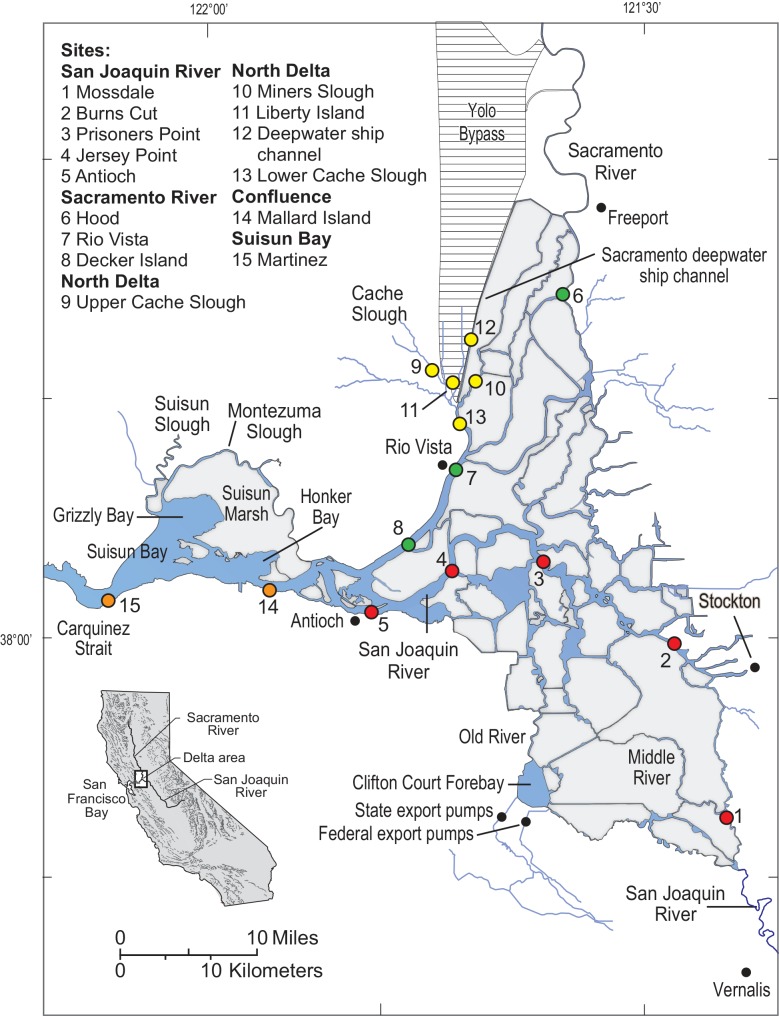
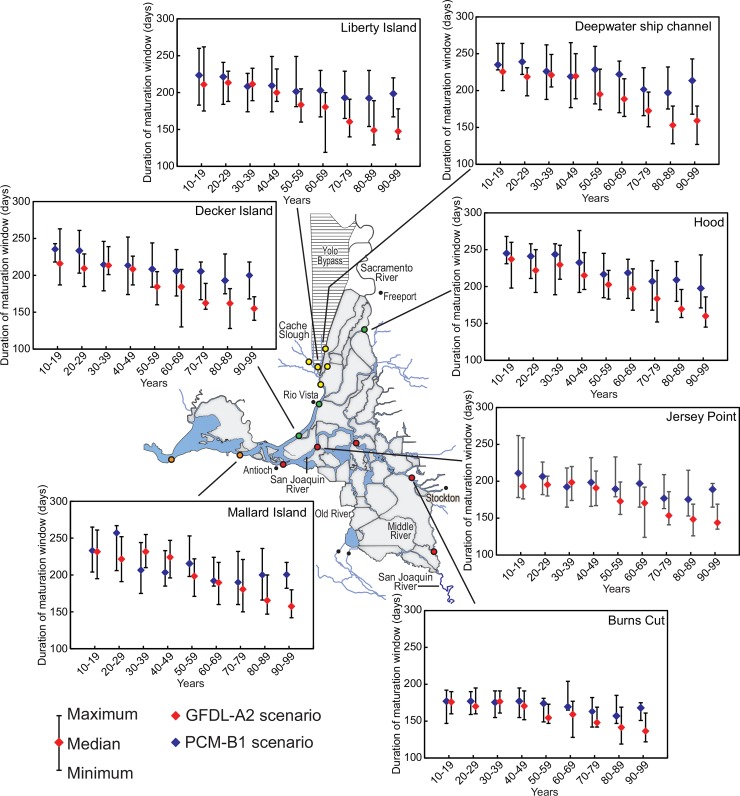
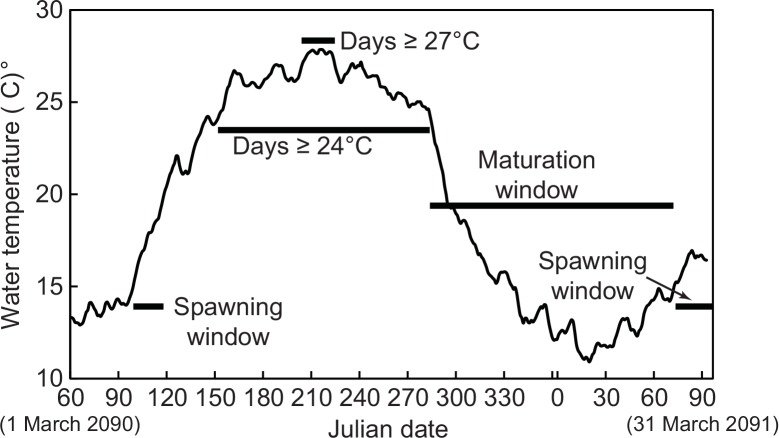
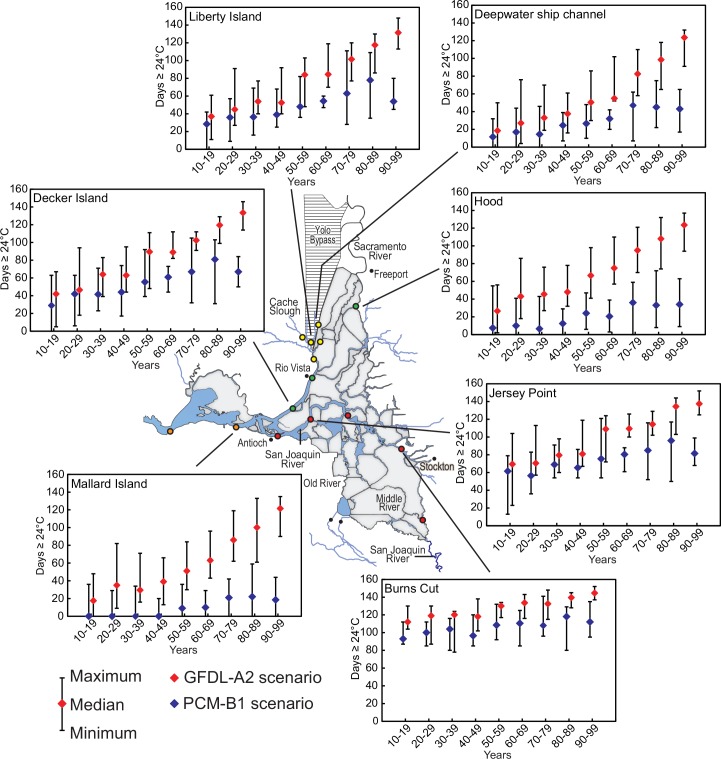
Climate change is driving rapid changes in environmental conditions and affecting population and species' persistence across spatial and temporal scales. Integrating climate change assessments into biological resource management, such as conserving endangered species, is a substantial challenge, partly due to a mismatch between global climate forecasts and local or regional conservation planning. Here, we demonstrate how outputs of global climate change models can be downscaled to the watershed scale, and then coupled with ecophysiological metrics to assess climate change effects on organisms of conservation concern. We employed models to estimate future water temperatures (2010-2099) under several climate change scenarios within the large heterogeneous San Francisco Estuary. We then assessed the warming effects on the endangered, endemic Delta Smelt, Hypomesus transpacificus, by integrating localized projected water temperatures with thermal sensitivity metrics (tolerance, spawning and maturation windows, and sublethal stress thresholds) across life stages. Lethal temperatures occurred under several scenarios, but sublethal effects resulting from chronic stressful temperatures were more common across the estuary (median >60 days above threshold for >50% locations by the end of the century). Behavioral avoidance of such stressful temperatures would make a large portion of the potential range of Delta Smelt unavailable during the summer and fall. Since Delta Smelt are not likely to migrate to other estuaries, these changes are likely to result in substantial habitat compression. Additionally, the Delta Smelt maturation window was shortened by 18-85 days, revealing cumulative effects of stressful summer and fall temperatures with early initiation of spring spawning that may negatively impact fitness. Our findings highlight the value of integrating sublethal thresholds, life history, and in situ thermal heterogeneity into global change impact assessments. As downscaled climate models are becoming widely available, we conclude that similar assessments at management-relevant scales will improve the scientific basis for resource management decisions.
气候变化正在推动环境条件的快速变化,并在空间和时间尺度上影响种群和物种的存续。将气候变化评估纳入生物资源管理,如保护濒危物种,是一项重大挑战,部分原因是全球气候预测与地方或区域保护规划之间存在不匹配。在此,我们展示了全球气候变化模型的输出结果如何能够缩放到流域尺度,然后与生态生理学指标相结合,以评估气候变化对受保护生物的影响。我们使用模型来估计在大型异质旧金山湾内几种气候变化情景下的未来水温(2010 - 2099年)。然后,我们通过将局部预测水温与跨生命阶段的热敏感性指标(耐受性、产卵和成熟窗口以及亚致死应激阈值)相结合,评估了对濒危的本地三角洲胡瓜鱼(Hypomesus transpacificus)的变暖影响。在几种情景下出现了致死温度,但整个河口因长期应激温度导致的亚致死影响更为常见(到本世纪末,超过50%的地点有超过60天的时间温度高于阈值)。在夏季和秋季,行为上避开这种应激温度会使三角洲胡瓜鱼的大部分潜在活动范围无法利用。由于三角洲胡瓜鱼不太可能迁移到其他河口,这些变化可能导致栖息地大幅压缩。此外,三角洲胡瓜鱼的成熟窗口缩短了18 - 85天,这揭示了夏季和秋季应激温度与春季早期产卵开始的累积效应,可能对适应性产生负面影响。我们的研究结果强调了将亚致死阈值、生活史和原位热异质性纳入全球变化影响评估的价值。随着缩尺度气候模型的广泛应用,我们得出结论,在与管理相关的尺度上进行类似评估将改善资源管理决策的科学依据。