Hammock Bruce G, Slater Steven B, Baxter Randall D, Fangue Nann A, Cocherell Dennis, Hennessy April, Kurobe Tomofumi, Tai Christopher Y, Teh Swee J
Aquatic Health Program, School of Veterinary Medicine, Department of Anatomy, Physiology, and Cell Biology, VetMed 3B, University of California Davis, Davis, California, United States of America.
California Department of Fish and Wildlife, Stockton, California, United States of America.
PLoS One. 2017 Mar 14;12(3):e0173497. doi: 10.1371/journal.pone.0173497. eCollection 2017.
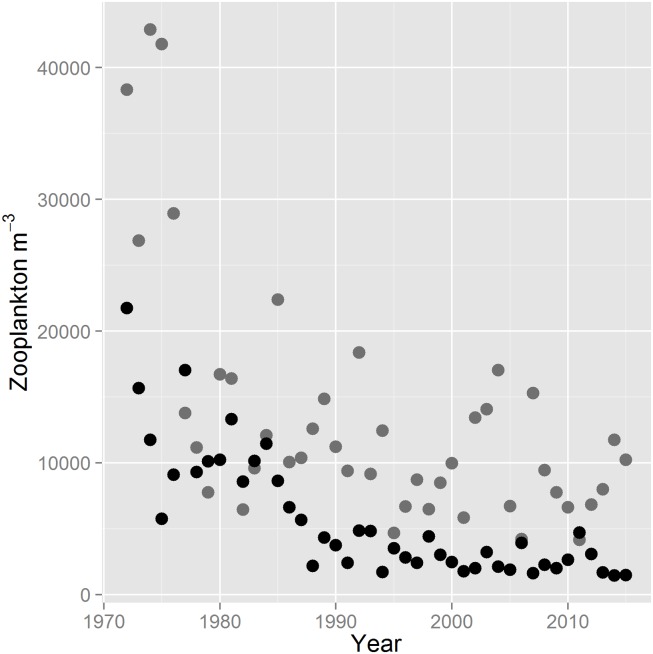
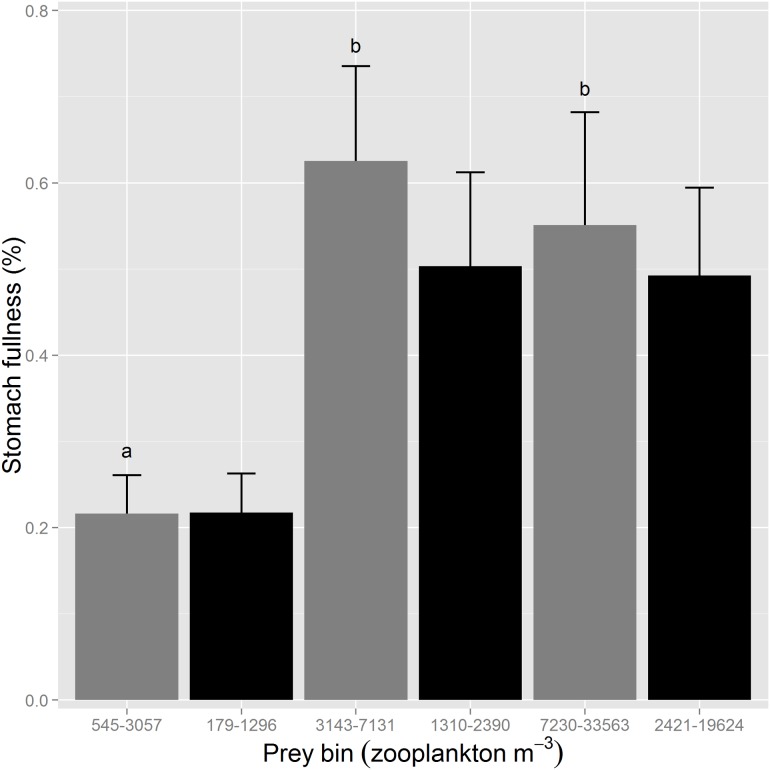
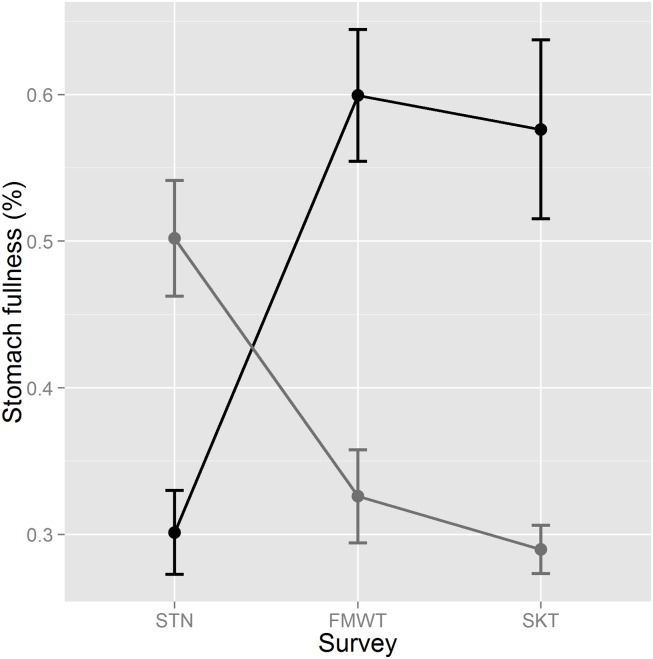
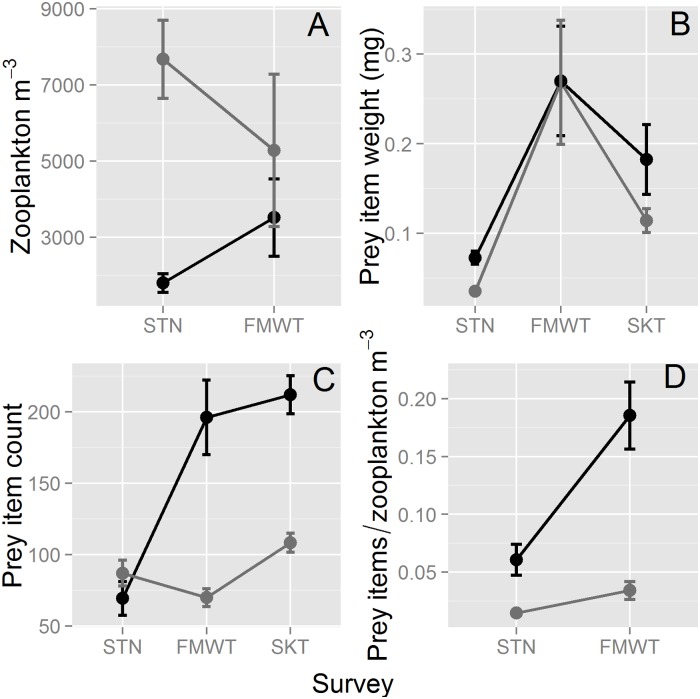
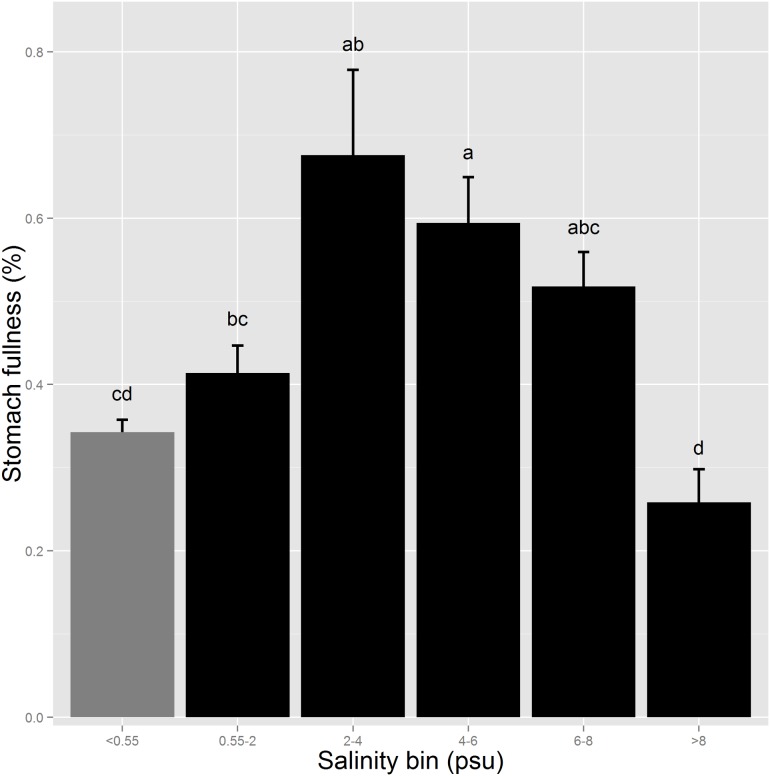
Diadromy affords fish access to productive ecosystems, increasing growth and ultimately fitness, but it is unclear whether these advantages persist for species migrating within highly altered habitat. Here, we compared the foraging success of wild Delta Smelt-an endangered, zooplanktivorous, annual, semi-anadromous fish that is endemic to the highly altered San Francisco Estuary (SFE)-collected from freshwater (<0.55 psu) and brackish habitat (≥0.55 psu). Stomach fullness, averaged across three generations of wild Delta Smelt sampled from juvenile through adult life stages (n = 1,318), was 1.5-fold higher in brackish than in freshwater habitat. However, salinity and season interacted, with higher fullness (1.7-fold) in freshwater than in brackish habitat in summer, but far higher fullness in brackish than freshwater habitat during fall/winter and winter/spring (1.8 and 2.0-fold, respectively). To examine potential causes of this interaction we compared mesozooplankton abundance, collected concurrently with the Delta Smelt, in freshwater and brackish habitat during summer and fall/winter, and the metabolic rate of sub-adult Delta Smelt acclimated to salinities of 0.4, 2.0, and 12.0 psu in a laboratory experiment. A seasonal peak in mesozooplankton density coincided with the summer peak in Delta Smelt foraging success in freshwater, and a pronounced decline in freshwater mesozooplankton abundance in the fall coincided with declining stomach fullness, which persisted for the remainder of the year (fall, winter and spring). In brackish habitat, greater foraging 'efficiency' (prey items in stomachs/mesozooplankton abundance) led to more prey items per fish and generally higher stomach fullness (i.e., a higher proportion of mesozooplankton detected in concurrent trawls were eaten by fish in brackish habitat). Delta Smelt exhibited no difference in metabolic rate across the three salinities, indicating that metabolic responses to salinity are unlikely to have caused the stomach fullness results. Adult migration and freshwater spawning therefore places young fish in a position to exploit higher densities of prey in freshwater in the late spring/summer, and subsequent movement downstream provides older fish more accessible prey in brackish habitat. Thus, despite endemism to a highly-altered estuary, semi-anadromy provided substantial foraging benefits to Delta Smelt, consistent with other temperate migratory fish.
洄游习性使鱼类能够进入高产的生态系统,促进生长并最终提升适应性,但对于在栖息地高度改变的区域内洄游的物种而言,这些优势是否依然存在尚不清楚。在此,我们比较了野生三角洲鳉(一种濒危的、以浮游动物为食的一年生半溯河洄游鱼类,原产于高度改变的旧金山河口(SFE))在淡水(<0.55 盐度单位)和微咸水栖息地(≥0.55 盐度单位)的觅食成功率。从幼鱼到成鱼阶段采集的三代野生三角洲鳉(n = 1318)的平均胃饱满度显示,微咸水栖息地的胃饱满度比淡水栖息地高 1.5 倍。然而,盐度和季节存在相互作用,夏季淡水栖息地的胃饱满度比微咸水栖息地高(1.7 倍),但在秋冬和冬春季节,微咸水栖息地的胃饱满度远高于淡水栖息地(分别为 1.8 倍和 2.0 倍)。为探究这种相互作用的潜在原因,我们比较了在夏季和秋冬与三角洲鳉同时采集的淡水和微咸水栖息地中型浮游动物的丰度,以及在实验室实验中适应 0.4、2.0 和 12.0 盐度单位的亚成年三角洲鳉的代谢率。中型浮游动物密度的季节性峰值与夏季三角洲鳉在淡水栖息地觅食成功率的峰值相吻合,秋季淡水中型浮游动物丰度的显著下降与胃饱满度的下降相吻合,这种下降在一年中的剩余时间(秋季、冬季和春季)持续存在。在微咸水栖息地,更高的觅食“效率”(胃中的猎物数量/中型浮游动物丰度)导致每条鱼的猎物数量更多,胃饱满度总体更高(即,在同时拖网中检测到的中型浮游动物中,有更高比例被微咸水栖息地的鱼吃掉)。三角洲鳉在三种盐度下的代谢率没有差异,这表明对盐度变化的代谢反应不太可能导致胃饱满度的结果。因此,成年鱼的洄游和在淡水区域产卵使幼鱼能够在春末/夏末利用淡水中更高密度的猎物,随后向下游移动则使成年鱼在微咸水栖息地更容易获取猎物。所以,尽管原产于一个高度改变的河口,但半溯河洄游习性为三角洲鳉提供了显著的觅食优势,这与其他温带洄游鱼类一致。