Bi Xinyan, Tey Siew Ling, Leong Claudia, Quek Rina, Henry Christiani Jeyakumar
Clinical Nutrition Research Centre, Centre for Translational Medicine, 14 Medical Drive #07-02, MD 6 Building, Singapore 117599, Singapore.
Singapore Institute for Clinical Sciences, Agency for Science, Technology and Research (A*STAR), Brenner Centre for Molecular Medicine, 30 Medical Drive, Singapore 117609, Singapore.
PLoS One. 2016 Jan 22;11(1):e0147616. doi: 10.1371/journal.pone.0147616. eCollection 2016.
Vitamin D deficiency is a global health challenge and has been linked to type 2 diabetes and other chronic diseases. However, the relationship between vitamin D status, body composition, and cardiovascular risks has not been well characterized in Asian populations. The objectives of this study were to examine the factors associated with the low vitamin D levels in a sunny tropical region and to assess the role of vitamin D status in cardiovascular risk factors.
This was a cross-sectional study. One hundred and fourteen healthy participants (59 males and 55 females) residing in Singapore took part in this study. Plasma 25OH-D3 concentration was measured by using LC-MS/MS. Body fat (%) was measured by using three different techniques including bioelectrical impedance analysis (BIA), BOD POD, and dual-energy X-ray absorptiometry (DEXA). Basic anthropometric measurements, fasting blood glucose (FBG), fasting serum insulin (FSI), and lipid profiles were obtained using standard protocols.
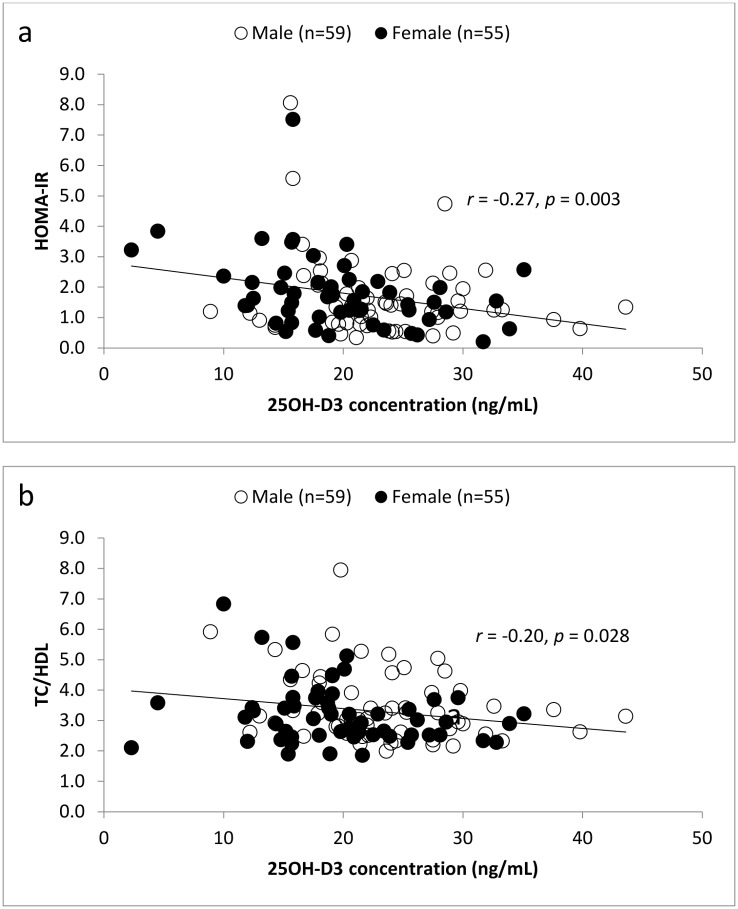
Approximately 42% of the participants were vitamin D deficient (< 20 ng/mL). Vitamin D status was inversely associated with body fat (%), homeostasis model assessment of insulin resistance (HOMA-IR), and total cholesterol/high density lipoprotein (TC/HDL) ratio, while positively associated with lean body mass (LBM) and hand grip strength (HGS).
The high prevalence of vitamin D deficiency in a sunny tropical region reinforces the need to recognize that sunlight alone is not the precursor for optimal vitamin D status. This raises the need to investigate public health measures that will encourage exposure to sunlight without overexposure that is harmful to skin. More importantly, vitamin D deficiency is associated with increased cardiovascular risks, i.e. HOMA-IR, TC/HDL, and LDL/HDL. Future studies should attempt to elucidate the potential mechanisms.
维生素D缺乏是一项全球性的健康挑战,且与2型糖尿病及其他慢性疾病相关。然而,在亚洲人群中,维生素D状态、身体组成与心血管风险之间的关系尚未得到充分描述。本研究的目的是探究阳光充足的热带地区维生素D水平低的相关因素,并评估维生素D状态在心血管危险因素中的作用。
这是一项横断面研究。居住在新加坡的114名健康参与者(59名男性和55名女性)参与了本研究。采用液相色谱-串联质谱法测定血浆25-羟基维生素D3浓度。使用生物电阻抗分析(BIA)、人体成分分析仪(BOD POD)和双能X线吸收法(DEXA)三种不同技术测量体脂(%)。采用标准方案获取基本人体测量数据、空腹血糖(FBG)、空腹血清胰岛素(FSI)和血脂谱。
约42%的参与者维生素D缺乏(<20 ng/mL)。维生素D状态与体脂(%)、胰岛素抵抗稳态模型评估(HOMA-IR)以及总胆固醇/高密度脂蛋白(TC/HDL)比值呈负相关,而与瘦体重(LBM)和握力(HGS)呈正相关。
阳光充足的热带地区维生素D缺乏的高患病率凸显了认识到仅靠阳光并非最佳维生素D状态的前体的必要性。这就需要研究公共卫生措施,鼓励适度晒太阳,避免过度暴露对皮肤造成伤害。更重要的是,维生素D缺乏与心血管风险增加相关,即HOMA-IR、TC/HDL和LDL/HDL。未来的研究应试图阐明潜在机制。