Pompe Esther, de Jong Pim A, de Jong Werner U, Takx Richard A P, Eikendal Anouk L M, Willemink Martin J, Oudkerk Matthijs, Budde Ricardo P J, Lammers Jan-Willem J, Mohamed Hoesein Firdaus A A
Department of Pulmonology, University Medical Center Utrecht, P.O. Box 85500, 3508 GA, Utrecht, E.03.511, The Netherlands.
Department of Radiology, University Medical Center Utrecht, Utrecht, The Netherlands.
Eur Radiol. 2016 Sep;26(9):3046-53. doi: 10.1007/s00330-015-4145-x. Epub 2016 Jan 22.
To determine inter-observer and inter-examination variability of manual attenuation measurements of the vertebrae in low-dose unenhanced chest computed tomography (CT).
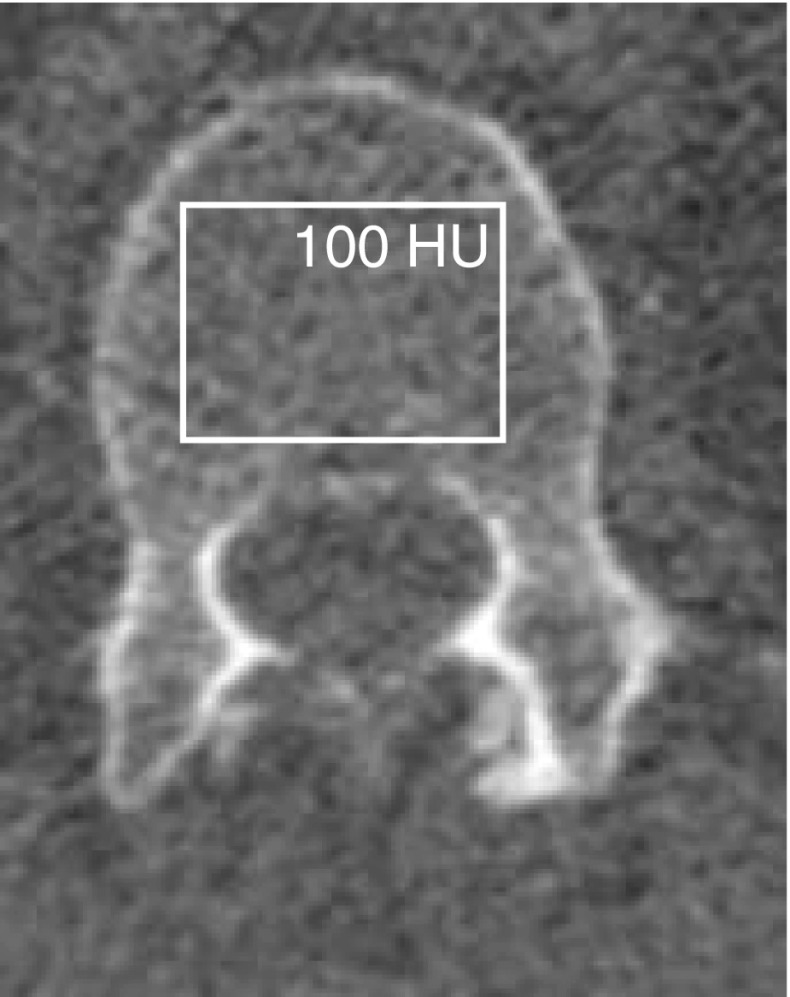
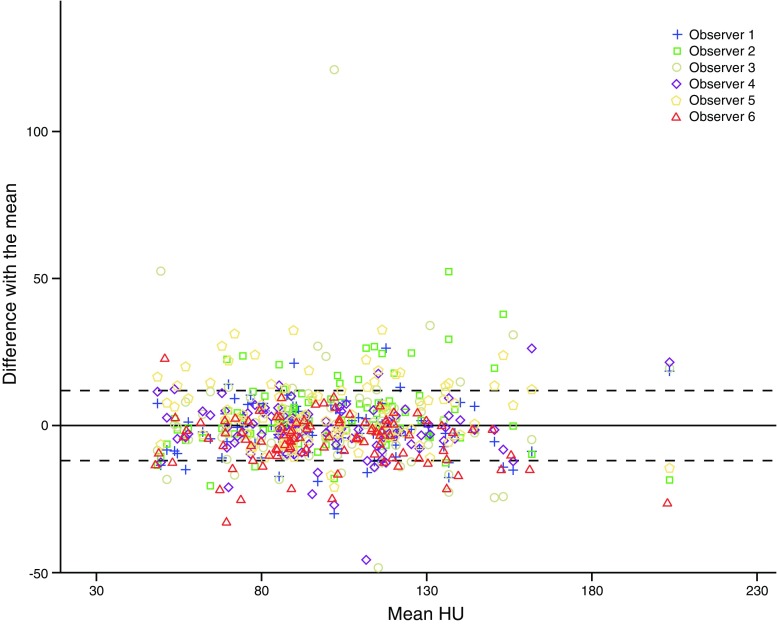
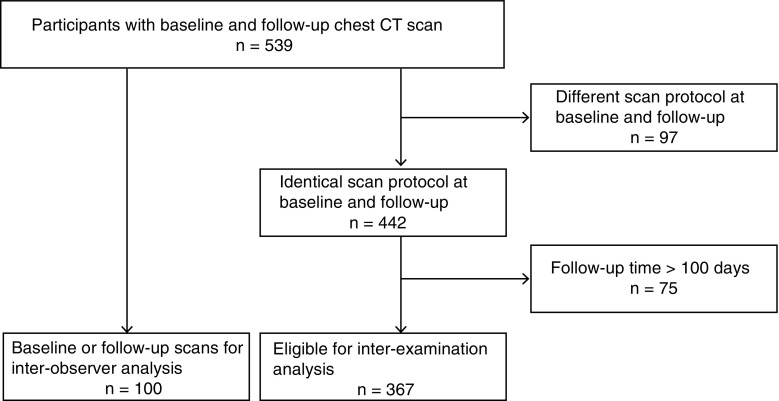
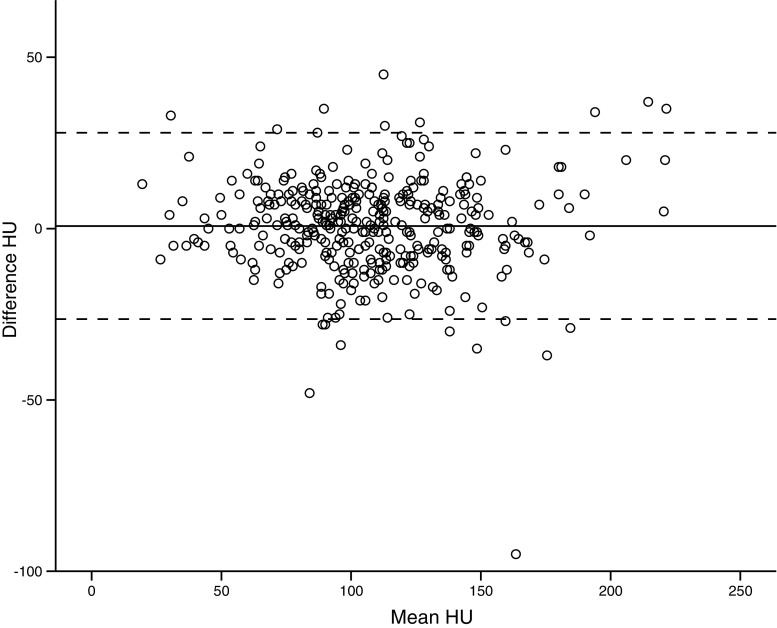
Three hundred and sixty-seven lung cancer screening trial participants who underwent baseline and repeat unenhanced low-dose CT after 3 months because of an indeterminate lung nodule were included. The CT attenuation value of the first lumbar vertebrae (L1) was measured in all CTs by one observer to obtain inter-examination reliability. Six observers performed measurements in 100 randomly selected CTs to determine agreement with limits of agreement and Bland-Altman plots and reliability with intraclass correlation coefficients (ICCs). Reclassification analyses were performed using a threshold of 110 HU to define osteoporosis.
Inter-examination reliability was excellent with an ICC of 0.92 (p < 0.001). Inter-examination limits of agreement ranged from -26 to 28 HU with a mean difference of 1 ± 14 HU. Inter-observer reliability ICCs ranged from 0.70 to 0.91. Inter-examination variability led to 11.2 % reclassification of participants and inter-observer variability led to 22.1 % reclassification.
Vertebral attenuation values can be manually quantified with good to excellent inter-examination and inter-observer reliability on unenhanced low-dose chest CT. This information is valuable for early detection of osteoporosis on low-dose chest CT.
• Vertebral attenuation values can be manually quantified on low-dose unenhanced CT reliably. • Vertebral attenuation measurements may be helpful in detecting subclinical low bone density. • This could become of importance in the detection of osteoporosis.
确定低剂量非增强胸部计算机断层扫描(CT)中椎体手动衰减测量的观察者间和检查间变异性。
纳入367名肺癌筛查试验参与者,他们因肺结节不确定在基线时接受了低剂量非增强CT检查,并在3个月后进行了重复检查。由一名观察者在所有CT图像上测量第一腰椎(L1)的CT衰减值,以获得检查间的可靠性。六名观察者对100例随机选择的CT图像进行测量,以确定一致性界限和Bland-Altman图,并通过组内相关系数(ICC)确定可靠性。使用110 HU的阈值进行重新分类分析,以定义骨质疏松症。
检查间可靠性极佳,ICC为0.92(p < 0.001)。检查间一致性界限为-26至28 HU,平均差值为1±14 HU。观察者间可靠性ICC范围为0.70至0.91。检查间变异性导致11.2%的参与者重新分类,观察者间变异性导致22.1%的参与者重新分类。
在非增强低剂量胸部CT上,椎体衰减值可以通过手动定量,检查间和观察者间可靠性良好至极佳。该信息对于在低剂量胸部CT上早期检测骨质疏松症具有重要价值。
• 椎体衰减值可以在低剂量非增强CT上可靠地手动定量。• 椎体衰减测量可能有助于检测亚临床低骨密度。• 这在骨质疏松症的检测中可能变得很重要。