Amone-P'Olak Kennedy, Lekhutlile Tlholego Molemane, Ovuga Emilio, Abbott Rosemary Ann, Meiser-Stedman Richard, Stewart David Gage, Jones Peter Brian
Department of Psychology, University of Botswana, Private Bag UB 00705, Gaborone, Botswana.
Department of Psychiatry and Mental Health, Gulu University, Gulu, Uganda.
BMC Public Health. 2016 Jan 22;16:64. doi: 10.1186/s12889-016-2735-4.
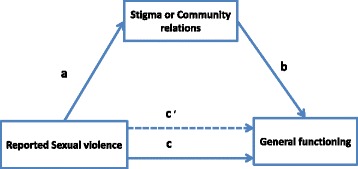
Although sexual violence in war is associated with long-term mental health problems, little is known about its association with general functioning and the factors that explain this association. This study aims to illuminate the path from sexual violence to poor functioning. The prevalence of sexual violence among formerly abducted girls in Northern Uganda was assessed as well as the extent to which stigma and community relations explain the association between sexual violence and general functioning.
In a cross-sectional analysis using data from the WAYS study (N = 210, baseline age 22.06, SD = 2.06, minimum-maximum 18-25), the extent of mediation of the association between sexual violence and general functioning was assessed in multiple regression models.
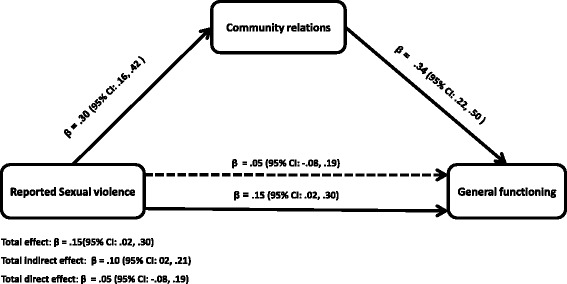
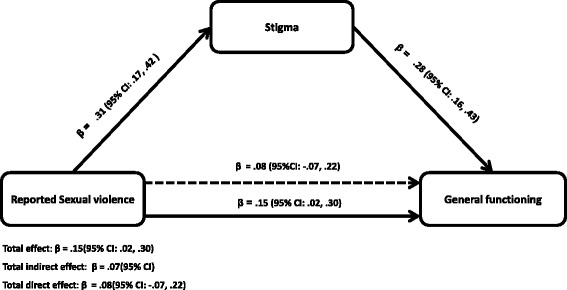
Sexual violence was found to be associated with increased stigma, poor community relations, and poor general functioning. The association between sexual violence and general functioning was mediated by stigma and community relations. The bootstrap results indicated significant mediation by stigma of 47 % (95 % confidence interval [CI] 35 to 78 % and by community relations of 67 % (95 % CI: 52 to 78 %) in the association between sexual violence and general functioning.
Thus, poor functioning among formerly abducted girls is largely mediated by stigma and poor community relations. However, due to the relatively small effect sizes of the associations, targeted interventions to prevent impaired functioning may have only modest benefits to the formerly abducted girls. Interventions to alleviate the toxic effects of sexual violence in formerly abducted girls would benefit from a holistic approach that targets stigma and poor relationships within communities.
尽管战争中的性暴力与长期心理健康问题相关,但对于其与总体功能的关联以及解释这种关联的因素却知之甚少。本研究旨在阐明从性暴力到功能不良的路径。评估了乌干达北部曾被绑架女孩中性暴力的发生率,以及耻辱感和社区关系在多大程度上解释了性暴力与总体功能之间的关联。
在一项横断面分析中,使用来自WAYS研究的数据(N = 210,基线年龄22.06,标准差 = 2.06,最小 - 最大年龄18 - 25岁),在多元回归模型中评估性暴力与总体功能之间关联的中介程度。
发现性暴力与耻辱感增加、社区关系不良和总体功能不良相关。性暴力与总体功能之间的关联由耻辱感和社区关系介导。自抽样结果表明,在性暴力与总体功能的关联中,耻辱感的中介效应显著,为47%(95%置信区间[CI] 35%至78%),社区关系的中介效应为67%(95% CI:52%至78%)。
因此,曾被绑架女孩的功能不良在很大程度上由耻辱感和不良社区关系介导。然而,由于这些关联的效应量相对较小,针对预防功能受损的针对性干预措施对曾被绑架女孩可能只有适度的益处。减轻曾被绑架女孩性暴力毒性影响的干预措施将受益于一种针对耻辱感和社区内不良关系的整体方法。