Jandu Haatisha, Aluzaite Kristina, Fogh Louise, Thrane Sebastian Wingaard, Noer Julie B, Proszek Joanna, Do Khoa Nguyen, Hansen Stine Ninel, Damsgaard Britt, Nielsen Signe Lykke, Stougaard Magnus, Knudsen Birgitta R, Moreira José, Hamerlik Petra, Gajjar Madhavsai, Smid Marcel, Martens John, Foekens John, Pommier Yves, Brünner Nils, Schrohl Anne-Sofie, Stenvang Jan
Faculty of Health and Medical Sciences, Department of Veterinary Disease Biology, Section for Molecular Disease Biology and Sino-Danish Breast Cancer Research Centre, University of Copenhagen, Strandboulevarden 49, DK-2100, Copenhagen, Denmark.
Department of Pathology, Aarhus University Hospital, Noerrebrogade 44, building 18B, 8000, Aarhus C, Denmark.
BMC Cancer. 2016 Jan 22;16:34. doi: 10.1186/s12885-016-2071-1.
Studies in taxane and/or anthracycline refractory metastatic breast cancer (mBC) patients have shown approximately 30% response rates to irinotecan. Hence, a significant number of patients will experience irinotecan-induced side effects without obtaining any benefit. The aim of this study was to lay the groundwork for development of predictive biomarkers for irinotecan treatment in BC.
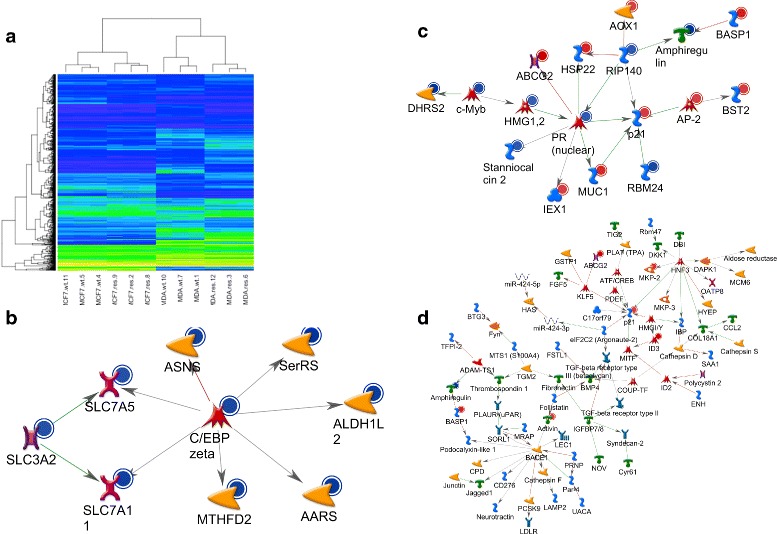
We established BC cell lines with acquired or de novo resistance to SN-38, by exposing the human BC cell lines MCF-7 and MDA-MB-231 to either stepwise increasing concentrations over 6 months or an initial high dose of SN-38 (the active metabolite of irinotecan), respectively. The resistant cell lines were analyzed for cross-resistance to other anti-cancer drugs, global gene expression, growth rates, TOP1 and TOP2A gene copy numbers and protein expression, and inhibition of the breast cancer resistance protein (ABCG2/BCRP) drug efflux pump.
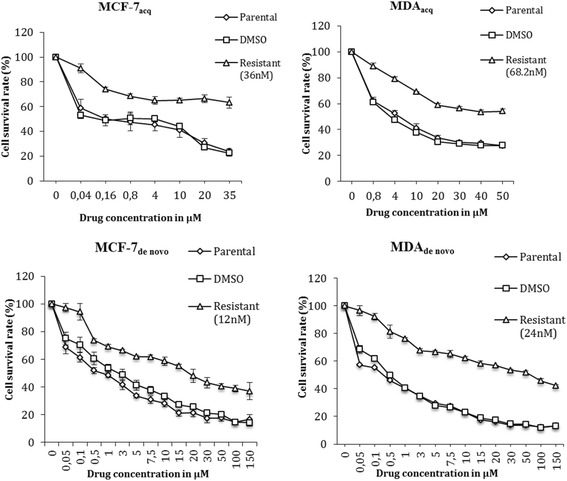
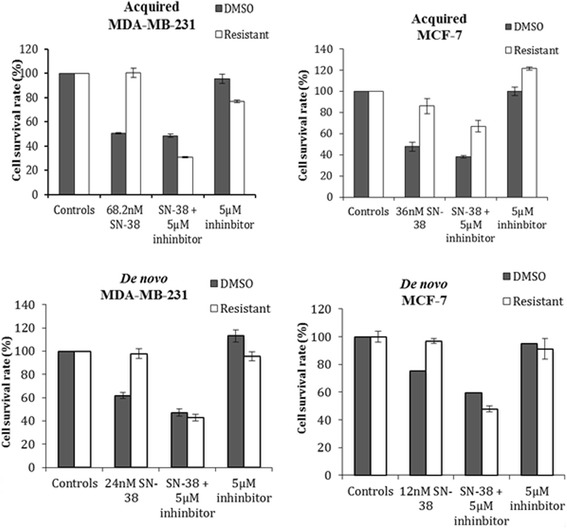
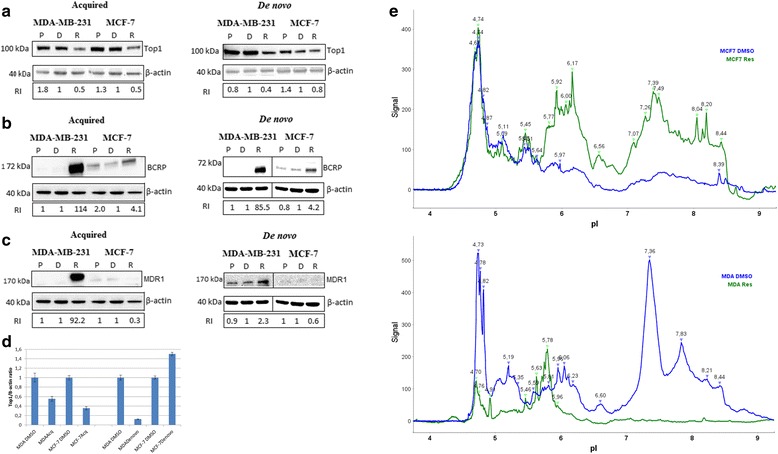
We found that the resistant cell lines showed 7-100 fold increased resistance to SN-38 but remained sensitive to docetaxel and the non-camptothecin Top1 inhibitor LMP400. The resistant cell lines were characterized by Top1 down-regulation, changed isoelectric points of Top1 and reduced growth rates. The gene and protein expression of ABCG2/BCRP was up-regulated in the resistant sub-lines and functional assays revealed BCRP as a key mediator of SN-38 resistance.
Based on our preclinical results, we suggest analyzing the predictive value of the BCRP in breast cancer patients scheduled for irinotecan treatment. Moreover, LMP400 should be tested in a clinical setting in breast cancer patients with resistance to irinotecan.
针对紫杉烷和/或蒽环类难治性转移性乳腺癌(mBC)患者的研究表明,伊立替康的缓解率约为30%。因此,相当一部分患者会出现伊立替康诱导的副作用而未获任何益处。本研究的目的是为开发BC中伊立替康治疗的预测生物标志物奠定基础。
我们通过将人乳腺癌细胞系MCF-7和MDA-MB-231分别在6个月内逐步增加浓度或给予初始高剂量的SN-38(伊立替康的活性代谢物),建立了对SN-38获得性或原发性耐药的乳腺癌细胞系。对耐药细胞系进行了对其他抗癌药物的交叉耐药性、整体基因表达、生长速率、TOP1和TOP2A基因拷贝数及蛋白表达,以及乳腺癌耐药蛋白(ABCG2/BCRP)药物外排泵抑制作用的分析。
我们发现耐药细胞系对SN-38的耐药性增加了7至100倍,但对多西他赛和非喜树碱类Top1抑制剂LMP400仍敏感。耐药细胞系的特征是Top1下调、Top1等电点改变和生长速率降低。ABCG2/BCRP的基因和蛋白表达在耐药亚系中上调,功能试验表明BCRP是SN-38耐药的关键介质。
基于我们的临床前结果,我们建议分析BCRP在计划接受伊立替康治疗的乳腺癌患者中的预测价值。此外,LMP400应在对伊立替康耐药的乳腺癌患者的临床环境中进行测试。