Jung Jae-Chul, Lee Yun-Hee, Kim Sou Hyun, Kim Keuk-Jun, Kim Kyung-Mi, Oh Seikwan, Jung Young-Suk
Life Science Research Institute, Novarex Co., Ltd, Ochang, Cheongwon, Chungbuk, 363-885, Republic of Korea.
College of Pharmacy, Yonsei University, Incheon, 406-840, Republic of Korea.
BMC Complement Altern Med. 2016 Jan 22;16:19. doi: 10.1186/s12906-016-0997-0.
Our previous study suggested that licorice has anti-inflammatory activity in lipopolysaccharide-stimulated microglial cells and anti-oxidative activity in tert-butyl hydroperoxide-induced oxidative liver damage. In this study, we evaluated the effect of licorice on chronic alcohol-induced fatty liver injury mediated by inflammation and oxidative stress.
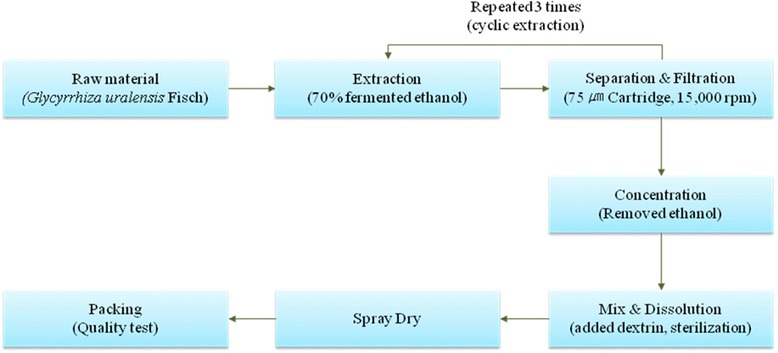
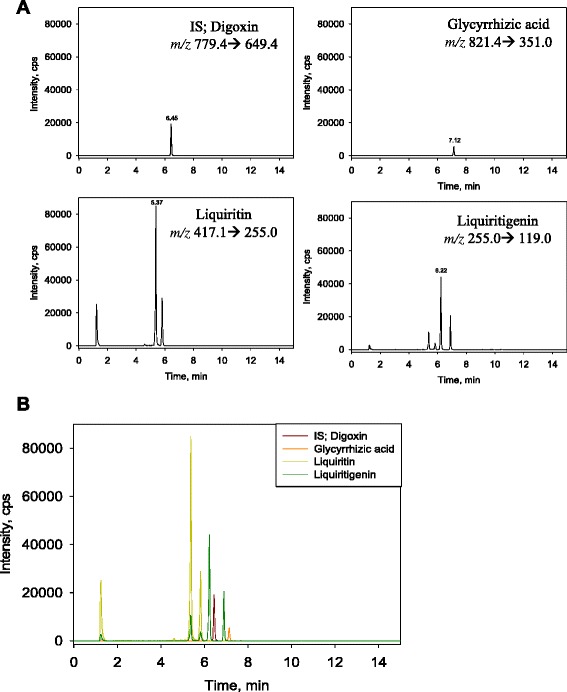
Raw licorice was extracted, and quantitative and qualitative analysis of its components was performed by using LC-MS/MS. Mice were fed a liquid alcohol diet with or without licorice for 4 weeks.
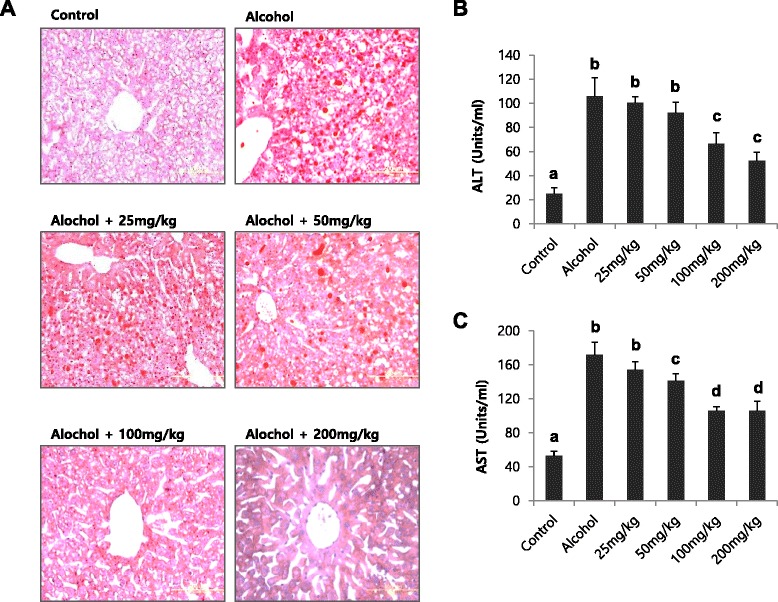
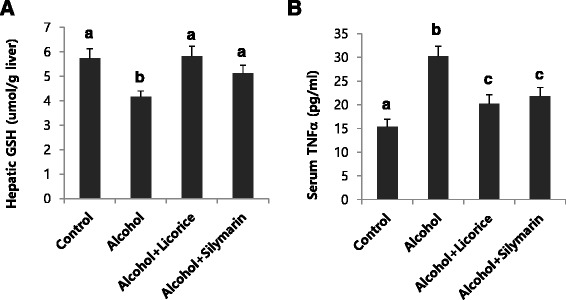
We have standardized 70% fermented ethanol extracted licorice and confirmed by LC-MS/MS as glycyrrhizic acid (GA), 15.77 ± 0.34 μg/mg; liquiritin (LQ), 14.55 ± 0.42 μg/mg; and liquiritigenin (LG), 1.34 ± 0.02 μg/mg, respectively. Alcohol consumption increased serum alanine aminotransferase and aspartate aminotransferase activities and the levels of triglycerides and tumor necrosis factor (TNF)-α. Lipid accumulation in the liver was also markedly induced, whereas the glutathione level was reduced. All these alcohol-induced changes were effectively inhibited by licorice treatment. In particular, the hepatic glutathione level was restored and alcohol-induced TNF-α production was significantly inhibited by licorice.
Taken together, our data suggests that protective effect of licorice against alcohol-induced liver injury may be attributed to its anti-inflammatory activity and enhancement of antioxidant defense.
我们之前的研究表明,甘草在脂多糖刺激的小胶质细胞中具有抗炎活性,在叔丁基过氧化氢诱导的氧化性肝损伤中具有抗氧化活性。在本研究中,我们评估了甘草对由炎症和氧化应激介导的慢性酒精性脂肪肝损伤的影响。
提取生甘草,并使用液相色谱 - 串联质谱法对其成分进行定量和定性分析。给小鼠喂食含或不含甘草的液体酒精饮食4周。
我们对70%发酵乙醇提取的甘草进行了标准化,并通过液相色谱 - 串联质谱法确认其甘草酸(GA)含量为15.77±0.34μg/mg;甘草苷(LQ)含量为14.55±0.42μg/mg;甘草素(LG)含量为1.34±0.02μg/mg。酒精摄入增加了血清丙氨酸氨基转移酶和天冬氨酸氨基转移酶活性以及甘油三酯和肿瘤坏死因子(TNF)-α水平。肝脏中的脂质积累也明显增加,而谷胱甘肽水平降低。甘草治疗有效抑制了所有这些酒精诱导的变化。特别是,甘草恢复了肝脏谷胱甘肽水平,并显著抑制了酒精诱导的TNF-α产生。
综上所述,我们的数据表明甘草对酒精性肝损伤的保护作用可能归因于其抗炎活性和增强抗氧化防御能力。