Lancaster Kathryn Elizabeth, Powers Kimberly A, Lungu Thandie, Mmodzi Pearson, Hosseinipour Mina C, Chadwick Katy, Go Vivian F, Pence Brian W, Hoffman Irving F, Miller William C
Department of Epidemiology, Gillings School of Global Public Health, The University of North Carolina at Chapel Hill, Chapel Hill, North Carolina, United States of America.
Division of Infectious Diseases, School of Medicine, University of North Carolina at Chapel Hill, Chapel Hill, North Carolina, United States of America.
PLoS One. 2016 Jan 25;11(1):e0147662. doi: 10.1371/journal.pone.0147662. eCollection 2016.
The HIV care continuum among female sex workers (FSW), a key population, has not been well characterized, especially within the generalized epidemics of sub-Saharan Africa. This was the first study to characterize the HIV care continuum among FSW in Lilongwe, Malawi.
From July through September 2014, we used venue-based sampling to enroll 200 adult FSW in Lilongwe, Malawi into a cross-sectional evaluation assessing HIV care continuum outcomes. Seropositive FSW, identified using HIV rapid testing, received rapid CD4 counts in addition to viral loads using dried blood spots. We calculated proportions of HIV-infected FSW who had history of care, were on ART, and had suppressed viral load and we used Poisson regression to estimate the associations of demographic characteristics and transmission risk behaviors with each outcome.
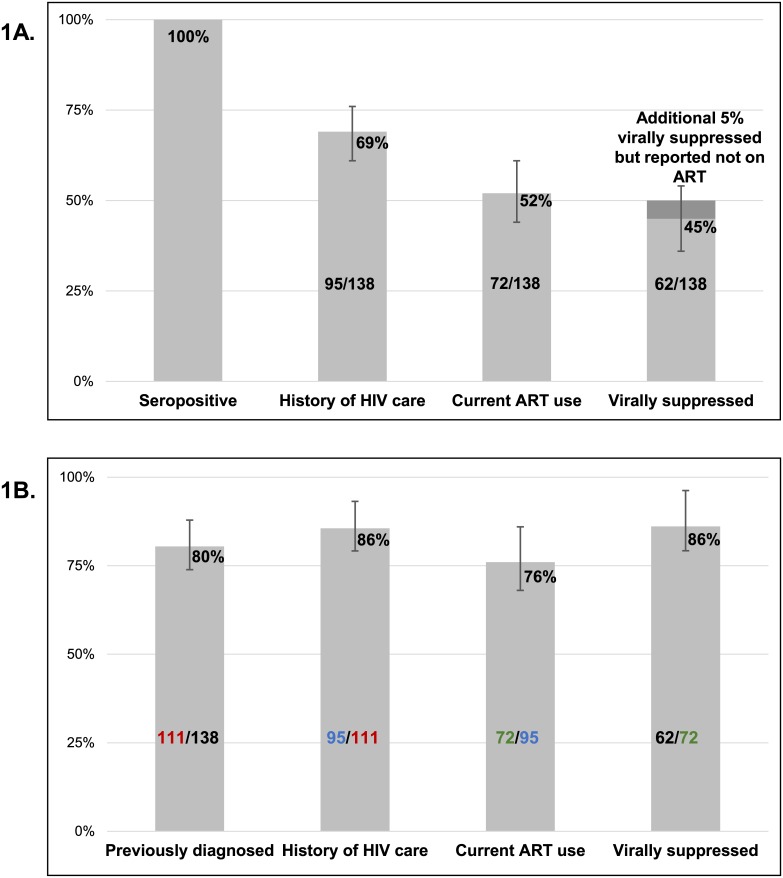
HIV seroprevalence was 69% (n = 138). Among all FSW the median age was 24 years (IQR: 22-28). Among the 20% who were newly diagnosed and reported previously testing negative, the median time since last HIV test was 11 months (interquartile range: 3-17). The majority (69%) of HIV-infected FSW had a history of HIV care, 52% reported current ART use, and 45% were virally suppressed. Of the FSW who reported current ART use, 86% were virally suppressed. Transmission risk behaviors were not associated with continuum outcomes.
FSW in Lilongwe were predominately young and have a high HIV prevalence. Only half of HIV-infected FSW reported current ART use, but the majority of those on ART were virally suppressed. To reduce ongoing transmission and improve health outcomes, increased HIV testing, care engagement, and ART coverage is urgently needed among FSW. Universal testing and treatment strategies for all FSW in Malawi must be strongly considered.
女性性工作者(FSW)作为关键人群,其艾滋病病毒(HIV)护理连续过程尚未得到充分描述,尤其是在撒哈拉以南非洲的广泛流行地区。这是第一项描述马拉维利隆圭女性性工作者HIV护理连续过程的研究。
2014年7月至9月,我们采用基于场所的抽样方法,将马拉维利隆圭的200名成年女性性工作者纳入一项横断面评估,以评估HIV护理连续过程的结果。使用HIV快速检测确定的血清阳性女性性工作者,除了通过干血斑检测病毒载量外,还接受了快速CD4细胞计数。我们计算了有护理史、正在接受抗逆转录病毒治疗(ART)以及病毒载量得到抑制的HIV感染女性性工作者的比例,并使用泊松回归来估计人口统计学特征和传播风险行为与每个结果之间的关联。
HIV血清阳性率为69%(n = 138)。所有女性性工作者的中位年龄为24岁(四分位间距:22 - 28岁)。在新诊断且之前检测为阴性的20%的女性性工作者中,自上次HIV检测以来的中位时间为11个月(四分位间距:3 - 17个月)。大多数(69%)HIV感染的女性性工作者有HIV护理史,52%报告目前正在接受ART治疗,45%的病毒载量得到抑制。在报告目前正在接受ART治疗的女性性工作者中,86%的病毒载量得到抑制。传播风险行为与连续过程结果无关。
利隆圭的女性性工作者以年轻人为主,HIV感染率很高。只有一半的HIV感染女性性工作者报告目前正在接受ART治疗,但大多数接受ART治疗的人病毒载量得到抑制。为了减少持续传播并改善健康结果,迫切需要在女性性工作者中增加HIV检测、护理参与度和ART覆盖率。必须大力考虑针对马拉维所有女性性工作者的普遍检测和治疗策略。