Abeje Gedefaw, Motbaynor Achenef
School of Public Health, College of Medicine and Health Sciences, Bahir Dar University, P.O.Box 79, Bahir Dar, Ethiopia.
College of Health Sciences, Madawalabu University, Bale Goba, Ethiopia.
BMC Res Notes. 2016 Jan 25;9:43. doi: 10.1186/s13104-016-1850-8.
Although family planning for human immune deficiency virus positive women has numerous advantages, evidences in different parts of the world showed the existence of persistent unmet need. There were few studies done in Ethiopia on level of unmet need for family planning among women in reproductive age on antiretroviral therapy (ART). This study was therefore done to determine the level of demand and unmet need for family planning among women on ART in South Gondar and North Wollo Zones, Amhara region.
Institution based cross-sectional study design was used. Data was collected from June 15 to 25, 2013 in South Gondar and North Wollo Zones. Study participants were recruited from six health centers and two hospitals. The study participants were proportionally allocated to the health institutions. Multistage sampling technique was used to recruit study participants. Trained nurses interviewed the respondents using pretested structured Amharic questionnaire. Data was entered, cleaned and analyzed using Statistical Package for Social Science version 16. Ratios and proportions were computed to determine demand and unmet need for family planning.
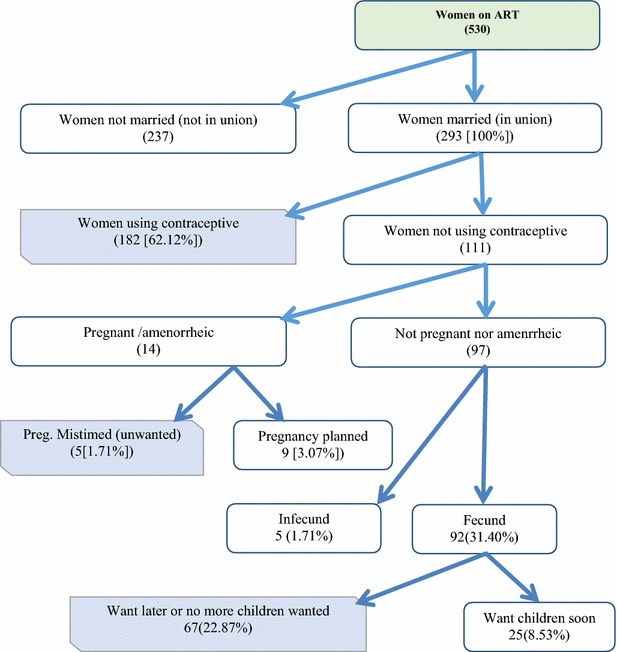
A total of 530 women in reproductive age on ART were interviewed in this study. Two hundred ninety-three women were married. Fourteen (2.6%) women were pregnant at the time of interview. Five of these pregnancies were not planned. In this study, 242 (45.7%) women reported that they were using contraceptives. Most women (74.4%) were using injectable (depo). Among those who were not using contraceptives, 84 (29.2%) reported that they will use in the future. Fifty-two (61.9%) of them said that they will use injectables (depo). In this study, the total demand for family planning among women on ART was 86.7%. From this, 62.1% and 24.6% was met and unmet need respectively.
This study revealed that the level of demand and met need for modern contraceptives among reproductive age women on antiretroviral therapy in South Gondar and North Wollo Zones was higher than that of sexually active married women in Ethiopia. But the level of unmet need is still similar with that of sexually active married women in Ethiopia.
尽管为感染人类免疫缺陷病毒的女性提供计划生育服务有诸多益处,但世界各地的证据表明,仍存在持续未被满足的需求。在埃塞俄比亚,针对接受抗逆转录病毒疗法(ART)的育龄女性计划生育需求未得到满足的程度,开展的研究较少。因此,本研究旨在确定阿姆哈拉地区南贡德尔和北沃洛地区接受ART治疗的女性对计划生育的需求程度及未满足的需求情况。
采用基于机构的横断面研究设计。2013年6月15日至25日在南贡德尔和北沃洛地区收集数据。研究参与者从六个健康中心和两家医院招募。研究参与者按比例分配到各医疗机构。采用多阶段抽样技术招募研究参与者。经过培训的护士使用预先测试的结构化阿姆哈拉语问卷对受访者进行访谈。使用社会科学统计软件包第16版录入、清理和分析数据。计算比率和比例以确定计划生育的需求和未满足的需求。
本研究共访谈了530名接受ART治疗的育龄女性。其中293名女性已婚。14名(2.6%)女性在访谈时怀孕。这些怀孕中有5例是意外怀孕。在本研究中,242名(45.7%)女性报告称她们正在使用避孕药具。大多数女性(74.4%)使用注射用避孕药(长效避孕针)。在未使用避孕药具的女性中,84名(29.2%)报告称她们未来会使用。其中52名(61.9%)表示会使用注射用避孕药(长效避孕针)。在本研究中,接受ART治疗的女性对计划生育的总需求为86.7%。其中,需求得到满足和未得到满足的比例分别为62.1%和24.6%。
本研究表明,南贡德尔和北沃洛地区接受抗逆转录病毒治疗的育龄女性对现代避孕方法的需求程度和需求得到满足的程度高于埃塞俄比亚有性活动的已婚女性。但未满足需求的程度仍与埃塞俄比亚有性活动的已婚女性相似。