Breitve Monica H, Hynninen Minna J, Brønnick Kolbjørn, Chwiszczuk Luiza J, Auestad Bjørn H, Aarsland Dag, Rongve Arvid
Department of Research and Innovation, Helse-Fonna HF Haugesund Hospital, Postbox 2170, 5504, Haugesund, Norway.
Old Age Department, Clinic of Psychiatry, Helse-Fonna HF Haugesund Hospital, Postbox 2170, 5504, Haugesund, Norway.
Alzheimers Res Ther. 2016 Jan 26;8:3. doi: 10.1186/s13195-016-0171-4.
Anxiety in dementia is common but not well studied. We studied the associations of anxiety longitudinally in Alzheimer's disease (AD) and dementia with Lewy bodies (DLB).
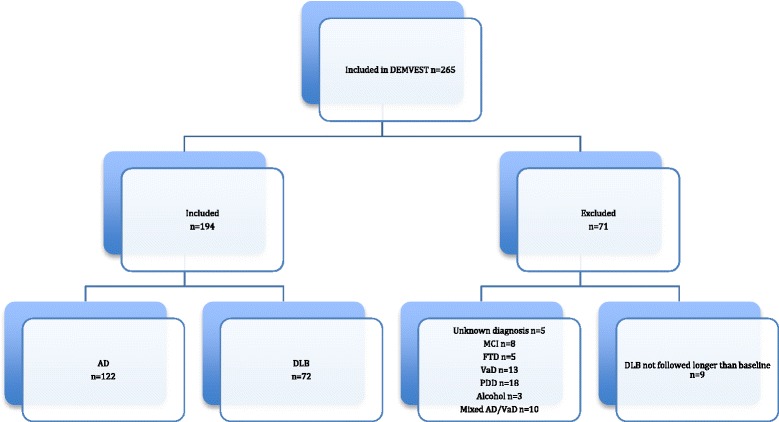
In total, 194 patients with a first-time diagnosis of dementia were included (n = 122 patients with AD, n = 72 patients with DLB). Caregivers rated the patients' anxiety using the Neuropsychiatric Inventory, and self-reported anxiety was assessed with the anxiety and tension items on the Montgomery-Åsberg Depression Rating Scale. The Mini Mental State Examination was used to assess cognitive outcome, and the Clinical Dementia Rating (CDR)-Global and CDR boxes were used for dementia severity. Linear mixed effects models were used for longitudinal analysis.
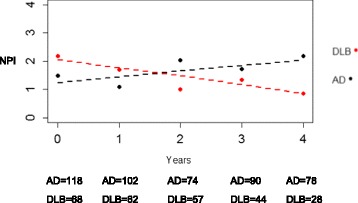
Neither in the total sample nor in AD or DLB was caregiver-rated anxiety significantly associated with cognitive decline or dementia severity over a 4-year period. However, in patients with DLB, self-reported anxiety was associated with a slower cognitive decline than in patients with AD. No support was found for patients with DLB with clinical anxiety having a faster decline than patients with DLB without clinical anxiety. Over the course of 4 years, the level of anxiety declined in DLB and increased in AD.
Anxiety does not seem to be an important factor for the rate of cognitive decline or dementia severity over time in patients with a first-time diagnosis of dementia. Further research into anxiety in dementia is needed.
痴呆症患者中焦虑症很常见,但研究尚不充分。我们纵向研究了阿尔茨海默病(AD)和路易体痴呆(DLB)患者焦虑症的相关性。
共纳入194例首次诊断为痴呆症的患者(n = 122例AD患者,n = 72例DLB患者)。照料者使用神经精神科问卷对患者的焦虑程度进行评分,同时采用蒙哥马利-Åsberg抑郁量表中的焦虑和紧张项目评估患者的自评焦虑。采用简易精神状态检查表评估认知结果,使用临床痴呆评定量表(CDR)整体评分和CDR分项评分评估痴呆严重程度。采用线性混合效应模型进行纵向分析。
在整个样本、AD患者或DLB患者中,照料者评定的焦虑程度在4年期间均与认知功能下降或痴呆严重程度无显著相关性。然而,在DLB患者中,自评焦虑与认知功能下降较慢有关,而AD患者则不然。未发现DLB合并临床焦虑的患者比未合并临床焦虑的DLB患者认知功能下降更快。在4年期间,DLB患者的焦虑水平下降,而AD患者的焦虑水平上升。
对于首次诊断为痴呆症的患者,焦虑似乎并非认知功能下降速度或痴呆严重程度随时间变化的重要因素。需要对痴呆症患者的焦虑症进行进一步研究。