Ruhaak L Renee, Kim Kyoungmi, Stroble Carol, Taylor Sandra L, Hong Qiuting, Miyamoto Suzanne, Lebrilla Carlito B, Leiserowitz Gary
Department of Chemistry, University of California , Davis, California 95616, United States.
Division of Biostatistics, Department of Public Health Sciences, University of California , Davis, California 95616, United States.
J Proteome Res. 2016 Mar 4;15(3):1002-10. doi: 10.1021/acs.jproteome.5b01071. Epub 2016 Feb 24.
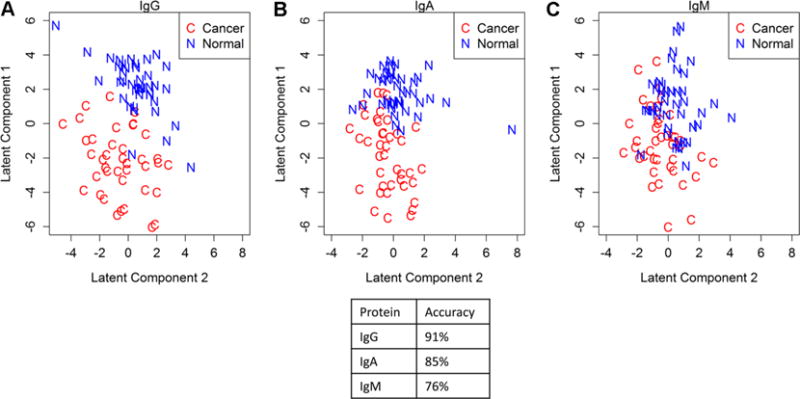
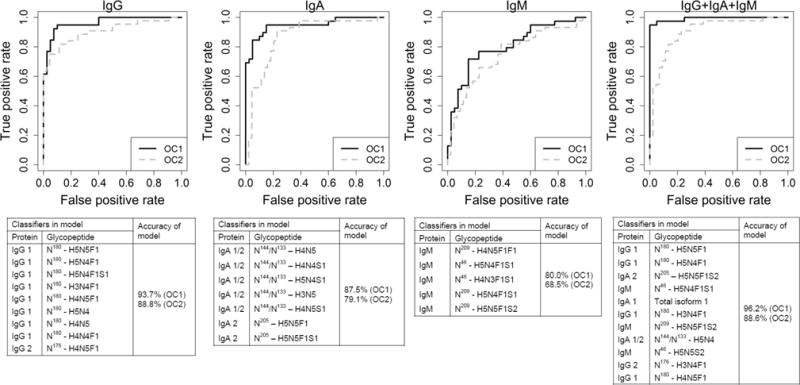
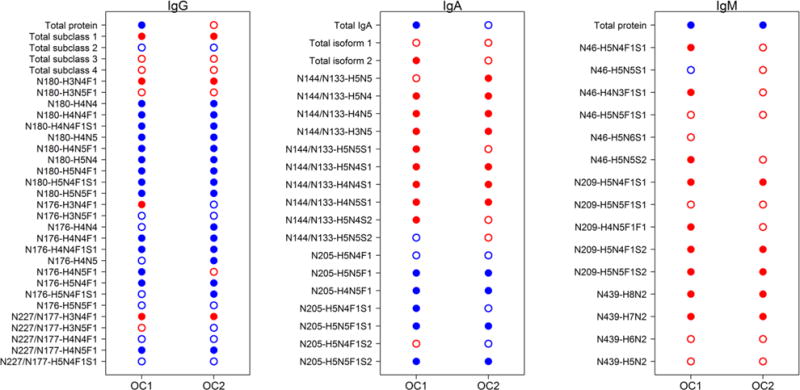
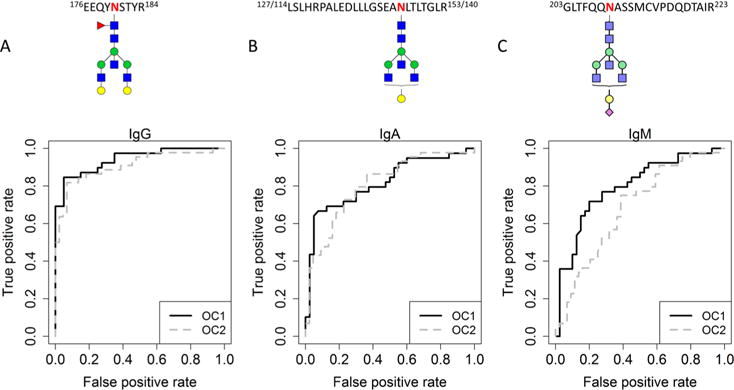
Previous studies indicated that glycans in serum may serve as biomarkers for diagnosis of ovarian cancer; however, it was unclear to which proteins these glycans belong. We hypothesize that protein-specific glycosylation profiles of the glycans may be more informative of ovarian cancer and can provide insight into biological mechanisms underlying glycan aberration in serum of diseased individuals. Serum samples from women diagnosed with epithelial ovarian cancer (EOC, n = 84) and matched healthy controls (n = 84) were obtained from the Gynecologic Oncology Group. Immunoglobulin (IgG, IgA, and IgM) concentrations and glycosylation profiles were quantified using multiple reaction monitoring mass spectrometry. Differential and classification analyses were performed to identify aberrant protein-specific glycopeptides using a training set. All findings were validated in an independent test set. Multiple glycopeptides from immunoglubins IgA, IgG, and IgM were found to be differentially expressed in serum of EOC patients compared with controls. The protein-specific glycosylation profiles showed their potential in the diagnosis of EOC. In particular, IgG-specific glycosylation profiles are the most powerful in discriminating between EOC case and controls. Additional studies of protein- and site-specific glycosylation profiles of immunoglobulins and other proteins will allow further elaboration on the characteristics of biological functionality and causality of the differential glycosylation in ovarian cancer and thus ultimately lead to increased sensitivity and specificity of diagnosis.
以往研究表明,血清中的聚糖可能作为卵巢癌诊断的生物标志物;然而,尚不清楚这些聚糖属于哪些蛋白质。我们推测,聚糖的蛋白质特异性糖基化谱可能对卵巢癌更具信息价值,并能深入了解患病个体血清中聚糖异常的生物学机制。从妇科肿瘤学组获取了被诊断为上皮性卵巢癌(EOC,n = 84)的女性和匹配的健康对照(n = 84)的血清样本。使用多反应监测质谱法定量免疫球蛋白(IgG、IgA和IgM)的浓度和糖基化谱。使用训练集进行差异分析和分类分析,以鉴定异常的蛋白质特异性糖肽。所有发现均在独立测试集中得到验证。与对照组相比,发现来自免疫球蛋白IgA、IgG和IgM的多种糖肽在EOC患者血清中差异表达。蛋白质特异性糖基化谱显示出其在EOC诊断中的潜力。特别是,IgG特异性糖基化谱在区分EOC病例和对照方面最具效力。对免疫球蛋白和其他蛋白质的蛋白质和位点特异性糖基化谱进行进一步研究,将有助于进一步阐明卵巢癌中差异糖基化的生物学功能特征和因果关系,从而最终提高诊断的敏感性和特异性。