Institute of Laboratory Medicine, Clinical Chemistry and Pathobiochemistry, Charité - Universitätsmedizin Berlin, Corporate Member of Freie Universität Berlin, Humboldt-Universität zu Berlin, and Berlin Institute of Health, Berlin, Germany.
Department of Biology, Chemistry and Pharmacy, Freie Universität Berlin, Berlin, Germany.
Front Immunol. 2020 May 15;11:654. doi: 10.3389/fimmu.2020.00654. eCollection 2020.
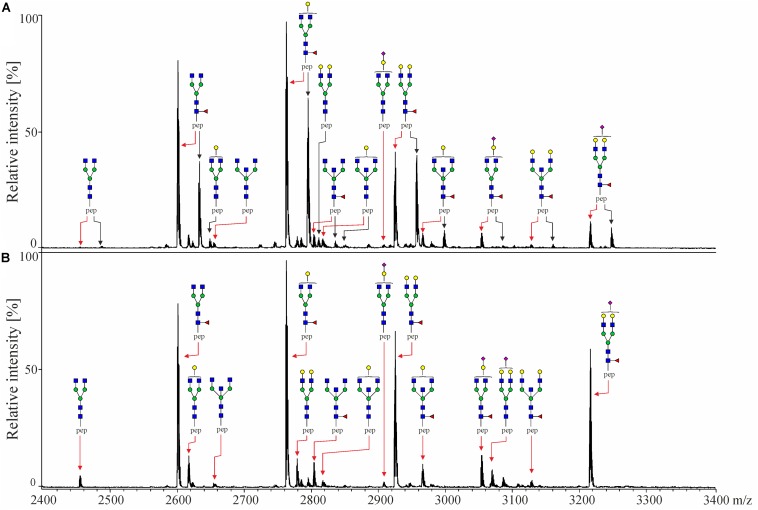
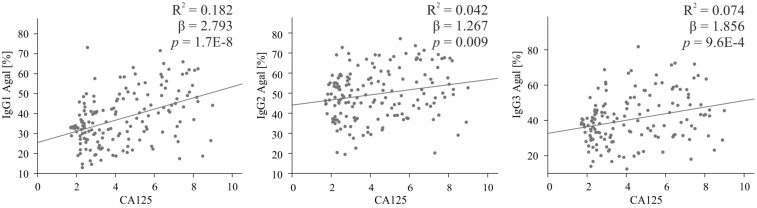
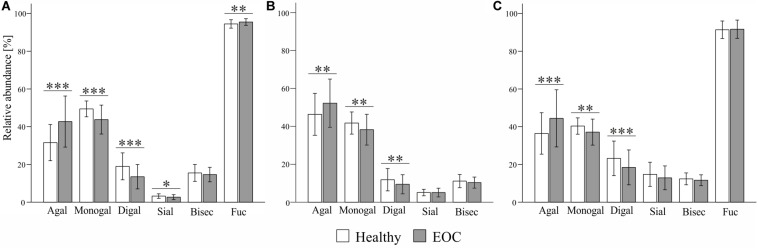
Epithelial ovarian cancer (EOC) was previously shown to be associated with glycosylation changes of total serum and total IgG proteins. However, as a majority of previous studies analyzed released glycan profiles, still little is known about IgG subclass-specific alterations in ovarian cancer. Hence, in this study, we investigated EOC-related glycosylation changes of the three most abundant IgG subclasses, namely, IgG, IgG and IgG isolated from sera of 87 EOC patients and 74 age-matched healthy controls. In order to separate IgG and IgG, we performed a two-step affinity purification employing Protein A and Protein G Sepharose. After tryptic digestion, IgG glycopeptides were enriched and measured by MALDI-TOF-MS. Finally, EOC-related glycosylation changes were monitored at the level of total agalactosylation, monogalactosylation, digalactosylation, sialylation, bisection and fucosylation, which were calculated separately for each IgG subclass. Interestingly, aside from an EOC-related increase in agalactosylation/decrease in monogalactosylation and digalactosylation observed in all IgG subclasses, some subclass-specific trends were detected. Glycosylation of IgG was found to be most strongly affected in EOC, as it exhibited the highest number of significant differences between healthy controls and EOC patients. Specifically, IgG was the only subclass that showed a significant decrease in sialylation and a significant increase in fucosylation in EOC patients. Interestingly, IgG and IgG that were often investigated collectively in previous studies, were found to have distinct glycosylation patterns. IgG displayed stronger EOC-related increase in agalactosylation/decrease in digalactosylation and was characterized by notably higher sialylation, which consequently decreased in EOC patients. In conclusion, our study indicates that IgG subclasses exhibit subtly distinct glycosylation patterns of EOC-related alterations and that IgG and IgG agalactosylation show the strongest association with CA125, the routine diagnostic marker. Additionally, our results show that simultaneous analyses of IgG and IgG might lead to wrong conclusions as these two subclasses exhibit noticeably different glycosylation phenotypes.
上皮性卵巢癌 (EOC) 先前被证明与总血清和总 IgG 蛋白的糖基化变化有关。然而,由于大多数先前的研究分析了释放的聚糖谱,因此对于卵巢癌中 IgG 亚类特异性改变仍然知之甚少。因此,在这项研究中,我们研究了 87 名 EOC 患者和 74 名年龄匹配的健康对照者血清中三种最丰富的 IgG 亚类 IgG、IgG 和 IgG 的 EOC 相关糖基化变化。为了分离 IgG 和 IgG,我们采用两步亲和纯化法,使用 Protein A 和 Protein G Sepharose。在胰蛋白酶消化后,通过 MALDI-TOF-MS 对 IgG 糖肽进行富集和测量。最后,分别监测了每个 IgG 亚类的总半乳糖基化、单半乳糖基化、双半乳糖基化、唾液酸化、二分叉和岩藻糖化的 EOC 相关糖基化变化。有趣的是,除了所有 IgG 亚类观察到的 EOC 相关半乳糖基化增加和单半乳糖基化和双半乳糖基化减少外,还检测到一些亚类特异性趋势。在 EOC 中发现 IgG 的糖基化受到最强烈的影响,因为它在健康对照组和 EOC 患者之间表现出最多的显著差异。具体而言,IgG 是唯一在 EOC 患者中显示唾液酸化显著减少和岩藻糖化显著增加的亚类。有趣的是,在以前的研究中经常一起研究的 IgG 和 IgG,被发现具有不同的糖基化模式。与 IgG 相比,IgG 显示出更强的 EOC 相关半乳糖基化增加/双半乳糖基化减少,并具有显著更高的唾液酸化,这导致 EOC 患者中的唾液酸化减少。总之,我们的研究表明,IgG 亚类表现出微妙的不同的 EOC 相关改变的糖基化模式,并且 IgG 和 IgG 的半乳糖基化与常规诊断标志物 CA125 具有最强的关联。此外,我们的结果表明,同时分析 IgG 和 IgG 可能会导致错误的结论,因为这两个亚类表现出明显不同的糖基化表型。