Runyan Carol W, Becker Amy, Brandspigel Sara, Barber Catherine, Trudeau Aimee, Novins Douglas
Colorado School of Public Health, Departments of Epidemiology and of Community and Behavioral Health, Program for Injury Prevention, Education and Research, Aurora, Colorado.
University of Colorado School of Medicine, Department of Psychiatry, Aurora, Colorado.
West J Emerg Med. 2016 Jan;17(1):8-14. doi: 10.5811/westjem.2015.11.28590. Epub 2016 Jan 12.
A youth's emergency department (ED) visit for suicidal behaviors or ideation provides an opportunity to counsel families about securing medications and firearms (i.e., lethal means counseling).
In this quality improvement project drawing on the Counseling on Access to Lethal Means (CALM) model, we trained 16 psychiatric emergency clinicians to provide lethal means counseling with parents of patients under age 18 receiving care for suicidality and discharged home from a large children's hospital. Through chart reviews and follow-up interviews of parents who received the counseling, we examined what parents recalled, their reactions to the counseling session, and actions taken after discharge.
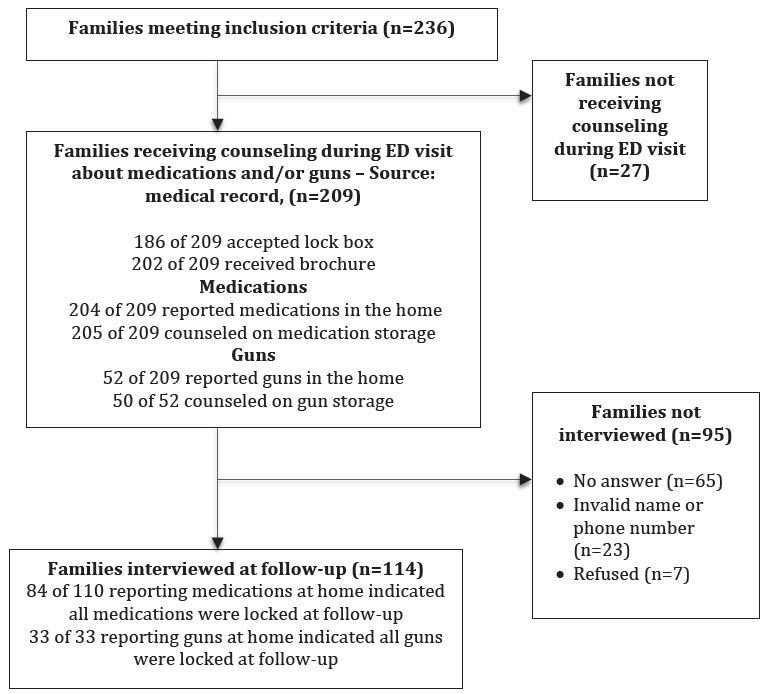
Between March and July 2014, staff counseled 209 of the 236 (89%) parents of eligible patients. We conducted follow-up interviews with 114 parents, or 55% of those receiving the intervention; 48% of those eligible. Parents had favorable impressions of the counseling and good recall of the main messages. Among the parents contacted at follow up, 76% reported all medications in the home were locked as compared to fewer than 10% at the time of the visit. All who had indicated there were guns in the home at the time of the visit reported at follow up that all were currently locked, compared to 67% reporting this at the time of the visit.
Though a small project in just one hospital, our findings demonstrate the feasibility of adding a counseling protocol to the discharge process within a pediatric psychiatric emergency service. Our positive findings suggest that further study, including a randomized control trial in more facilities, is warranted.
青少年因自杀行为或想法前往急诊科就诊,为向其家人提供有关确保药物和枪支安全的咨询(即致命手段咨询)提供了契机。
在这个借鉴“获取致命手段咨询”(CALM)模型的质量改进项目中,我们培训了16名精神科急诊临床医生,以便为18岁以下因自杀倾向接受治疗并从一家大型儿童医院出院回家的患者的父母提供致命手段咨询。通过对接受咨询的父母进行病历审查和随访访谈,我们调查了父母记得的内容、他们对咨询 session 的反应以及出院后采取的行动。
在2014年3月至7月期间,工作人员为236名符合条件患者中的209名(89%)父母提供了咨询。我们对114名父母进行了随访访谈,占接受干预父母的55%;占符合条件父母的48%。父母对咨询给予了积极评价,并对主要信息有良好的记忆。在随访中联系的父母中,76%报告家中所有药物都已上锁,而就诊时这一比例不到10%。所有在就诊时表示家中有枪的父母在随访中报告目前所有枪支都已上锁,而就诊时报告这一情况的比例为67%。
尽管这只是一家医院的一个小项目,但我们的研究结果表明,在儿科精神科急诊服务的出院流程中增加咨询方案是可行的。我们的积极发现表明,有必要进行进一步研究,包括在更多机构开展随机对照试验。