Zhang Yu, Lee John K, Toso Erik A, Lee Joslynn S, Choi Si Ho, Slattery Matthew, Aihara Hideki, Kyba Michael
Lillehei Heart Institute, University of Minnesota, Minneapolis, MN 55455 USA ; Department of Pediatrics, University of Minnesota, Minneapolis, MN 55455 USA.
Department of Biochemistry, Molecular Biology and Biophysics, University of Minnesota, Minneapolis, MN 55455 USA.
Skelet Muscle. 2016 Jan 28;6:8. doi: 10.1186/s13395-016-0080-z. eCollection 2016.
Misexpression of the double homeodomain transcription factor DUX4 results in facioscapulohumeral muscular dystrophy (FSHD). A DNA-binding consensus with two tandem TAAT motifs based on chromatin IP peaks has been discovered; however, the consensus has multiple variations (flavors) of unknown relative activity. In addition, not all peaks have this consensus, and the Pitx1 promoter, the first DUX4 target sequence mooted, has a different TAAT-rich sequence. Furthermore, it is not known whether and to what extent deviations from the consensus affect DNA-binding affinity and transcriptional activation potential.
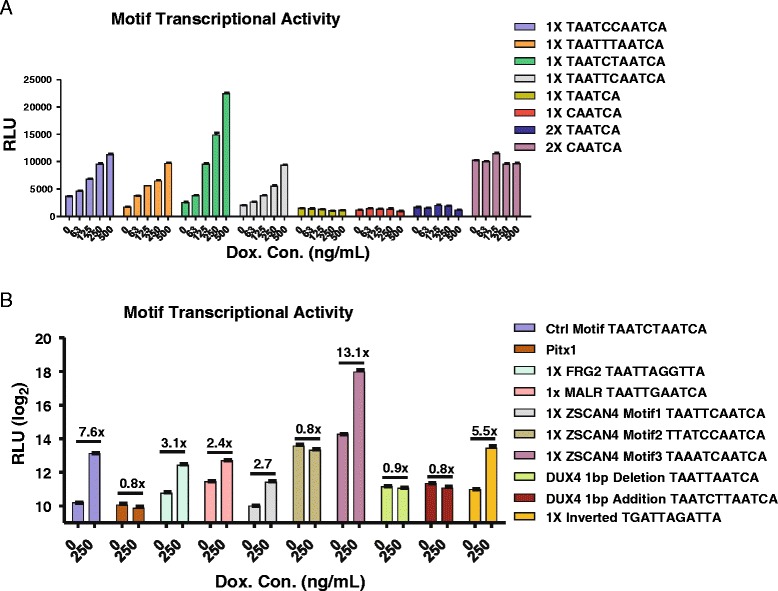
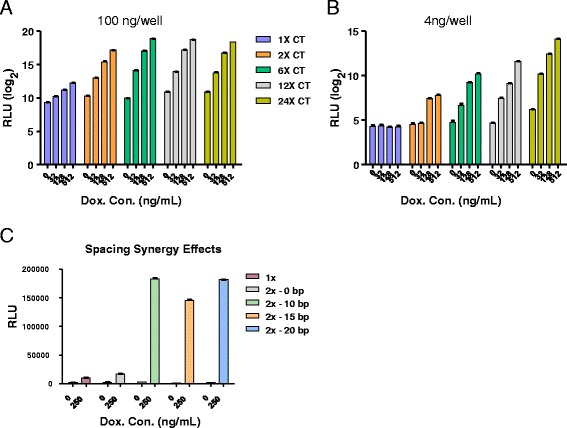
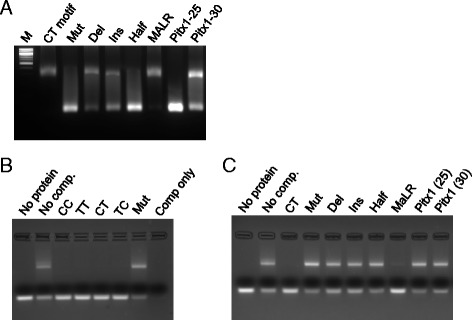
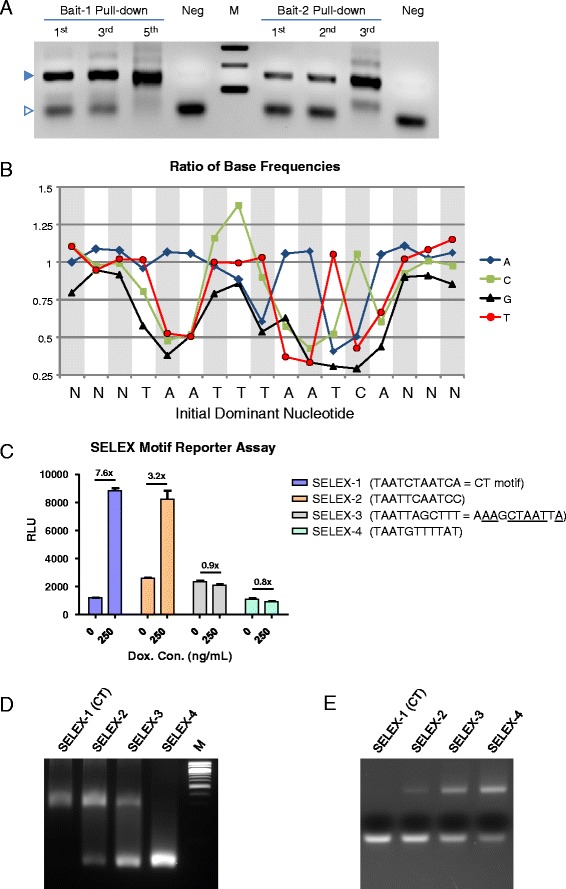
Here, we take both unbiased and consensus sequence-driven approaches to determine the DNA-binding specificity of DUX4 and its tolerance to mismatches at each site within its consensus sequence. We discover that the best binding and the greatest transcriptional activation are observed when the two TAAT motifs are separated by a C residue. The second TAAT motif in the consensus sequence is actually (T/C)AAT. We find that a T is preferred here. DUX4 has no transcriptional activity on "half-sites", i.e., those bearing only a single TAAT motif. We further find that DUX4 does not bind to the TAATTA motif in the Pitx1 promoter, that Pitx1 sequences have no competitive band shift activity, and that the Pitx1 sequence is transcriptionally inactive, calling into question PITX1 as a DUX4 target gene. Finally, by multimerizing binding sites, we find that DUX4 transcriptional activation demonstrates tremendous synergy and that at low DNA concentrations, at least two motifs are necessary to detect a transcriptional response.
These studies illuminate the DNA-binding sequence preferences of DUX4.
双同源异型域转录因子DUX4的错误表达会导致面肩肱型肌营养不良(FSHD)。基于染色质免疫沉淀峰,已发现一种具有两个串联TAAT基序的DNA结合共有序列;然而,该共有序列存在多种未知相对活性的变体(类型)。此外,并非所有峰都具有这种共有序列,并且首个被提出的DUX4靶序列Pitx1启动子具有不同的富含TAAT的序列。此外,尚不清楚与共有序列的偏差是否以及在何种程度上影响DNA结合亲和力和转录激活潜力。
在这里,我们采用无偏和共有序列驱动的方法来确定DUX4的DNA结合特异性及其对共有序列中每个位点错配的耐受性。我们发现,当两个TAAT基序被一个C残基隔开时,观察到最佳结合和最大转录激活。共有序列中的第二个TAAT基序实际上是(T/C)AAT。我们发现这里更喜欢T。DUX4对“半位点”没有转录活性,即那些仅带有单个TAAT基序的位点。我们进一步发现,DUX4不与Pitx1启动子中的TAATTA基序结合,Pitx1序列没有竞争性带移活性,并且Pitx1序列在转录上无活性,这使人们对PITX1作为DUX4靶基因产生质疑。最后,通过将结合位点多聚化,我们发现DUX4转录激活表现出巨大的协同作用,并且在低DNA浓度下,至少需要两个基序才能检测到转录反应。
这些研究阐明了DUX4的DNA结合序列偏好。