• 文献检索
  • 文档翻译
  • 深度研究
  • 学术资讯
  • Suppr Zotero 插件Zotero 插件
  • 邀请有礼
  • 套餐&价格
  • 历史记录
应用&插件
Suppr Zotero 插件Zotero 插件浏览器插件Mac 客户端Windows 客户端微信小程序
定价
高级版会员购买积分包购买API积分包
服务
文献检索文档翻译深度研究API 文档MCP 服务
关于我们
关于 Suppr公司介绍联系我们用户协议隐私条款
关注我们

Suppr 超能文献

核心技术专利:CN118964589B侵权必究
粤ICP备2023148730 号-1Suppr @ 2026

文献检索

告别复杂PubMed语法,用中文像聊天一样搜索,搜遍4000万医学文献。AI智能推荐,让科研检索更轻松。

立即免费搜索

文件翻译

保留排版,准确专业,支持PDF/Word/PPT等文件格式,支持 12+语言互译。

免费翻译文档

深度研究

AI帮你快速写综述,25分钟生成高质量综述,智能提取关键信息,辅助科研写作。

立即免费体验

非人灵长类动物中长期植入的皮层内微电极阵列的扫描电子显微镜观察。

Scanning electron microscopy of chronically implanted intracortical microelectrode arrays in non-human primates.

作者信息

Barrese James C, Aceros Juan, Donoghue John P

机构信息

Department of Neurological Surgery, New Jersey Medical School, Rutgers University, Newark, NJ, USA. Department of Neuroscience and Brown Institute for Brain Science, Brown University, Providence, RI, USA.

出版信息

J Neural Eng. 2016 Apr;13(2):026003. doi: 10.1088/1741-2560/13/2/026003. Epub 2016 Jan 29.

DOI:10.1088/1741-2560/13/2/026003
PMID:26824680
原文链接:https://pmc.ncbi.nlm.nih.gov/articles/PMC4854331/
Abstract

OBJECTIVE

Signal attenuation is a major problem facing intracortical sensors for chronic neuroprosthetic applications. Many studies suggest that failure is due to gliosis around the electrode tips, however, mechanical and material causes of failure are often overlooked. The purpose of this study was to investigate the factors contributing to progressive signal decline by using scanning electron microscopy (SEM) to visualize structural changes in chronically implanted arrays and histology to examine the tissue response at corresponding implant sites.

APPROACH

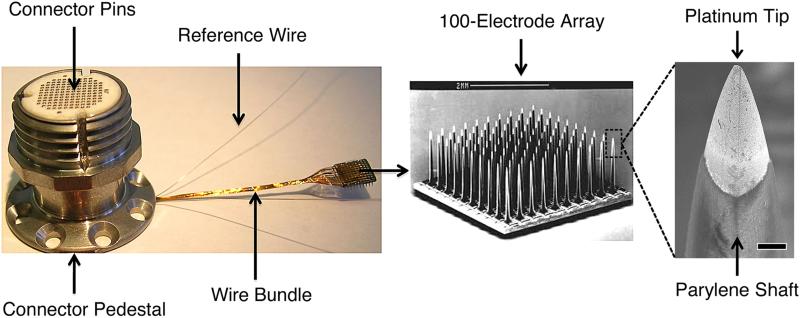
We examined eight chronically implanted intracortical microelectrode arrays (MEAs) explanted from non-human primates at times ranging from 37 to 1051 days post-implant. We used SEM, in vivo neural recordings, and histology (GFAP, Iba-1, NeuN). Three MEAs that were never implanted were also imaged as controls.

MAIN RESULTS

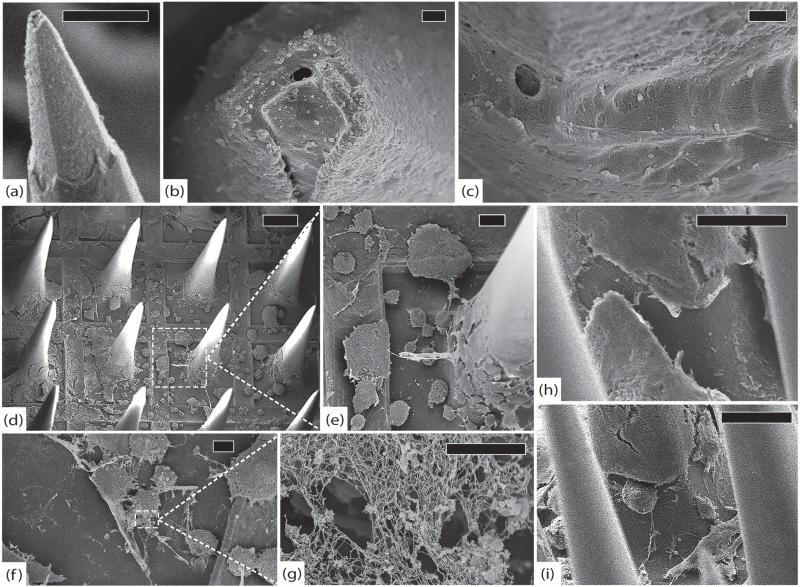
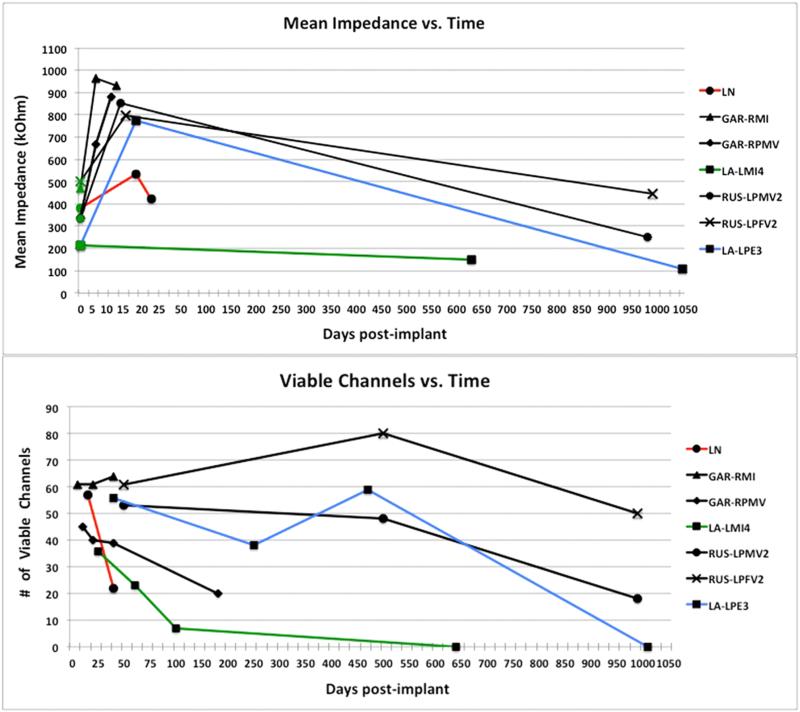
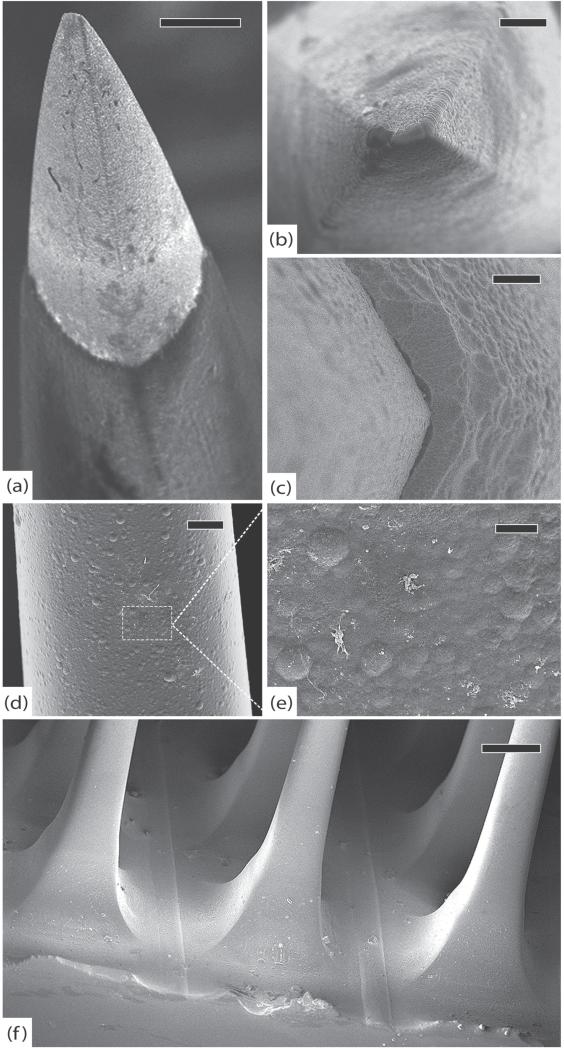
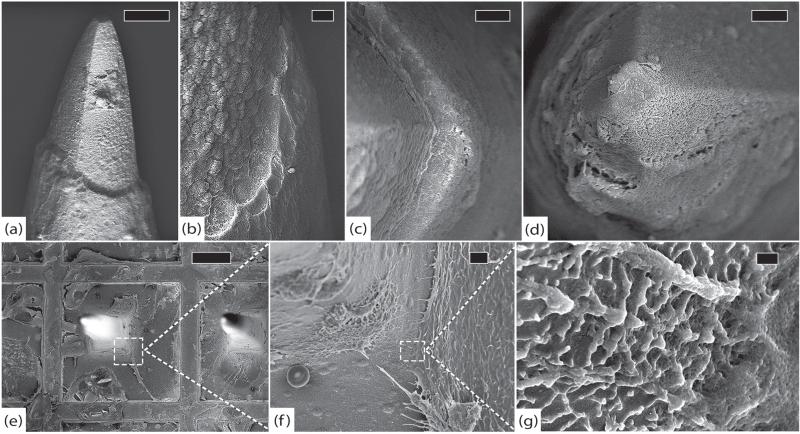
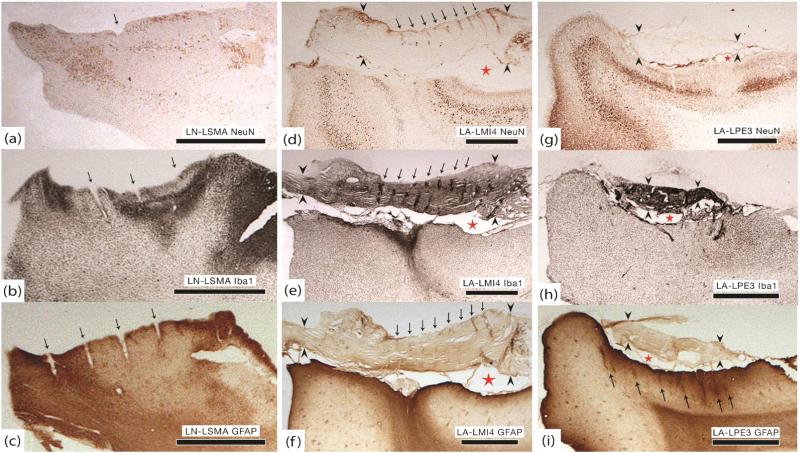
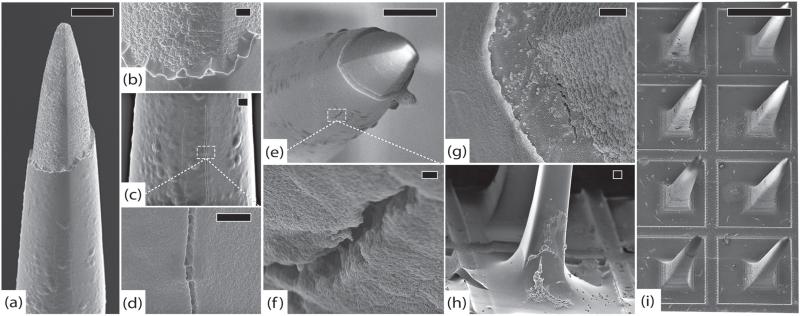
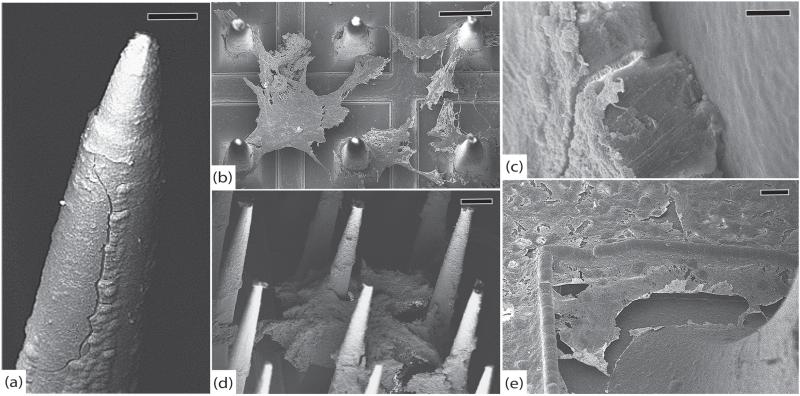
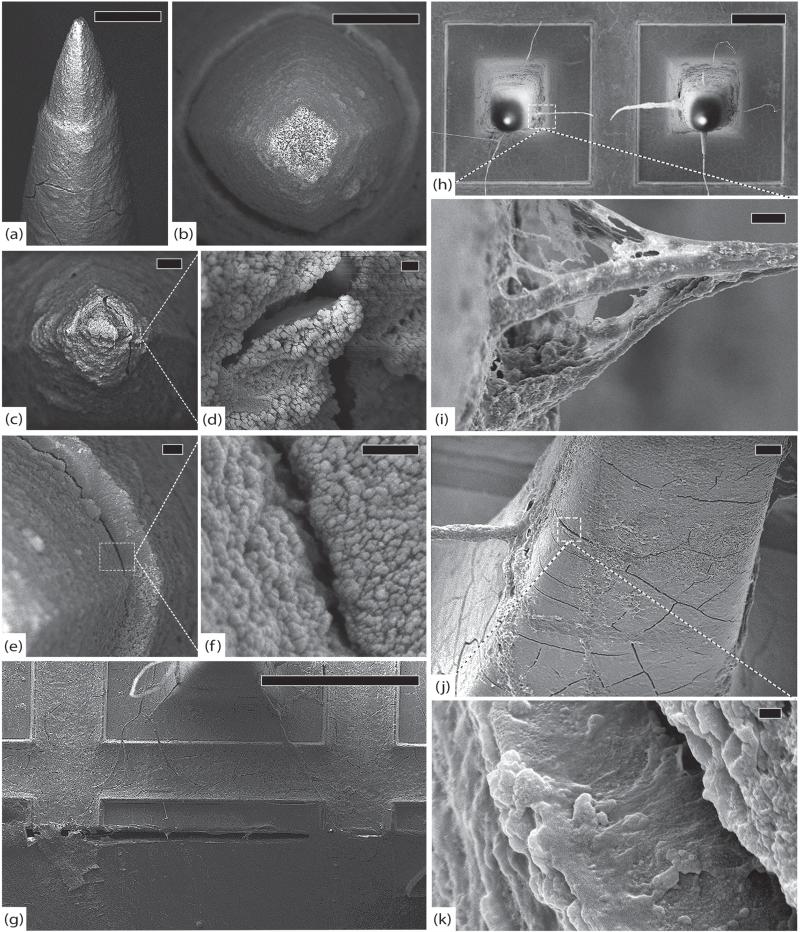
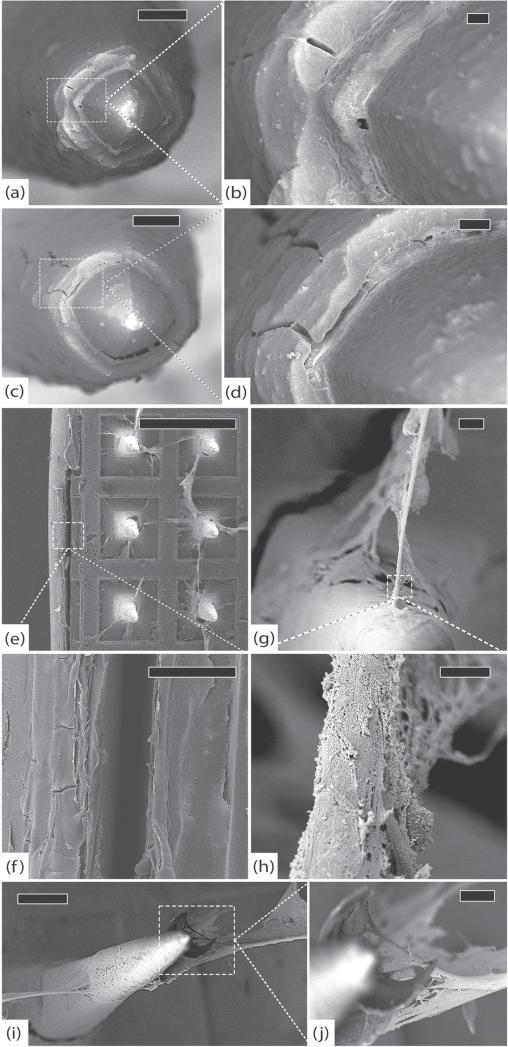
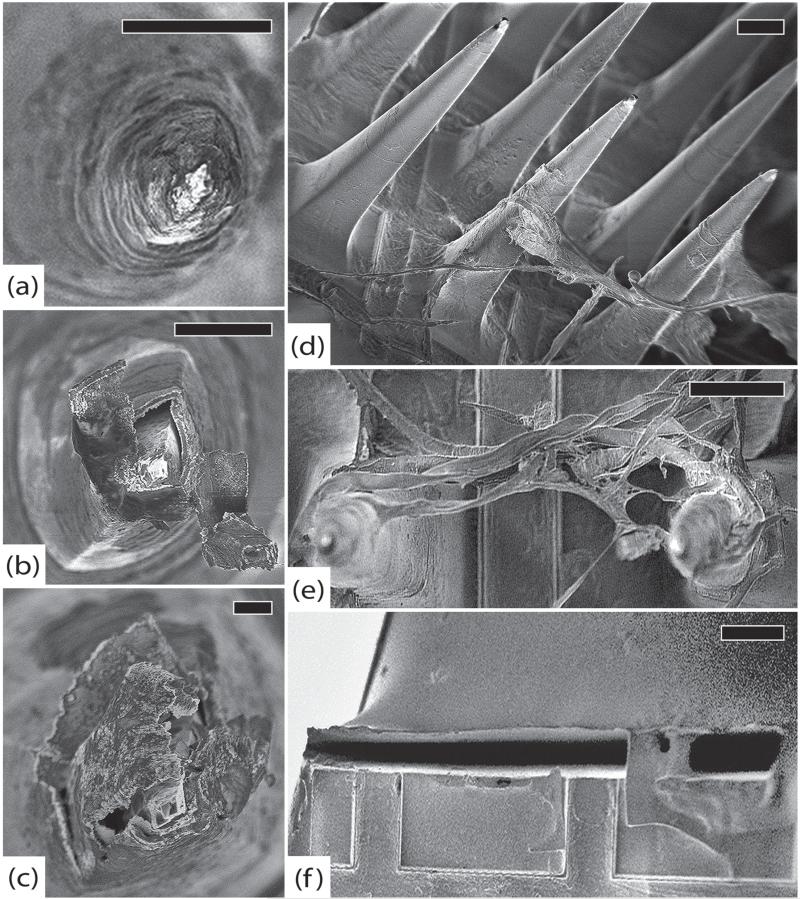
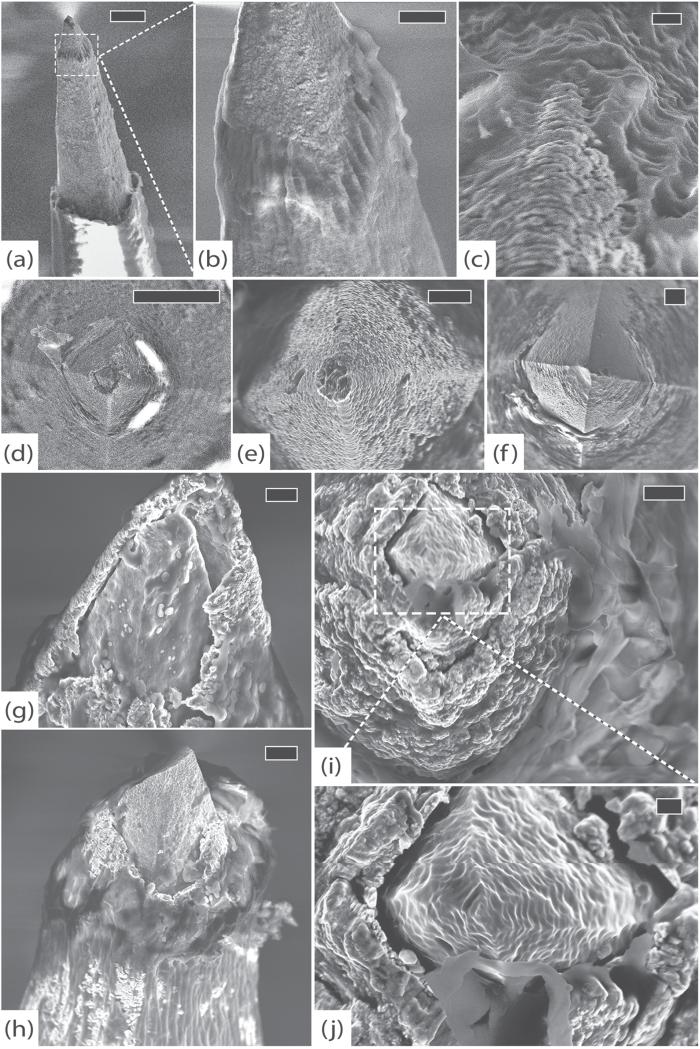
SEM revealed progressive corrosion of the platinum electrode tips and changes to the underlying silicon. The parylene insulation was prone to cracking and delamination, and in some instances the silicone elastomer also delaminated from the edges of the MEA. Substantial tissue encapsulation was observed and was often seen growing into defects in the platinum and parylene. These material defects became more common as the time in vivo increased. Histology at 37 and 1051 days post-implant showed gliosis, disruption of normal cortical architecture with minimal neuronal loss, and high Iba-1 reactivity, especially within the arachnoid and dura. Electrode tracts were either absent or barely visible in the cortex at 1051 days, but were seen in the fibrotic encapsulation material suggesting that the MEAs were lifted out of the brain. Neural recordings showed a progressive drop in impedance, signal amplitude, and viable channels over time.

SIGNIFICANCE

These results provide evidence that signal loss in MEAs is truly multifactorial. Gliosis occurs in the first few months after implantation but does not prevent useful recordings for several years. Progressive meningeal fibrosis encapsulates and lifts MEAs out of the cortex while ongoing foreign body reactions lead to progressive degradation of the materials. Long-term impedance drops are due to the corrosion of platinum, cracking and delamination of parylene, and delamination of silicone elastomer. Oxygen radicals released by cells of the immune system likely mediate the degradation of these materials. Future MEA designs must address these problems through more durable insulation materials, more inert electrode alloys, and pharmacologic suppression of fibroblasts and leukocytes.

摘要

目的

信号衰减是慢性神经假体应用中皮层内传感器面临的主要问题。许多研究表明,故障是由于电极尖端周围的胶质增生所致,然而,故障的机械和材料原因常常被忽视。本研究的目的是通过使用扫描电子显微镜(SEM)观察长期植入阵列的结构变化以及组织学检查相应植入部位的组织反应,来研究导致信号逐渐下降的因素。

方法

我们检查了8个从非人灵长类动物体内取出的长期植入的皮层内微电极阵列(MEA),植入时间从37天到1051天不等。我们使用了SEM、体内神经记录和组织学(GFAP、Iba-1、NeuN)。还对3个从未植入的MEA进行了成像作为对照。

主要结果

SEM显示铂电极尖端逐渐腐蚀以及其下方硅的变化。聚对二甲苯绝缘层容易出现裂纹和分层,在某些情况下,硅橡胶也会从MEA边缘分层。观察到大量组织包封,并且经常可见其生长到铂和聚对二甲苯的缺陷中。随着体内植入时间的增加,这些材料缺陷变得更加常见。植入后37天和1051天的组织学显示胶质增生、正常皮质结构破坏且神经元损失最小,以及高Iba-1反应性,尤其是在蛛网膜和硬脑膜内。在1051天时,电极轨迹在皮层中要么不存在要么几乎不可见,但在纤维化包封材料中可见,这表明MEA被从大脑中抬起。神经记录显示随着时间的推移,阻抗、信号幅度和可用通道逐渐下降。

意义

这些结果提供了证据,表明MEA中的信号损失确实是多因素的。胶质增生在植入后的头几个月发生,但并不妨碍数年的有效记录。进行性脑膜纤维化将MEA包封并从皮层中抬起,同时持续的异物反应导致材料逐渐降解。长期阻抗下降是由于铂的腐蚀、聚对二甲苯的裂纹和分层以及硅橡胶的分层。免疫系统细胞释放的氧自由基可能介导了这些材料的降解。未来MEA的设计必须通过更耐用的绝缘材料、更惰性的电极合金以及对成纤维细胞和白细胞的药物抑制来解决这些问题。
https://cdn.ncbi.nlm.nih.gov/pmc/blobs/f4ff/4854331/d90037544ea2/nihms-764593-f0013.jpg
https://cdn.ncbi.nlm.nih.gov/pmc/blobs/f4ff/4854331/59b50aad26da/nihms-764593-f0001.jpg
https://cdn.ncbi.nlm.nih.gov/pmc/blobs/f4ff/4854331/d83bc5083ba6/nihms-764593-f0002.jpg
https://cdn.ncbi.nlm.nih.gov/pmc/blobs/f4ff/4854331/141e64b47e15/nihms-764593-f0003.jpg
https://cdn.ncbi.nlm.nih.gov/pmc/blobs/f4ff/4854331/f2556ead5e0c/nihms-764593-f0004.jpg
https://cdn.ncbi.nlm.nih.gov/pmc/blobs/f4ff/4854331/edf5ba40c9cb/nihms-764593-f0005.jpg
https://cdn.ncbi.nlm.nih.gov/pmc/blobs/f4ff/4854331/25b323136f64/nihms-764593-f0006.jpg
https://cdn.ncbi.nlm.nih.gov/pmc/blobs/f4ff/4854331/4ee428eaea7c/nihms-764593-f0007.jpg
https://cdn.ncbi.nlm.nih.gov/pmc/blobs/f4ff/4854331/43f5eb9d5605/nihms-764593-f0008.jpg
https://cdn.ncbi.nlm.nih.gov/pmc/blobs/f4ff/4854331/91a9f25a32be/nihms-764593-f0009.jpg
https://cdn.ncbi.nlm.nih.gov/pmc/blobs/f4ff/4854331/686ea580a3ea/nihms-764593-f0010.jpg
https://cdn.ncbi.nlm.nih.gov/pmc/blobs/f4ff/4854331/27d4fda94178/nihms-764593-f0011.jpg
https://cdn.ncbi.nlm.nih.gov/pmc/blobs/f4ff/4854331/a626e9f7913f/nihms-764593-f0012.jpg
https://cdn.ncbi.nlm.nih.gov/pmc/blobs/f4ff/4854331/d90037544ea2/nihms-764593-f0013.jpg
https://cdn.ncbi.nlm.nih.gov/pmc/blobs/f4ff/4854331/59b50aad26da/nihms-764593-f0001.jpg
https://cdn.ncbi.nlm.nih.gov/pmc/blobs/f4ff/4854331/d83bc5083ba6/nihms-764593-f0002.jpg
https://cdn.ncbi.nlm.nih.gov/pmc/blobs/f4ff/4854331/141e64b47e15/nihms-764593-f0003.jpg
https://cdn.ncbi.nlm.nih.gov/pmc/blobs/f4ff/4854331/f2556ead5e0c/nihms-764593-f0004.jpg
https://cdn.ncbi.nlm.nih.gov/pmc/blobs/f4ff/4854331/edf5ba40c9cb/nihms-764593-f0005.jpg
https://cdn.ncbi.nlm.nih.gov/pmc/blobs/f4ff/4854331/25b323136f64/nihms-764593-f0006.jpg
https://cdn.ncbi.nlm.nih.gov/pmc/blobs/f4ff/4854331/4ee428eaea7c/nihms-764593-f0007.jpg
https://cdn.ncbi.nlm.nih.gov/pmc/blobs/f4ff/4854331/43f5eb9d5605/nihms-764593-f0008.jpg
https://cdn.ncbi.nlm.nih.gov/pmc/blobs/f4ff/4854331/91a9f25a32be/nihms-764593-f0009.jpg
https://cdn.ncbi.nlm.nih.gov/pmc/blobs/f4ff/4854331/686ea580a3ea/nihms-764593-f0010.jpg
https://cdn.ncbi.nlm.nih.gov/pmc/blobs/f4ff/4854331/27d4fda94178/nihms-764593-f0011.jpg
https://cdn.ncbi.nlm.nih.gov/pmc/blobs/f4ff/4854331/a626e9f7913f/nihms-764593-f0012.jpg
https://cdn.ncbi.nlm.nih.gov/pmc/blobs/f4ff/4854331/d90037544ea2/nihms-764593-f0013.jpg

相似文献

1
Scanning electron microscopy of chronically implanted intracortical microelectrode arrays in non-human primates.非人灵长类动物中长期植入的皮层内微电极阵列的扫描电子显微镜观察。
J Neural Eng. 2016 Apr;13(2):026003. doi: 10.1088/1741-2560/13/2/026003. Epub 2016 Jan 29.
2
Failure mode analysis of silicon-based intracortical microelectrode arrays in non-human primates.硅基皮层内微电极阵列在非人灵长类动物中的失效模式分析。
J Neural Eng. 2013 Dec;10(6):066014. doi: 10.1088/1741-2560/10/6/066014. Epub 2013 Nov 12.
3
Planar amorphous silicon carbide microelectrode arrays for chronic recording in rat motor cortex.用于大鼠运动皮层慢性记录的平面非晶硅碳化硅微电极阵列。
Biomaterials. 2024 Jul;308:122543. doi: 10.1016/j.biomaterials.2024.122543. Epub 2024 Mar 21.
4
Data-driven model comparing the effects of glial scarring and interface interactions on chronic neural recordings in non-human primates.数据驱动模型比较胶质瘢痕形成和界面相互作用对非人灵长类动物慢性神经记录的影响。
J Neural Eng. 2016 Feb;13(1):016010. doi: 10.1088/1741-2560/13/1/016010. Epub 2015 Dec 14.
5
Reliability of signals from a chronically implanted, silicon-based electrode array in non-human primate primary motor cortex.来自慢性植入的非人灵长类动物初级运动皮层中基于硅的电极阵列的信号可靠性。
IEEE Trans Neural Syst Rehabil Eng. 2005 Dec;13(4):524-41. doi: 10.1109/TNSRE.2005.857687.
6
Neuropathological effects of chronically implanted, intracortical microelectrodes in a tetraplegic patient.慢性植入皮质内微电极对四肢瘫痪患者的神经病理学影响。
J Neural Eng. 2021 Jul 27;18(4). doi: 10.1088/1741-2552/ac127e.
7
Versatile, modular 3D microelectrode arrays for neuronal ensemble recordings: from design to fabrication, assembly, and functional validation in non-human primates.用于神经元群体记录的多功能模块化3D微电极阵列:从设计到制造、组装以及在非人类灵长类动物中的功能验证
J Neural Eng. 2017 Jun;14(3):036010. doi: 10.1088/1741-2552/aa5a90. Epub 2017 Jan 19.
8
Comprehensive characterization and failure modes of tungsten microwire arrays in chronic neural implants.慢性神经植入物中钨丝微阵列的综合特征和失效模式。
J Neural Eng. 2012 Oct;9(5):056015. doi: 10.1088/1741-2560/9/5/056015. Epub 2012 Sep 25.
9
Analysis of AlO-parylene C bilayer coatings and impact of microelectrode topography on long term stability of implantable neural arrays.分析 AlO-parylene C 双层涂层以及微电极形貌对植入式神经阵列长期稳定性的影响。
J Neural Eng. 2017 Aug;14(4):046011. doi: 10.1088/1741-2552/aa69d3.
10
Abiotic-biotic characterization of Pt/Ir microelectrode arrays in chronic implants.慢性植入物中铂/铱微电极阵列的非生物-生物特性
Front Neuroeng. 2014 Feb 4;7:2. doi: 10.3389/fneng.2014.00002. eCollection 2014.

引用本文的文献

1
Long-term performance of intracortical microelectrode arrays in 14 BrainGate clinical trial participants.14名参与BrainGate临床试验的患者皮质内微电极阵列的长期性能
medRxiv. 2025 Jul 2:2025.07.02.25330310. doi: 10.1101/2025.07.02.25330310.
2
Immune-compatible designs of semiconducting polymers for bioelectronics with suppressed foreign-body response.用于生物电子学的具有抑制异物反应的半导体聚合物的免疫兼容设计。
Nat Mater. 2025 Apr 17. doi: 10.1038/s41563-025-02213-x.
3
Material Damage to Multielectrode Arrays after Electrolytic Lesioning is in the Noise.

本文引用的文献

1
Progress towards biocompatible intracortical microelectrodes for neural interfacing applications.用于神经接口应用的生物相容性皮层内微电极的研究进展。
J Neural Eng. 2015 Feb;12(1):011001. doi: 10.1088/1741-2560/12/1/011001. Epub 2014 Dec 2.
2
A high-performance keyboard neural prosthesis enabled by task optimization.通过任务优化实现的高性能键盘神经假体。
IEEE Trans Biomed Eng. 2015 Jan;62(1):21-29. doi: 10.1109/TBME.2014.2354697. Epub 2014 Sep 4.
3
A comparison of neuroinflammation to implanted microelectrodes in rat and mouse models.
电解损伤后多电极阵列的材料损伤微不足道。
bioRxiv. 2025 Mar 30:2025.03.26.645429. doi: 10.1101/2025.03.26.645429.
4
Quantifying physical degradation alongside recording and stimulation performance of 980 intracortical microelectrodes chronically implanted in three humans for 956-2130 days.对长期植入三名人类体内956 - 2130天的980个皮层内微电极的物理降解情况进行量化,同时记录并评估其刺激性能。
Acta Biomater. 2025 May 15;198:188-206. doi: 10.1016/j.actbio.2025.02.030. Epub 2025 Mar 2.
5
Intravascular delivery of an ultraflexible neural electrode array for recordings of cortical spiking activity.颅内递送超柔韧神经电极阵列以记录皮质尖峰活动。
Nat Commun. 2024 Nov 1;15(1):9442. doi: 10.1038/s41467-024-53720-5.
6
Cell-specific spatial profiling of targeted protein expression to characterize the impact of intracortical microelectrode implantation on neuronal health.靶向蛋白质表达的细胞特异性空间分析,以表征皮层内微电极植入对神经元健康的影响。
J Mater Chem B. 2024 Dec 4;12(47):12307-12319. doi: 10.1039/d4tb01628a.
7
Quantifying physical degradation alongside recording and stimulation performance of 980 intracortical microelectrodes chronically implanted in three humans for 956-2246 days.对长期植入三名人类体内956 - 2246天的980个皮层内微电极的物理降解进行量化,并记录和评估其刺激性能。
medRxiv. 2024 Sep 10:2024.09.09.24313281. doi: 10.1101/2024.09.09.24313281.
8
NeuroRoots, a bio-inspired, seamless brain machine interface for long-term recording in delicate brain regions.NeuroRoots,一种受生物启发的无缝脑机接口,用于在精细脑区进行长期记录。
AIP Adv. 2024 Aug 7;14(8):085109. doi: 10.1063/5.0216979. eCollection 2024 Aug.
9
Induction of cell death by sodium hexachloroplatinate (IV) in the HEI-OC1 cell line, primary rat spiral ganglion cells and rat organ of Corti explants.六氯铂酸钠(IV)诱导 HEI-OC1 细胞系、大鼠初级螺旋神经节细胞和大鼠耳蜗器官外植体细胞死亡。
PLoS One. 2024 Jul 26;19(7):e0307973. doi: 10.1371/journal.pone.0307973. eCollection 2024.
10
Ultraflexible electrodes for recording neural activity in the mouse spinal cord during motor behavior.用于记录运动行为期间小鼠脊髓神经活动的超灵活电极。
Cell Rep. 2024 May 28;43(5):114199. doi: 10.1016/j.celrep.2024.114199. Epub 2024 May 9.
神经炎症与大鼠和小鼠模型中植入的微电极的比较。
Biomaterials. 2014 Jul;35(22):5637-46. doi: 10.1016/j.biomaterials.2014.03.076. Epub 2014 Apr 19.
4
Failure mode analysis of silicon-based intracortical microelectrode arrays in non-human primates.硅基皮层内微电极阵列在非人灵长类动物中的失效模式分析。
J Neural Eng. 2013 Dec;10(6):066014. doi: 10.1088/1741-2560/10/6/066014. Epub 2013 Nov 12.
5
A brain machine interface control algorithm designed from a feedback control perspective.一种从反馈控制角度设计的脑机接口控制算法。
Annu Int Conf IEEE Eng Med Biol Soc. 2012;2012:1318-22. doi: 10.1109/EMBC.2012.6346180.
6
High-performance neuroprosthetic control by an individual with tetraplegia.高位截瘫患者的高性能神经假体控制。
Lancet. 2013 Feb 16;381(9866):557-64. doi: 10.1016/S0140-6736(12)61816-9. Epub 2012 Dec 17.
7
Comprehensive characterization and failure modes of tungsten microwire arrays in chronic neural implants.慢性神经植入物中钨丝微阵列的综合特征和失效模式。
J Neural Eng. 2012 Oct;9(5):056015. doi: 10.1088/1741-2560/9/5/056015. Epub 2012 Sep 25.
8
Reach and grasp by people with tetraplegia using a neurally controlled robotic arm.四肢瘫痪患者使用神经控制的机器臂进行触及和抓握。
Nature. 2012 May 16;485(7398):372-5. doi: 10.1038/nature11076.
9
Hydrogen peroxide electrochemistry on platinum: towards understanding the oxygen reduction reaction mechanism.铂上的过氧化氢电化学:深入理解氧还原反应机制。
Phys Chem Chem Phys. 2012 May 28;14(20):7384-91. doi: 10.1039/c2cp40616k. Epub 2012 Apr 19.
10
Quantifying long-term microelectrode array functionality using chronic in vivo impedance testing.使用慢性体内阻抗测试来量化长期微电极阵列的功能。
J Neural Eng. 2012 Apr;9(2):026028. doi: 10.1088/1741-2560/9/2/026028. Epub 2012 Mar 23.