Wang Yuan, Huang Xin, Cai Juan, Xie Lijiao, Wang Weili, Tang Sha, Yin Shiwei, Gao Xuejing, Zhang Jun, Zhao Jinghong, Huang Yunjian, Li Yafei, Zhang Ying, Zhang Jingbo
From the Department of Nephrology, Xinqiao Hospital (YW, XH, JC, LX, WW, ST, SY, XG, JZ, JZ, YH, YZ, JZ); and Department of Epidemiology in College of Preventive Medicine, Third Military Medical University, Chongqing, China (YL).
Medicine (Baltimore). 2016 Jan;95(4):e2580. doi: 10.1097/MD.0000000000002580.
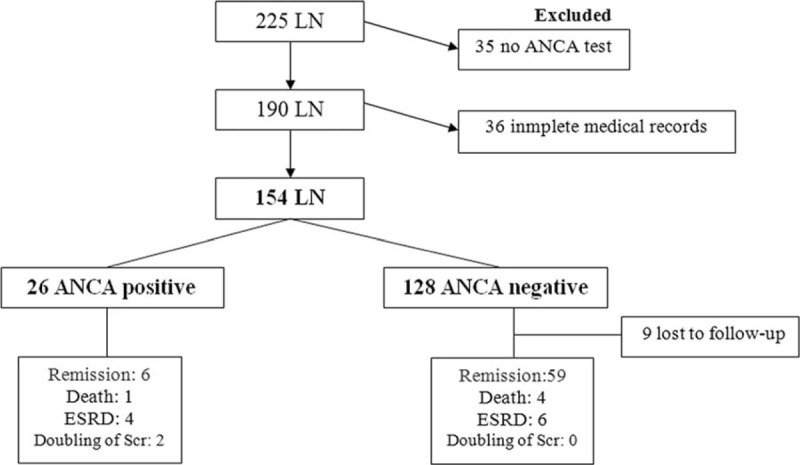
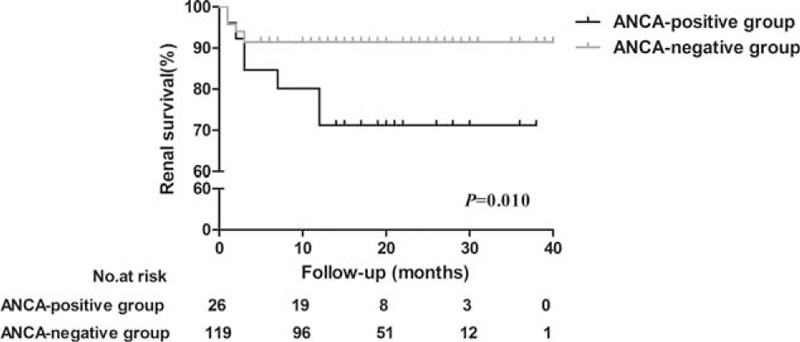
Few studies have analyzed the clinicopathologic characteristics and outcomes of lupus nephritis (LN) patients with antineutrophil cytoplasmic antibody (ANCA). The clinical and renal histopathologic data of 154 patients with biopsy-proven LN from 2011 to 2013 were analyzed retrospectively. The patients were followed up for a median period of 16.8 ± 9.4 months, and their outcomes were analyzed. Multivariate Cox analysis was used to evaluate the independent factors for poor outcomes. Among the 154 LN patients, 26 (16.88%) were seropositive for ANCA. The incidences of alopecia, oral ulcer, photosensitivity and skin lesion, and psychosomatic manifestations in the ANCA-positive group were significantly higher than in the ANCA-negative group (P = 0.007, 0.02, 0.02, and 0.03, respectively). Compared with the ANCA-negative group, the ANCA-positive group had significantly lower levels of complement C3 (P = 0.03). Additionally, the positive rate of antinucleosome antibodies, antihistone antibodies, antimitochondrial antibody M2, and anticardiolipin antibodies were higher significantly in the ANCA-positive patients than in the ANCA-negative patients (P = 0.001, 0.001, 0.03, 0.005, respectively). The ANCA-positive group had a notably higher chronic index than the ANCA-negative group (P = 0.01). During the follow-up, the complete remission rate in the ANCA-negative group was higher than that in the ANCA-positive group (P = 0.01). The cumulative renal survival rate in the ANCA-positive group was significantly lower than in the ANCA-negative group (log-rank = 6.59, P = 0.01). Multivariate Cox analysis revealed that the reduced estimated glomerular filtration rate (HR, 1.02; 95% confidence interval, 1.01 to 1.03; P = 0.005), NLR (HR, 1.20; 95% confidence interval, 1.02 to 1.40; P = 0.03), and ANCA (HR, 3.37; 95% confidence interval, 1.12 to 10.09; P = 0.03) were independent risk factors for patients' renal survival after adjusting for age, sex, crescent formation, and glomerulosclerosis. The study found ANCA in LN patients is not rare, and patients with ANCA present with more severe clinicopathologic injuries. Thus, ANCA is an independent risk factor for poor renal outcomes in LN patients.
很少有研究分析抗中性粒细胞胞浆抗体(ANCA)阳性的狼疮性肾炎(LN)患者的临床病理特征及预后。回顾性分析了2011年至2013年154例经活检证实为LN患者的临床和肾脏组织病理学资料。对患者进行了为期16.8±9.4个月的中位随访,并分析其预后。采用多因素Cox分析评估预后不良的独立因素。在154例LN患者中,26例(16.88%)ANCA血清学阳性。ANCA阳性组的脱发、口腔溃疡、光敏及皮肤损害和身心表现的发生率显著高于ANCA阴性组(P分别为0.007、0.02、0.02和0.03)。与ANCA阴性组相比,ANCA阳性组补体C3水平显著降低(P = 0.03)。此外,ANCA阳性患者的抗核小体抗体、抗组蛋白抗体、抗线粒体抗体M2和抗心磷脂抗体的阳性率显著高于ANCA阴性患者(P分别为0.001、0.001、0.03、0.005)。ANCA阳性组的慢性指数显著高于ANCA阴性组(P = 0.01)。随访期间,ANCA阴性组的完全缓解率高于ANCA阳性组(P = 0.01)。ANCA阳性组的累积肾脏生存率显著低于ANCA阴性组(对数秩检验=6.59,P = 0.01)。多因素Cox分析显示,在调整年龄、性别、新月体形成和肾小球硬化后,估计肾小球滤过率降低(HR,1.02;95%置信区间,1.01至1.03;P = 0.005)、中性粒细胞与淋巴细胞比值(NLR)(HR,1.20;95%置信区间,1.02至1.40;P = 0.03)和ANCA(HR,3.37;95%置信区间,1.12至10.09;P = 0.03)是患者肾脏生存的独立危险因素。该研究发现LN患者中ANCA并不罕见,且ANCA阳性患者存在更严重的临床病理损伤。因此,ANCA是LN患者肾脏预后不良的独立危险因素。